

Cost of Home EV Charger Installation in Dubai and the UAE: 2026 Guide
COPAK’s standard home EV charger installation starts at AED 1,300 including VAT for up to 5 metres at suitable villas, townhouses and standalone homes. Charger supply is separate. Additional cable route, concealed sections, location charges and selected extras affect the total; apartment installations require a site survey and quotation.
For a solution tailored to your vehicle and property, use the Home EV Charger Installation Cost Calculator. It guides you through charger options, installation requirements and selected accessories, then shows an itemised calculated cost and lets you request a personalised email quote.
The calculated total covers the items identified in your selections. Site-dependent work and items not included in the quotation remain subject to assessment; this is not an unconditional fixed price for every property.
How Much Does Home EV Charger Installation Cost in Dubai?
Use the following rates to understand the installation calculation. All prices below include VAT; charger supply is separate.
- Standard installation, first 5 metres: AED 1,300.
- Additional standard cable route: AED 40 per metre beyond 5 metres.
- Concealed sections: add AED 45 per concealed metre, including concealed metres within the first 5 metres. Beyond the included allowance, a concealed metre therefore costs AED 85 in total, not AED 40 plus AED 85.
- Charger-and-installation discount: AED 100 when COPAK supplies the charger and carries out the installation.
- Apartments: charger prices can be shown, but installation requires a site survey and separate quotation.
What would a 7-metre route with 5 concealed metres cost?
AED 1,300 + (2 extra metres × AED 40) + (5 concealed metres × AED 45) = AED 1,605 including VAT for the installation calculation, before applicable location charges, extras or the charger-and-installation discount. Add the selected charger price separately.
Eligible concealed routes include above gypsum ceilings, soft soil, and interlock removal and restoration. Existing concealed pipes are subject to suitable size and practical cable-pulling feasibility. Tiles, asphalt and solid hard-core flooring are outside this concealed-installation rate.
Build your own charging solution and calculate its cost using your actual route, property and equipment selections. The tool distinguishes an estimated total from a known-cost or product-only subtotal where assessment is still needed.
For budgeting, keep these two components separate:
1. EV Charger Cost
The charger price depends on its rated power, connector type, cable or socket configuration, connectivity, smart features and whether it supports functions such as RFID access, OCPP communication or Dynamic Load Management.
Home chargers are commonly available in 7kW, 11kW and 22kW configurations.
A smart wallbox such as the VOX PRO 22kW Smart EV Charger is suitable for homeowners who want higher charging capability, smart connectivity and advanced charging-management features, provided the property's electrical supply and the vehicle's onboard charger support the required charging power.
2. Electrical Installation Cost
The installation portion can include electrical cable, containment, protective devices, termination, mounting, connection, testing and commissioning.
Additional costs may arise where the installation requires extra cable length, concealed routing, trenching, distribution-board modifications, pedestal installation, Dynamic Load Management equipment or other non-standard works.
COPAK provides a dedicated Residential EV Charger Installation Package for suitable villas, townhouses and standalone residential properties.
How to Reduce the Initial Cost of Home EV Charging
One of the most effective ways to reduce the cost of home EV charging is to select a charger based on your actual driving requirements instead of automatically choosing the highest charging power available.
Not every EV owner needs a premium 22kW smart wallbox.
For example, an individual car owner who normally parks overnight and does not require very fast AC charging may find that a 7kW portable EV charger provides sufficient charging performance at a considerably lower hardware cost.
The main trade-off is charging speed and the availability of advanced smart features.
A 7kW portable charger will charge more slowly than a 22kW three-phase wallbox where the vehicle supports the higher charging rate. However, many EVs are themselves limited to around 7kW or 11kW AC charging, which means installing a 22kW charger does not automatically make every vehicle charge at 22kW.
For drivers who typically charge overnight, approximately 7kW of AC charging can still be a practical solution.
Lower-Cost 7kW Portable EV Charger Options
COPAK offers 7kW portable EV chargers for several common vehicle charging standards:
- 7kW Portable EV Charger – Type-2 Connector
- 7kW Portable EV Charger – Type-1 / J1772 Connector
- 7kW Portable EV Charger – GB/T Connector
- 7kW Portable EV Charger – NACS Connector
These chargers operate from a suitable 230V single-phase electrical supply and can provide approximately 7.4kW at 32A, depending on the model and installation.
You can also browse the complete COPAK Portable EV Charger range or visit the COPAK EV Charger Shop to compare wallbox chargers, portable EV chargers, charging cables, adapters and other EV charging products.
The Electrical Installation Still Matters
Choosing a portable charger reduces the cost of the charging hardware, but it does not remove the need for suitable electrical infrastructure.
A 7kW portable EV charger normally requires a dedicated circuit and a suitable high-current socket, together with appropriate cabling and protection.
The safest approach is to separate the project into two decisions:
- Charging hardware: choose a fixed wallbox or portable EV charger according to the vehicle, daily driving distance and required charging speed.
- Electrical infrastructure: professionally install the correct circuit, cable, protection and outlet or charger connection.
COPAK's Fixed-Price Residential EV Charger Installation Package provides a predictable starting point for suitable residential electrical installations.
Main Factors Affecting Home EV Charger Installation Cost
The physical layout and electrical condition of the property are usually more important to the installation cost than simply mounting the charger on the wall.
Cable Distance
The distance between the main distribution board and the charger location is one of the most important cost variables.
Longer routes require additional cable, containment, supports, labour and installation time.
Cable size must be selected according to factors such as charging load, circuit design, cable length, installation method and voltage-drop requirements rather than using the same cable size for every installation.
Surface-Mounted or Concealed Cabling
Surface-mounted containment is generally simpler than concealed cabling.
Concealed installations may require cutting, coring, trenching, reinstatement or coordination with existing building finishes, which can increase both installation cost and completion time.
Distribution Board Condition
The existing distribution board must have sufficient capacity and an appropriate arrangement for the EV charging circuit.
Some properties may require additional protective devices, rearrangement of the distribution board or other electrical modifications.
Available Electrical Capacity
The property's available electrical capacity should be assessed before selecting the charger power.
A 22kW charger operating at its maximum output places a substantially higher load on the electrical system than a 7kW charger.
Choosing a charger that matches both the property and the vehicle can avoid unnecessary expenditure.
Civil Works
Depending on the parking location, outdoor installations may require trenching, underground ducting, concrete foundations, charger pedestals, bollards or other civil works.
Smart Wallbox vs Portable EV Charger
A permanently installed smart wallbox and a portable EV charger serve different requirements.
Smart Wall-Mounted EV Chargers
A dedicated smart wallbox provides a permanent charging point connected through its own electrical circuit.
Depending on the model and platform, smart chargers can provide features such as:
- Charging-session monitoring
- Energy-consumption tracking
- RFID access control
- Mobile-app connectivity
- Charging schedules
- OCPP connectivity
- Dynamic Load Management compatibility
- Remote monitoring and charging management
The VOX PRO is COPAK's smart 22kW wall-charging solution for residential and commercial applications.
For households or applications requiring two charging outputs, a dual-gun charger such as the MAG Duo may also be considered.
Portable EV Chargers
Portable chargers can provide a more economical option for individual EV owners, while also providing flexibility for home, workplace or travel use.
COPAK's 7kW portable units are available with Type-2, Type-1, GB/T and NACS connectors.
The lower hardware cost can make portable charging particularly attractive where:
- Only one vehicle needs to be charged
- The vehicle does not support 22kW AC charging
- Overnight charging is sufficient
- Advanced OCPP or CPO functionality is unnecessary
- The customer wants to reduce the initial charging-equipment cost
However, a portable charger should never be connected to an unsuitable household outlet simply because it is portable. High-power charging requires a properly designed electrical supply.
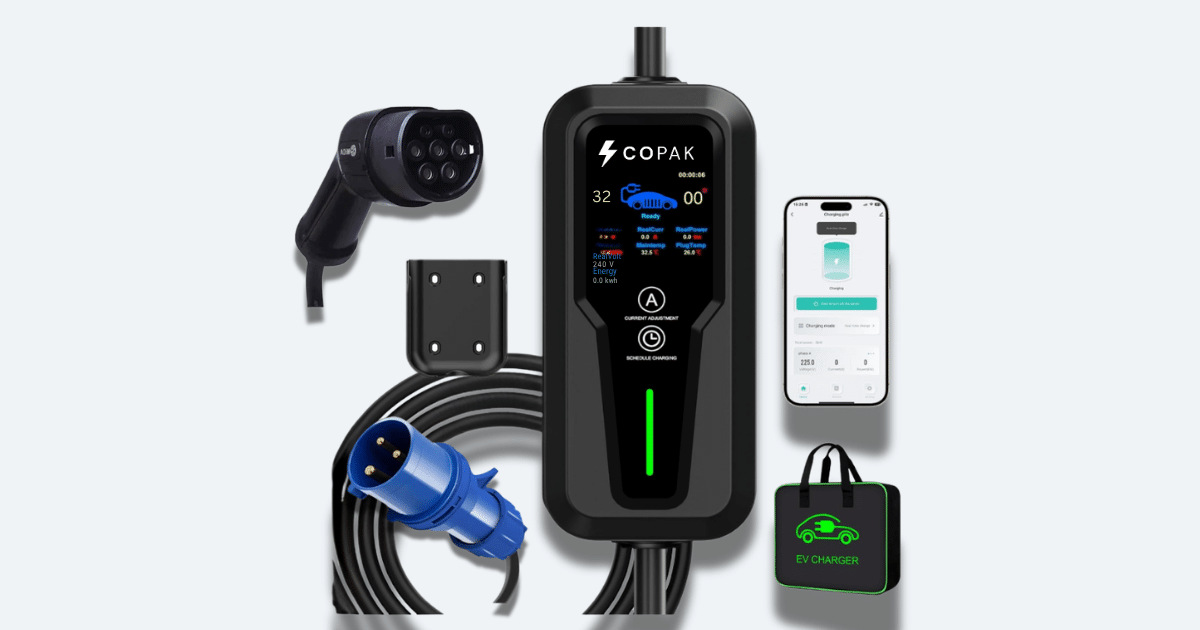
7kW Portable EV Charger
Single-phase charging with an attached Type 2 cable.
AED 1,200
Charger only · Installation separate
Features and setup
Up to 7.4kW at 32A, adjustable current and a 5m charging cable. Requires a suitable, professionally installed 32A industrial socket and dedicated electrical protection—not an ordinary household socket.
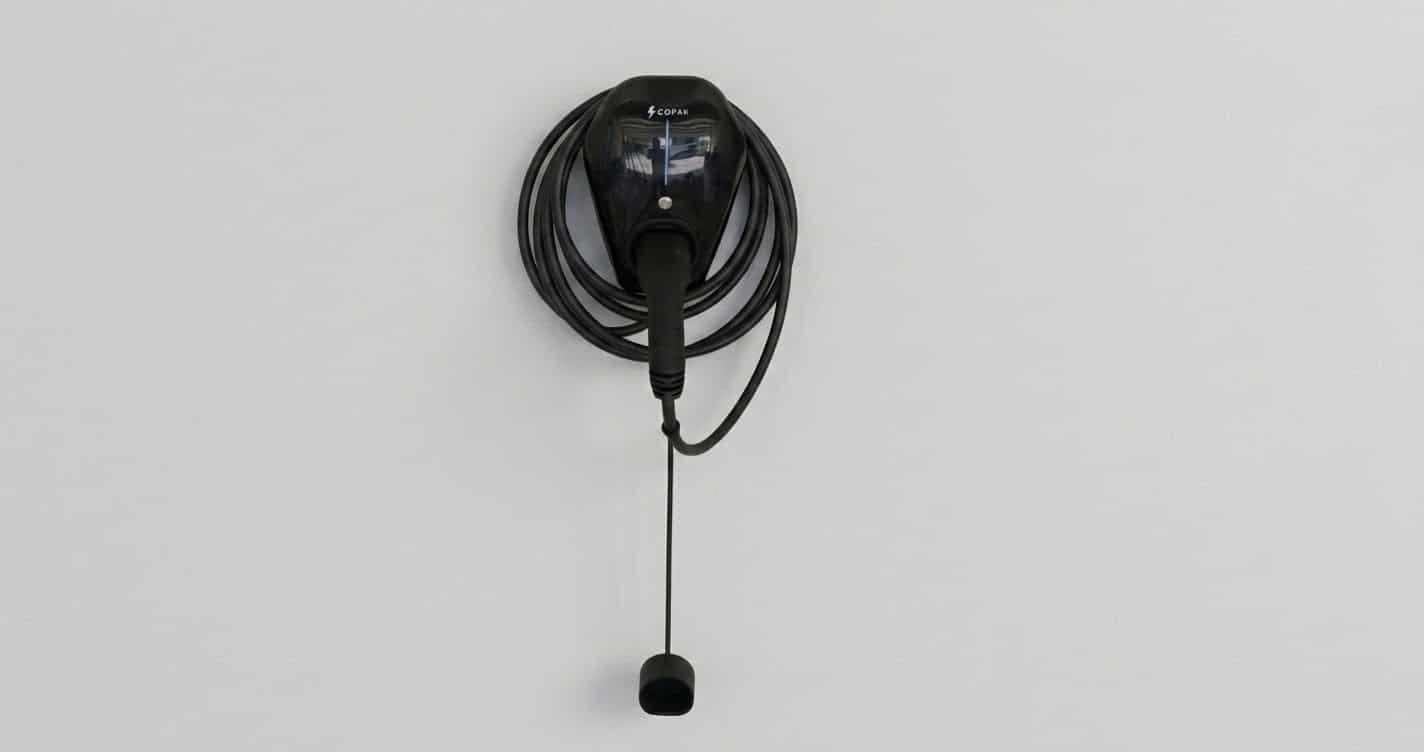
Vox Pro Cable
Smart wall-mounted charging with an attached Type 2 cable.
AED 2,600
Charger only · Installation separate
Features and setup
Up to 22kW on a suitable three-phase supply, with a 5m cable, app monitoring, Wi-Fi and Ethernet connectivity. Actual charging power depends on the vehicle, electrical supply and configuration.
What will your complete setup cost?
Standard standalone-home installation starts at AED 1,300 including VAT, covering a cable route of up to 5m. The charger is separate. Longer routes, concealed wiring and site-specific requirements can change the total; apartments require a site survey.
Use the calculator to select your charger and installation requirements and see your estimated total.
Product prices checked on 14 October 2026. Confirm current pricing on the product pages. Final installation scope is subject to site verification.
Technical Installation Costs: Infrastructure and Labour
A home EV charger represents a substantial continuous electrical load. Professional installation therefore involves much more than mounting a charging unit.
A typical installation assessment considers:
- Existing electrical supply
- Available electrical load
- Main distribution-board condition
- Required charging power
- Circuit and cable sizing
- Protective devices
- Earthing arrangements
- Cable routing
- Containment
- Indoor or outdoor installation conditions
- Testing and commissioning
Dedicated Electrical Protection
EV charging circuits require appropriate overcurrent and residual-current protection selected according to the charger, installation design and applicable authority requirements.
The precise protection arrangement should be based on the current applicable regulations together with the charger's technical specifications rather than assuming that every charger requires exactly the same protection configuration.
Professional Testing and Commissioning
Once installation is complete, the charging circuit and charger should be tested before being placed into service.
Testing helps confirm that the installation has been completed correctly and that the charging equipment operates as intended.
Fixed-Price Residential EV Charger Installation
For suitable villas, townhouses and standalone residential properties, COPAK offers a Fixed-Price Residential EV Charger Installation Package.
The package provides homeowners with a predictable starting point for their electrical installation instead of leaving basic installation costs open-ended.
Additional cost factors may include:
- Additional cable distance beyond the included allowance
- Concealed cabling
- Trenching or civil works
- Distribution-board modifications
- Additional electrical protection
- Pedestal installation
- Dynamic Load Management equipment
- Complex apartment or shared-parking cable routes
7kW, 11kW or 22kW Home EV Charger?
Choosing the highest-power charger available is not always necessary.
The correct charger depends primarily on the property's electrical supply, available capacity and the vehicle's maximum AC charging rate.
7kW EV Charging
A 7kW charger is commonly associated with single-phase residential charging and is suitable for many homeowners who charge overnight.
For cost-conscious EV owners, a 7kW portable EV charger can provide an economical alternative to a premium fixed wallbox.
11kW EV Charging
An 11kW charger generally uses a three-phase electrical supply and can provide faster AC charging where both the property and the vehicle support it.
22kW EV Charging
A 22kW AC charger requires a suitable three-phase electrical supply to provide its maximum rated output.
The vehicle must also support 22kW AC charging to receive the full charging power.
If a vehicle's onboard AC charger is limited to 7kW or 11kW, connecting the vehicle to a 22kW wallbox will not increase the vehicle's charging rate beyond its own onboard limit.
For more information, read our Ultimate Guide to 22kW EV Chargers in Dubai and the UAE.
Dynamic Load Management and Available Electrical Capacity
Dynamic Load Management, or DLM, can be useful where a property has significant electrical demand or where multiple chargers need to operate from limited available capacity.
A DLM system monitors the property's active electrical load and adjusts EV charging power according to the configured available capacity.
For example, charging power can be reduced while other high-demand appliances are operating and increased again when additional capacity becomes available.
Dynamic Load Management requires compatible monitoring and control components in addition to the EV charger.
Important: DLM does not create additional allocated electrical capacity and should not be treated as a substitute for the property's approved electrical load or applicable utility requirements.
DEWA Requirements for Home EV Charging in Dubai
Dubai homeowners should distinguish between private home charging and public EV charging infrastructure.
DEWA’s consumer FAQs explain that home EV chargers can be installed by a third party at the customer's premises behind the customer's electricity meter, similar to other electrical equipment.
DEWA also recommends the use of DEWA-approved electrical contractors for electrical installations in Dubai.
Electricity consumed by a private home EV charger behind the customer's meter is added to the normal DEWA electricity bill and charged according to the applicable residential electricity tariff.
Private residential charging should therefore not be confused with public EV charging infrastructure or CPO-operated charging stations, which operate under a different regulatory framework.
For further information, read our DEWA EV Charger Installation Requirements 2026 Guide.
Current DEWA AC EV Charging Technical Requirements
DEWA's published technical requirements for AC EV charging include specifications relating to:
- Single-phase and three-phase electrical supplies
- Charging current and maximum AC charging power
- IEC 62196-2 Type-2 connectivity
- Mode 3 AC charging
- Overcurrent protection
- Residual-current protection
- Indoor and outdoor installation
- Environmental protection requirements
The current applicable requirements should always be checked when designing a specific installation.
How Much Does Home EV Charging Cost in Dubai?
The electricity cost of charging an EV at home depends on several factors:
- The vehicle's energy consumption in kWh per 100 km
- The amount of energy required
- The household's applicable DEWA electricity tariff slab
- The current fuel surcharge
- VAT
- Charging losses
As of October 2026, DEWA’s published electricity tariffs and fuel surcharge set out the following residential monthly consumption slabs:
- 0–2,000 kWh: AED 0.230 per kWh
- 2,001–4,000 kWh: AED 0.280 per kWh
- 4,001–6,000 kWh: AED 0.320 per kWh
- Above 6,000 kWh: AED 0.380 per kWh
DEWA also lists an electricity fuel surcharge of AED 0.060 per kWh for October 2026, with 5% VAT applicable.
Illustrative Home Charging Example
If an EV consumes approximately 15 kWh per 100 km, travelling 1,000 km would require approximately 150 kWh before accounting for charging losses.
If those 150 kWh fall within the lowest residential tariff slab, an illustrative calculation using the October 2026 tariff and fuel surcharge would be:
150 kWh × (AED 0.230 + AED 0.060) = AED 43.50 before VAT and charging losses.
This is only an example. Actual charging cost depends on the vehicle, household electricity consumption, applicable tariff slab, charging efficiency and prevailing DEWA charges.
Dubai residential electricity tariffs are based on monthly consumption slabs rather than a standard residential off-peak EV tariff.
Smart charging schedules can still be useful for convenience, energy monitoring and load management, but homeowners should not assume that electricity automatically becomes cheaper at night.
Villa vs Apartment EV Charger Installation
Villas, Townhouses and Standalone Properties
Villa and townhouse installations are often more straightforward because the property's distribution board and parking location are usually within the same premises.
A typical residential project may involve:
- Site assessment
- Electrical load assessment
- Dedicated EV charging circuit
- Cable and containment
- Electrical protection
- Charger or socket installation
- Testing and commissioning
Additional works may be required for long cable routes, concealed cabling, trenching, distribution-board modification or pedestal-mounted installations.
Apartments and Residential Buildings
Apartment EV charger installations can involve additional coordination because the charger may need to be installed in a shared basement or common parking area.
Depending on the building, property management may request documentation such as:
- Method Statement
- Risk Assessment
- Contractor insurance documentation
- Trade licence
- Contractor identification
- Electrical drawings
- EV charger datasheet
- Relevant contractor approvals or registrations
The exact requirements depend on the property management company, Owners' Association and local authority applicable to the project.
Longer cable routes, common-area access, work permits and management approvals can make apartment installations more complex than many villa installations.
Professional Home EV Charger Installation with COPAK
COPAK provides residential EV charging solutions across the UAE, including charger supply, electrical installation, testing, commissioning and support.
For villas, townhouses, farmhouses and other standalone residential properties, COPAK can provide a fixed-price installation package for suitable standard installations, with any additional works identified separately where required.
For apartment and shared-building installations, COPAK can assist with the technical documents normally requested by property management and coordinate the installation after the necessary approvals and work permits are obtained.
The objective is to select the correct charging solution for the vehicle and property rather than automatically installing the highest-powered charger available.
Learn more about our Home EV Charger Installation Service or view the Residential EV Charger Installation Package.
Choosing the Right Home EV Charger
Before purchasing an EV charger, consider:
- Your vehicle's charging connector
- Your vehicle's maximum AC charging rate
- Single-phase or three-phase supply
- Available electrical capacity
- Daily driving distance
- Expected overnight charging time
- Indoor or outdoor installation
- Tethered cable or socket configuration
- Smart charging requirements
- RFID access requirements
- OCPP or remote-management requirements
- Dynamic Load Management requirements
- Whether a second EV may be added in the future
A properly selected 7kW portable charger or 7kW/11kW wallbox may be more cost-effective for some homes than installing a 22kW smart charger.
The charger should match both the vehicle and the property's electrical infrastructure.
How Can You Plan a Complete Home Charging Solution?
The COPAK installation cost calculator is the main planning tool for this guide. Rather than considering a charger price in isolation, work through the equipment and installation choices together.
- Tell us whether you already own a charger and identify your vehicle and connection requirements.
- Select your property and location, then provide the installation information requested.
- Enter the cable route and concealed sections where applicable, and review the available charger and accessory options.
- Check the itemised calculated cost and any items requiring further assessment.
- Choose Send Quote for This Estimate to request a personalised email quotation. Quotations are valid for seven days and remain subject to site verification and scope confirmation.
For apartments, the tool supports charger selection and product pricing; it does not calculate an apartment installation price. COPAK must survey the building’s supply, cable route and access requirements first.
Ready to Calculate Your Home Charging Setup?
Start the Home EV Charger Installation Cost Calculator to review your options and calculated total. If you need help with the property or vehicle details, contact COPAK.
For the installation process and handover, see our home EV charger installation service. The standard installation package sets out the purchasable scope for suitable standalone homes.
Frequently Asked Questions
How much does it cost to install an EV charger at home in Dubai?
Standard installation at suitable standalone homes starts at AED 1,300 including VAT for up to 5 metres, excluding the charger. Extra standard route is AED 40 per metre beyond 5 metres; concealed sections add AED 45 per concealed metre. Use the installation cost calculator for your selected solution. Location charges and extras may apply, and apartments require a site survey and separate installation quotation.
What is the cheapest practical way to charge an EV at home?
For an individual EV owner who does not require 11kW or 22kW charging, a 7kW portable EV charger connected to a professionally installed suitable electrical circuit can considerably reduce the initial hardware cost compared with a premium smart wallbox.
Is a portable 7kW charger much slower than a 22kW wallbox?
Yes, where the vehicle can actually accept 22kW AC charging. A 7kW portable charger provides approximately 7kW of charging power, while a suitable three-phase wallbox can provide up to 22kW. However, many EVs have onboard AC charging limits below 22kW, so the actual difference depends on the vehicle.
Where can I buy a 7kW portable EV charger in the UAE?
COPAK supplies 7kW portable EV chargers with Type-2, Type-1, GB/T and NACS connectors. You can compare them in the Portable EV Chargers section or browse the complete COPAK EV Charger Shop.
Does a 7kW portable EV charger require professional installation?
The charger itself is portable, but a high-power 7kW unit requires a suitable electrical supply. The dedicated circuit, cable, protective devices and high-current outlet should be professionally installed and appropriately rated for the intended charging load.
Is it cheaper to install an EV charger in a villa or an apartment?
Villa installations are often simpler because the distribution board and parking location are usually easier to access. Apartment installations may require building-management approval, common-area cable routing, longer cable distances and work permits, which can increase complexity and cost.
Can I install a 22kW charger at home?
Yes, where the property has a suitable three-phase electrical supply and sufficient available capacity. The vehicle must also support 22kW AC charging to receive the charger's full output.
Can a 22kW charger charge a car that only accepts 11kW AC?
Yes, provided the charger and vehicle are compatible. The vehicle will normally limit the charging rate to its own maximum AC capability, so an 11kW-capable vehicle will not charge at 22kW simply because it is connected to a 22kW charger.
Does a 22kW charger work on single-phase power?
A 22kW AC charger requires a suitable three-phase electrical supply to deliver its full rated output. A single-phase installation provides significantly lower charging power.
Do I need DEWA approval for a home EV charger?
DEWA states that private home EV chargers can be installed behind the customer's meter by a third party and that DEWA-approved electrical contractors should be used for electrical installations in Dubai. Requirements can vary according to the property and project configuration, so the applicable requirements should be confirmed before installation.
Does every EV charger installation require a Type B RCD?
No single protection arrangement should be assumed for every EV charger. The required protective devices depend on the charger, electrical design and applicable authority requirements. The charger's technical requirements should be considered together with the current electrical regulations.
What is Dynamic Load Management?
Dynamic Load Management monitors the property's active electrical demand and adjusts EV charging power according to available capacity. It requires compatible monitoring and control equipment in addition to the EV charger.
Can Dynamic Load Management replace an electrical load upgrade?
Not automatically. DLM can help manage the property's existing available capacity, but it does not create additional allocated electrical load or override utility requirements.
Is electricity cheaper at night for home EV charging in Dubai?
DEWA's standard residential electricity tariff is based on monthly consumption slabs rather than a general residential night-time EV tariff. Overnight charging can still be convenient and useful for load management, but it should not be assumed to receive a cheaper residential electricity rate.
How much electricity does an EV use for 1,000 km?
This depends on vehicle efficiency. For example, an EV consuming 15 kWh per 100 km would require approximately 150 kWh to travel 1,000 km before accounting for charging losses.
How long does home EV charger installation take?
Based on COPAK's installation experience, a home EV charger installation in a standalone house takes approximately five hours on average, unless unexpected cable-routing difficulties arise. Apartment installations usually require at least one full day and can take two to three days, depending on the complexity of the cable route. These timings cover on-site installation; any building-management approvals must be arranged separately.
Can I use a portable EV charger every day?
Yes, provided the charger is suitable for regular use and is connected to an appropriately designed and rated electrical circuit. The supply socket, wiring and electrical protection must be suitable for the charger's continuous load.
Can I install an EV charger in an apartment parking space?
In many buildings this is possible, but building-management approval and technical documentation may be required. The electrical-source location, cable route, parking-space status, common-area access and work-permit requirements should be assessed before installation.
Does home EV charging use a separate DEWA tariff?
For private home chargers installed behind the customer's meter, electricity consumption is added to the normal DEWA bill and charged according to the applicable residential electricity tariff.