
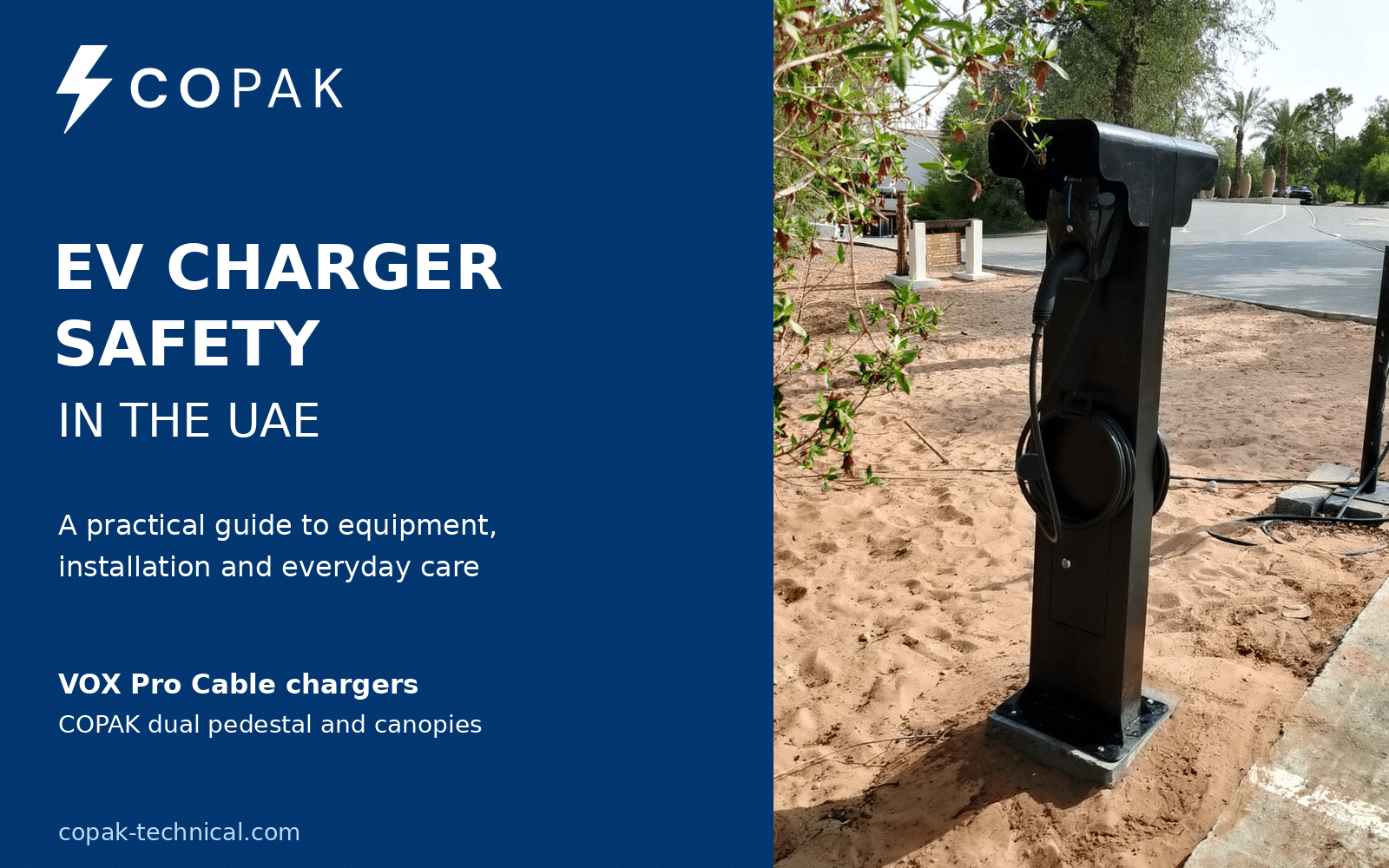
A safe EV charging installation depends on more than the charger mounted on the wall. The electrical supply, protective devices, installation quality, charging cable and vehicle connection must work together.
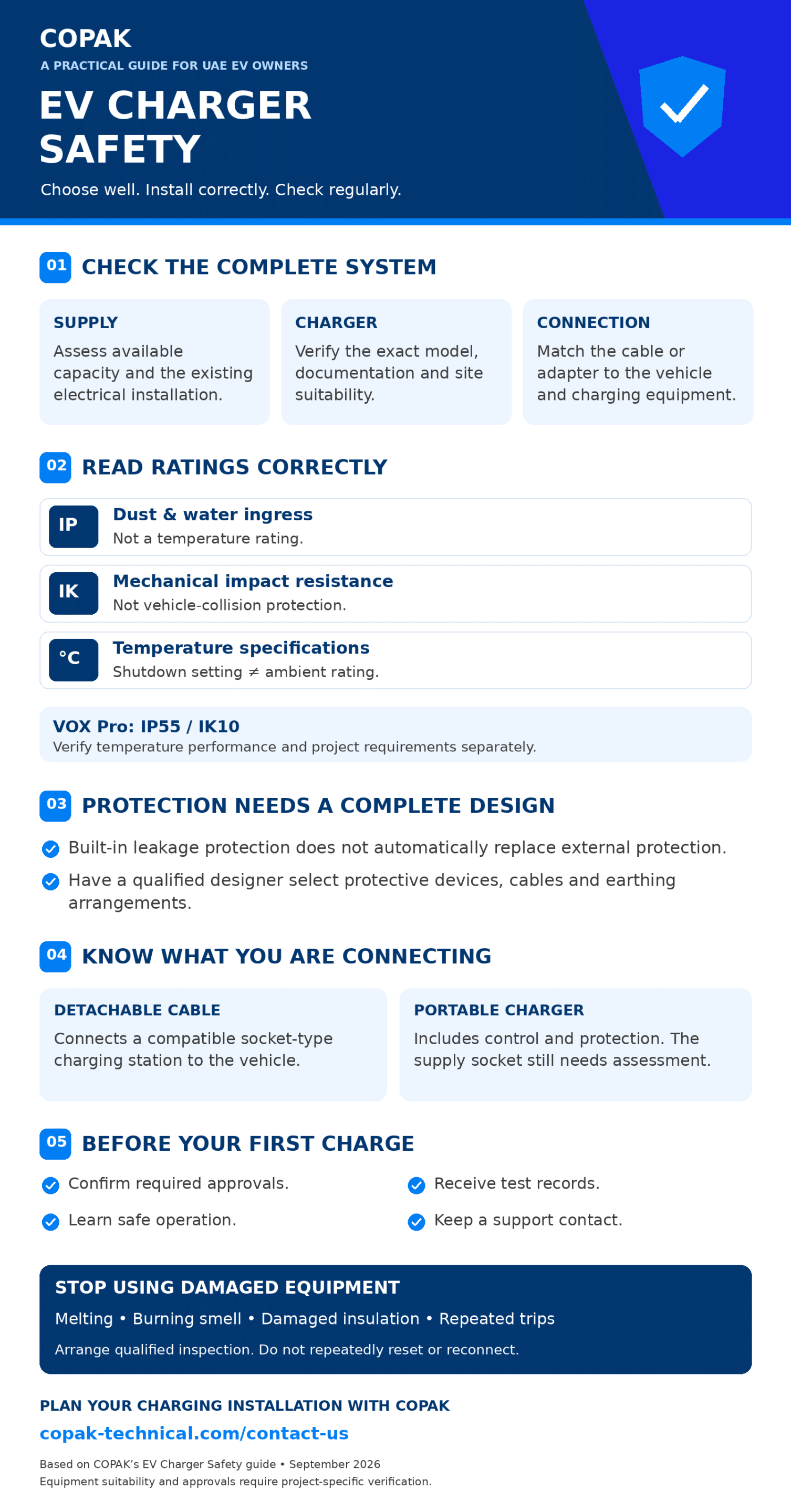
For UAE property owners, outdoor exposure and local approval requirements add further considerations. An enclosure rating does not establish temperature performance, and a feature described as “built-in protection” does not automatically replace protection elsewhere in the installation.
Understanding EV charger safety in the UAE helps you ask better questions before purchasing equipment—and recognise problems after installation.
This guide explains what to check, which claims deserve closer scrutiny and how to plan a charging setup around your vehicle and property.
1. What Makes an EV Charging Installation Safe?
Think of EV charging as a complete electrical system.
The charger controls the supply to the vehicle, but it relies on suitable upstream wiring and protection. The cable and connector must also be appropriate for the equipment and remain in good condition.
A useful assessment covers five areas:
| Area | What to check |
|---|---|
| Electrical supply | Available capacity, supply arrangement and existing installation condition |
| Charger | Exact model, documented ratings and suitability for the intended location |
| Protection | Coordinated protection against electrical faults |
| Cable and connection | Compatibility, electrical rating, condition and secure connection |
| Installation and operation | Competent installation, testing, instructions and maintenance |
A charger that successfully starts a session has demonstrated basic operation. That alone does not establish that the circuit design, protection and installation have been properly verified.
Before buying, ask who will assess the property and who will take responsibility for the completed installation. This is particularly important when equipment supply and electrical installation are handled by different companies.
2. Understand Standards, Approvals and Product Claims
Product Standards and Project Approval Are Different
A technical standard describes requirements for equipment or installation. Product conformity documentation provides evidence relevant to those requirements. Utility approval concerns the proposed connection or project.
These are related, but they are not interchangeable.
A product datasheet listing an IEC standard does not, by itself, prove that a particular installation has been approved. Equally, a charger used successfully at another property may require a different assessment at your site.
Ask for documents identifying the exact model being offered. A certificate for a different model or product family should not be accepted without an explanation of its applicability.
Check the Requirements for Your Location
In Dubai, consult DEWA’s EV charging regulatory framework.
For Abu Dhabi, the Department of Energy’s EV charging infrastructure policy provides the local policy framework, addressing ownership, installation, electricity supply and management of charging infrastructure.
Dubai requirements should not be presented as rules for every emirate.
Before installation, establish:
- Which authority serves the property.
- Whether the intended use is private, shared or public.
- Which equipment, connection and metering requirements apply.
- Whether building-management or landlord permission is needed.
- Who will prepare submissions and arrange any required inspections.
For commercial projects, COPAK’s commercial EV charging business guide explains the broader planning considerations.
What Does CE Marking Establish?
CE marking relates to applicable European product requirements. It is not a standalone UAE utility approval.
The European Commission’s explanation of CE marking clarifies that the marking does not mean a product has been individually approved as safe by an EU authority.
The practical question is therefore: What documentation supports this exact charger, and does it satisfy the requirements of this project?
3. Check Electrical Capacity Before Choosing Charging Power
Start with your vehicle and property, rather than choosing the largest number on a product label.
For a site assessment, provide the installer with:
- The vehicle model and charging connection.
- Your normal parking duration.
- Your expected daily charging requirement.
- The proposed charger position.
- Whether you expect to add another EV.
- Details of any existing charging equipment.
Ask the installer to explain the proposed charging power and how it relates to the available supply.
A wallbox’s maximum rating should not be treated as a promise of charging speed at every property or with every vehicle. Request confirmation of the expected operating arrangement for your installation.
Plan for Future Vehicles Realistically
If you expect to install another charger later, discuss the future cable routes, parking positions and electrical capacity now.
For example, a villa may have suitable capacity for one charger but need additional assessment before two vehicles can charge simultaneously. Planning an accessible route for future cabling may be useful even if the second charger is not installed immediately.
Do not assume that adding another charger is simply a matter of extending the existing circuit.
Private Charging Where Capacity Is Limited
For private charging in an apartment building or a villa with multiple chargers, compatible Dynamic Load Management may help adjust charging demand to available capacity.
Its suitability depends on the monitoring equipment, charger configuration and electrical design. It does not increase the utility-approved supply capacity or replace necessary infrastructure and approvals.
Ask the designer to explain what happens when demand rises, when communication is lost and when the system restarts. Any operating limits should be documented at handover.
4. Understand Electrical Protection Without Guessing
Electrical protection is an area where simple marketing statements can be misleading.
Different protective functions address different problems. A device intended to respond to excessive current does not necessarily provide the same protection as a device designed to detect leakage current.
You do not need to select the devices yourself. You should, however, expect the installer to explain the protection strategy.
Why Residual-Current Protection Matters
A residual-current device, commonly called an RCD, detects certain electrical leakage conditions and disconnects the supply.
EV charging equipment can involve DC residual currents that affect the operation of some RCDs. Protection therefore needs to be selected with the charger’s internal functions and upstream installation in mind.
The IET’s guidance on RCDs for EV charging equipment explains why a statement about integrated protection is not enough: the device’s actual function and conformity to relevant standards matter.
This is useful technical background, rather than a substitute for UAE project requirements.
What Should You Ask the Installer?
Useful questions include:
- What protection is built into the charger?
- What additional protection is required for this installation?
- How has the existing upstream protection been assessed?
- Which documents support the proposed arrangement?
- How will the completed installation be tested?
For VOX Pro, COPAK’s datasheet lists internal 30 mA AC and 6 mA DC leakage protection. These are documented product features, but they should not be interpreted as permission to omit external protection.
The correct protective arrangement requires project-specific verification.
Earthing and Cable Design Also Matter
Ask for confirmation that the installation assessment includes earthing, cable selection, the installation route and environmental conditions.
Avoid selecting cable size from charging power alone or copying a breaker arrangement from an unrelated installation. The designer needs to assess the actual circuit.
Final protective-device selection should follow applicable requirements, the approved design and current installation instructions.
5. Choose Outdoor Equipment for the Actual Conditions
Outdoor suitability involves several separate questions:
- Can the equipment tolerate the expected temperature?
- Is its enclosure suitable for dust and water exposure?
- Is it protected from foreseeable mechanical damage?
- Can it be installed and maintained according to its instructions?
A single “weatherproof” label does not answer all four.
IP and IK Ratings Mean Different Things
The IEC 60529 IP classification concerns enclosure protection. The IEC 62262 IK classification concerns external mechanical impacts.
| Specification | What it concerns | What it does not establish |
|---|---|---|
| IP rating | Protection against ingress of solid objects and water under specified conditions | Operating temperature or unlimited water exposure |
| IK rating | Resistance to specified external mechanical impacts | Resistance to a vehicle collision |
| Operating temperature | Documented ambient operating range | Guaranteed maximum output throughout that range unless specified |
| UV resistance | Suitability of materials for ultraviolet exposure | Every other aspect of outdoor durability |
DEWA’s EV Charging Technical Regulations specify IP54/IK10 in the AC equipment table. This does not establish a UAE-wide IP65 minimum.
The appropriate equipment still needs to be assessed against the applicable requirements and site exposure.
An impact rating should not replace protective positioning or barriers where vehicles could strike the charger.
Temperature Performance Needs Its Own Evidence
Check the documented operating range and whether the equipment can deliver the required output under the project’s design conditions.
These statements mean different things:
- The charger can operate at a stated ambient temperature.
- The charger reduces output under certain temperature conditions.
- The charger maintains full output at a stated ambient temperature.
- A temperature sensor triggers a protective shutdown at a configured threshold.
A shutdown threshold is a protection setting. It is not an outdoor operating-temperature rating.
When reviewing temperature information, ask what the sensor measures and whether the stated figure refers to ambient air, a component or another monitored location.
Suitable shaded positioning can be considered during site design, but shade does not change the product’s documented rating or automatically satisfy an authority requirement.
VOX Pro’s Documented Protection
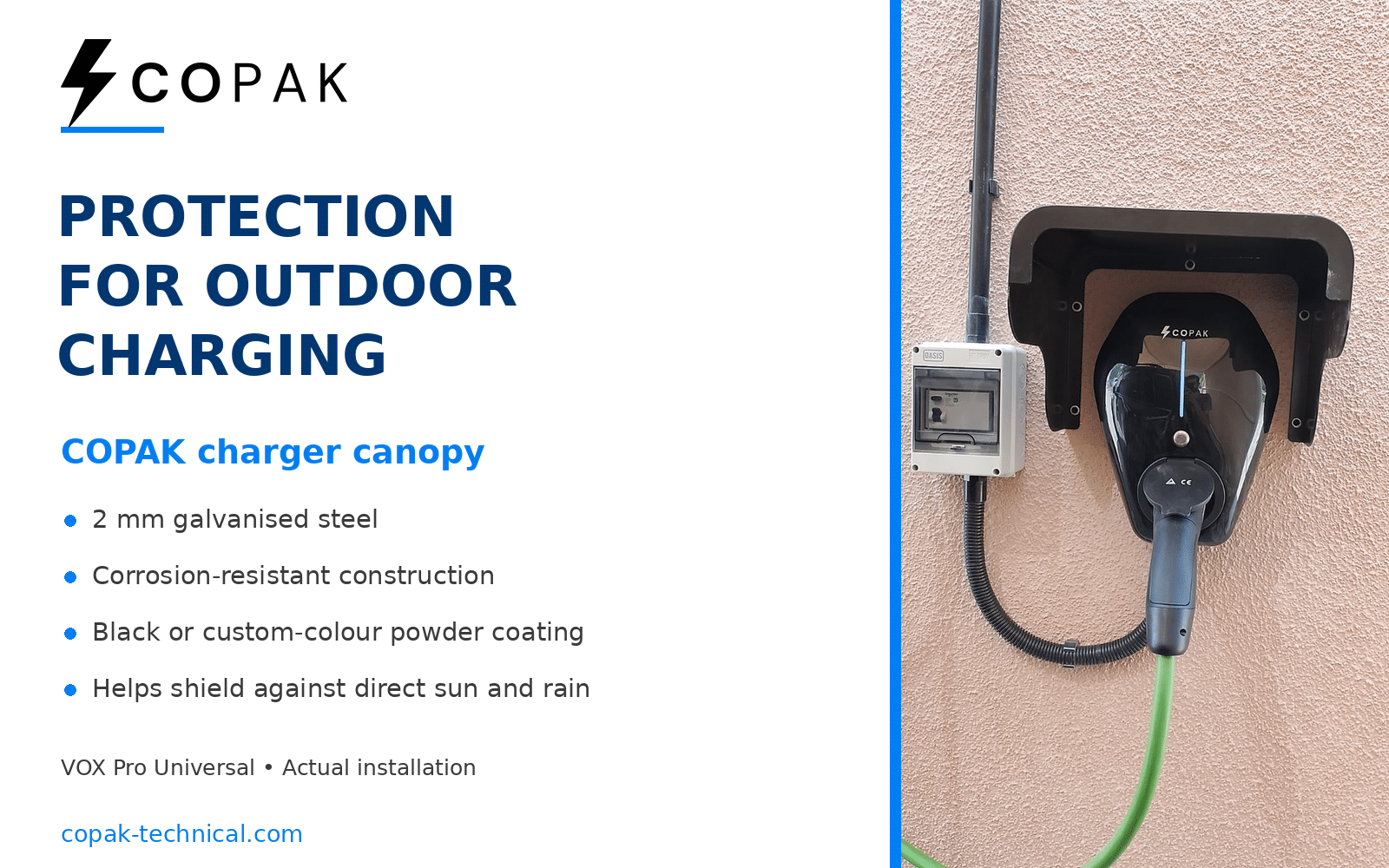
COPAK’s VOX Pro datasheet lists IP55/IK10, together with over-temperature protection.
Customers considering the VOX Pro wall charger should have its suitability verified for the specific project, installation position and applicable requirements.
Do not select an outdoor charger using an IP rating or a thermal shutdown setting alone.
6. Use the Right Charger, Cable and Adapter
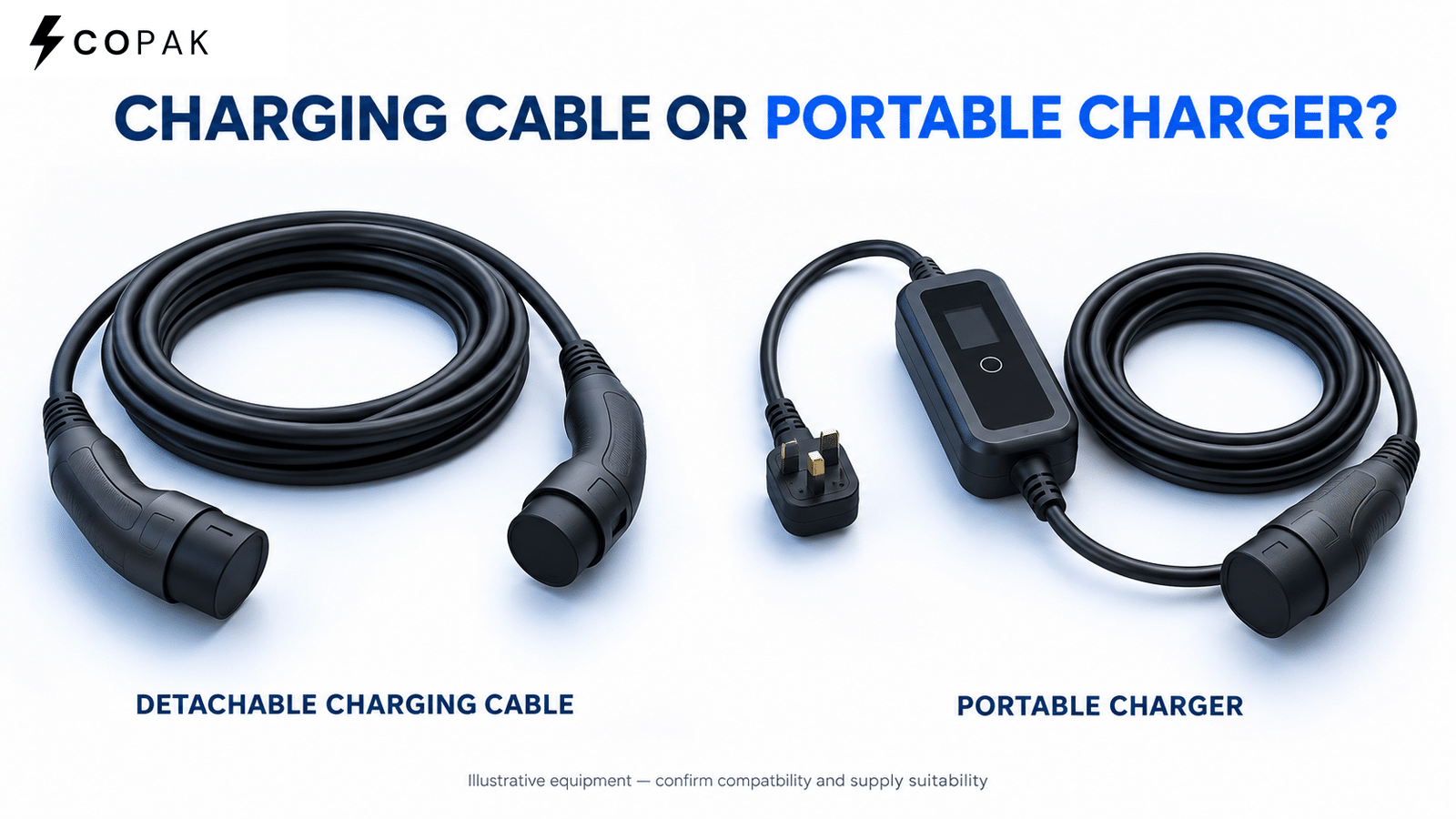
The terms “portable charger” and “charging cable” are often used interchangeably, but they describe different equipment.
A Detachable Charging Cable
A detachable cable connects a compatible socket-type charging station to the vehicle.
For example, a vehicle with a Type 2 AC inlet can use a suitable Type 2-to-Type 2 charging cable at a compatible Type 2 socket station.
This cable does not turn an ordinary household socket into a charging station.
A Portable Charger
A portable Mode 2 charger includes control and protection equipment between the supply plug and the vehicle.
It is inaccurate to say that all Mode 2 chargers lack safety monitoring. IEC 62752 specifically covers in-cable control and protection devices for this charging method.
However, the portable unit’s protection does not establish that an existing household socket and wiring are suitable for the intended charging duty.
Before using one, confirm the equipment instructions, supply suitability and applicable local requirements.
Can You Charge from a Domestic Socket?
Do not assume that an accessible socket is suitable simply because the plug fits.
Its condition, wiring, connections, protective arrangement and suitability for the expected load need assessment.
Electrical Safety First’s charging guidance recommends checking domestic wiring before charging from a household socket and warns against domestic multi-socket extension leads and daisy-chaining.
Its guidance is useful safety background; its UK regulatory context does not replace UAE requirements.
For routine home charging, discuss a properly designed fixed installation rather than relying on an unassessed socket or improvised extension arrangement.
Choose the Vehicle Connection Carefully
A matching connector shape is only the beginning of compatibility assessment.
Before buying a cable or adapter, provide the supplier with the vehicle model, model year, market specification and intended charging equipment. Ask for confirmation of the supported application and electrical ratings.
COPAK’s UAE charging plug, cable and adapter guide explains the main connection types and selection considerations.
Choose a cable length that reaches the vehicle comfortably without stretching the connector or creating an avoidable obstruction. Follow the equipment instructions for connection, disconnection and storage.
7. Plan for Your Property Type
Villas and Townhouses
For a villa installation, ask the installer to assess the proposed supply point, parking position and cable route before confirming the scope.
Consider everyday use:
- Will the cable reach the vehicle inlet in your normal parking position?
- Can it be stored clear of vehicle tyres and doors?
- Is the charger accessible without obstructing a walkway?
- Will garden irrigation or cleaning activities affect the location?
- Can the equipment be isolated and serviced safely?
COPAK’s residential EV charger installation service provides a starting point for discussing the work. Confirm the inclusions and any additional requirements for your property.
Apartments and Shared Residential Parking
In an apartment building, establish the approved electrical source and permissions before purchasing a charger.
Ask building management about:
- Permission to install equipment in the assigned parking bay.
- Approved cable routes through shared areas.
- Electrical capacity assessment.
- Metering and responsibility for electricity costs.
- Required drawings and contractor documentation.
- Work permits and access arrangements.
- Ownership and maintenance responsibilities.
A nearby distribution board should not be assumed to be available for your charger.
Where several residents want charging, a coordinated building plan can help avoid repeated surveys, conflicting cable routes and unclear maintenance responsibilities.
Workplaces and Public Charging Locations
Shared and public charging needs a separate project assessment covering authorised use, electrical infrastructure, equipment selection, applicable licensing and ongoing operation.
A charger being installed on private property does not, by itself, answer how its use is classified.
For a fuller discussion, refer to COPAK’s commercial charging guide rather than applying a home-charging checklist to a public service.
8. Know What to Expect at Installation and Handover
Before Installation
The proposal should identify:
- The charger model and configuration.
- The intended installation location.
- The electrical and installation scope.
- Required mounting accessories.
- Approval responsibilities.
- Testing and commissioning.
- Exclusions and additional work.
For a tethered charger, confirm the attached cable arrangement. For a socket model, confirm whether a suitable charging cable is included or must be purchased separately.
COPAK offers VOX Pro Universal and VOX Pro Cable. The datasheet identifies a Type 2 socket for the Universal version and an integrated 5 m Type 2 cable for the Cable version.
For projects considering two charging connections, the MAG Duo range is another option to discuss. Confirm the exact configuration and supply requirements before ordering.
During Commissioning
Ask for verification of both the electrical installation and the functions included in the agreed scope.
The handover should explain:
- How to start and stop charging.
- How the connector locks and releases.
- Where the relevant isolation point is located.
- What the charger’s indicators and warnings mean.
- How to report a fault.
- Which maintenance checks the owner should perform.
For connected equipment, also confirm account access and which functions depend on the platform or internet connection.
Documents to Retain
Keep a record of the equipment model and serial number, invoice, applicable approvals, installation test documentation, operating instructions and warranty terms.
Ask the installer to identify the charger circuit clearly.
These records support future servicing and help another qualified contractor understand what was installed.
9. Recognise Warning Signs and Maintain Your Equipment
Routine visual checks can identify damage before the next charging session.
Look for deterioration in the cable sheath, connector body, mounting and accessible external parts. Follow the product instructions for cleaning and maintenance.
Arrange professional inspection if you notice:
- Cracked or damaged insulation.
- Discolouration or melted plastic.
- A burning smell.
- A damaged or insecure connector.
- Repeated unexplained protective-device trips.
- Persistent charging faults.
- Visible damage following impact or water exposure.
Do not repeatedly reset a tripping protective device or reconnect visibly damaged equipment to see whether charging will resume.
If there is smoke, arcing or an immediate danger, keep people away and contact emergency services. Do not approach damaged equipment to operate controls.
Maintenance Should Match the Installation
Ask for a maintenance schedule appropriate to the equipment and its use.
A charger in a private garage and a charger used by many drivers require different operating arrangements. For shared sites, nominate someone to receive fault reports and arrange inspection.
Keep the charging area clear, store connectors as instructed and prevent cables from being crushed or pulled across sharp edges.
Do not open the enclosure or attempt internal repairs yourself.
10. Questions to Ask Before Accepting a Quotation
A useful quotation should make the proposed outcome clear—not simply list a charger and an installation charge.
Ask these questions:
- Has the electrical supply been assessed?
Request an explanation of the proposed charging capacity. - Which exact model and configuration will be supplied?
Confirm socket or cable version, mounting and accessories. - What documentation supports its suitability?
Ask for relevant product and conformity information. - Which approvals are required?
Confirm who handles submissions and inspections. - What electrical work is included?
Identify cable routes, protection, containment, and any modifications. - How will the installation be tested?
Ask which records you will receive. - What is excluded?
Clarify civil works, additional cabling, approvals, connectivity, and recurring services where relevant. - Who provides support after installation?
Confirm the process for reporting equipment and installation faults.
To discuss your property, contact COPAK with your vehicle details, location, parking arrangement and charging requirements. COPAK can help assess suitable equipment and the scope of the proposed installation.
11. Frequently Asked Questions
Does Every Outdoor EV Charger in the UAE Need IP65?
No single UAE-wide IP65 minimum should be assumed. DEWA’s published AC equipment table specifies IP54/IK10. The appropriate selection depends on applicable requirements and the site’s exposure.
Does IP55 or IP65 Prove That a Charger Can Handle Extreme Heat?
No. IP ratings concern ingress protection. Temperature performance must be checked separately using the product’s operating specifications and supporting information.
Is a Thermal Shutdown Setting the Same as an Operating-Temperature Rating?
No. A shutdown setting identifies a protection threshold associated with a monitored temperature. An ambient operating rating describes the surrounding conditions under which the equipment is specified to operate. One cannot be substituted for the other.
Does Built-In Leakage Protection Remove the Need for External Protection?
Not automatically. The installer must assess the internal protective functions, supporting documentation, and the rest of the electrical installation.
Are Portable EV Chargers Inherently Unsafe?
No. Properly specified Mode 2 equipment includes control and protection functions. Its use still depends on a suitable supply, correct installation conditions, equipment instructions, and applicable local requirements.
Can I Install a Wall Charger Myself?
Arrange installation through a competent electrical contractor who can meet the applicable authority and property requirements. Fixed EV charging involves electrical design, protection and testing beyond mounting the unit.
Will a Charger Problem Automatically Void My Vehicle Warranty or Home Insurance?
Do not assume an automatic outcome. Coverage depends on the relevant terms and circumstances. Ask the vehicle provider and insurer about applicable conditions, and retain your installation records.
Is a Socket Charger Safer Than a Tethered Charger?
Neither configuration alone establishes safety. Both require suitable equipment, compatible connections, and correct installation. Choose the format that suits your vehicles and daily use.
What Should I Do if a Connector Shows Melting or Discolouration?
Stop using the affected equipment and arrange a qualified inspection. Do not reconnect it to test whether it still works.