
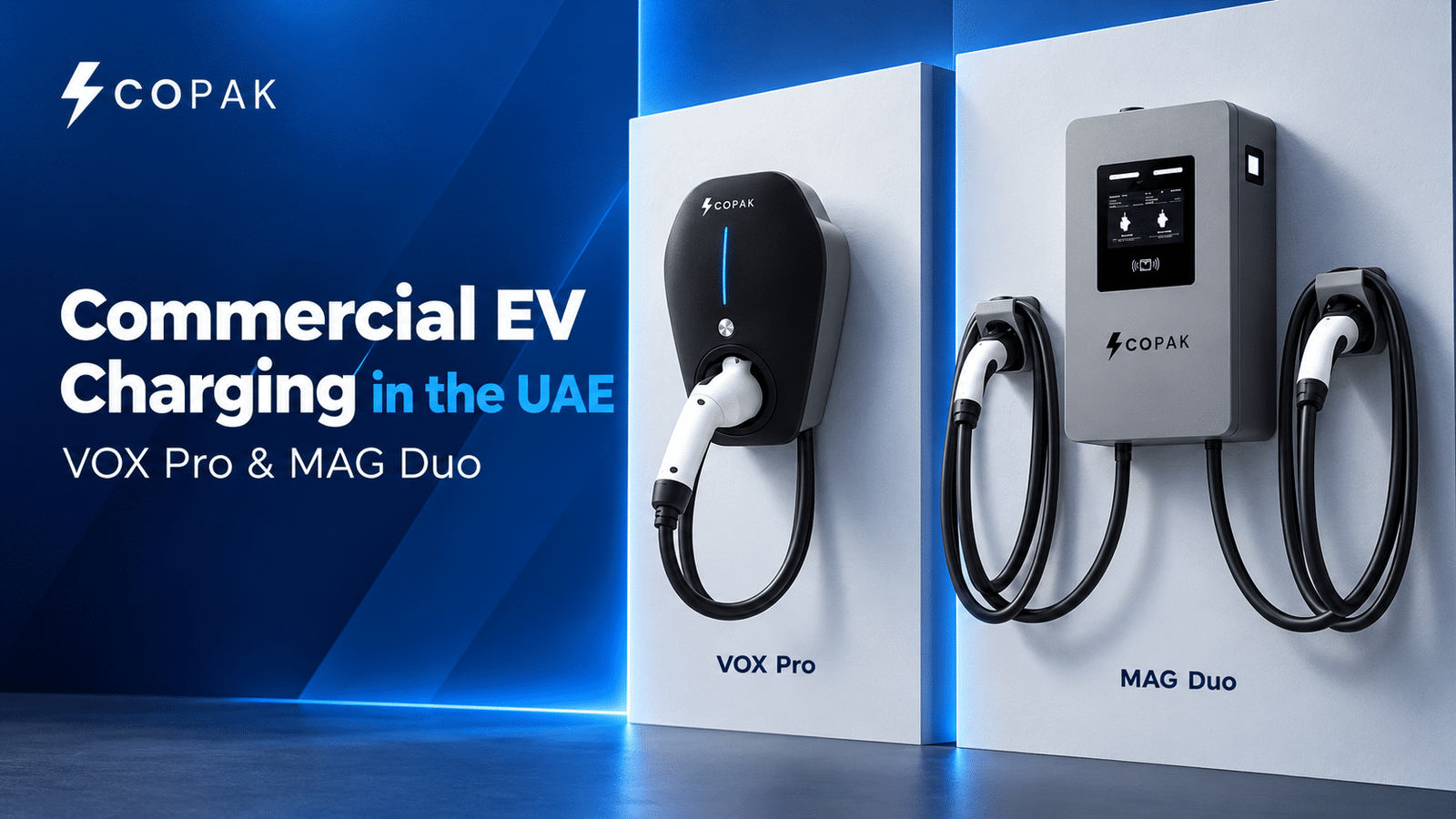
Commercial EV charging requires the right combination of equipment, electrical infrastructure, approvals and operating arrangements.
A workplace may need convenient charging throughout the day. A hotel may serve overnight guests and short-stay visitors. A fleet depot may need vehicles ready for their next shift. Each application requires a different assessment of charging power, parking duration and available electrical capacity.
For paid charging, the installation also needs a reliable way to authorise users, process payments and maintain communication between the chargers and the management platform.
This guide explains the main decisions involved in planning commercial EV charging in the UAE and introduces COPAK’s AC and DC charging options.
1. Define Your Commercial Charging Requirements
Start with the users and their vehicles.
Identify whether the installation will serve employees, customers, hotel guests, tenants, company vehicles or a combination of these groups.
Then answer five questions:
- How many vehicles need to charge?
- How long will they remain parked?
- How much energy will they typically need?
- Which charging connections and power levels do they support?
- Will charging be paid, provided as an amenity or reserved for an organisation’s own vehicles?
These decisions influence equipment selection, electrical infrastructure and operating requirements.
| Application | Main planning priority |
|---|---|
| Workplaces | Convenient charging during working hours |
| Hotels | Serving different guest parking durations |
| Retail destinations | Accessible charging and available bays for arriving customers |
| Fleet depots | Delivering the required energy before scheduled departures |
| Mixed-use developments | Clear access rules, metering and operating responsibilities |
Consider the installation’s initial requirements and potential expansion separately. Preparing suitable cable routes and equipment space can form part of a phased plan, while the number of chargers installed should reflect the business’s needs.
For related operational planning, see COPAK’s fleet EV charging guide.
2. Compare COPAK’s AC and DC Charger Options
Choosing a charger means matching its capabilities to the vehicles and the site. A higher power rating is useful only when the vehicle can accept that power and the installation can supply it.
AC Chargers
COPAK’s AC range includes four configurations:
| Charger | Connection arrangement | Practical consideration |
|---|---|---|
| VOX Pro Universal | Type-2 socket | Uses a separate compatible charging cable |
| VOX Pro Cable | Integrated Type-2 cable | Convenient for repeated use without connecting a separate cable |
| MAG Duo Universal | Dual socket configuration | Supports a layout with two charging positions using compatible separate cables |
| MAG Duo Cable | Dual cable configuration | Provides attached cables for two charging positions |
The VOX Pro Wall EV Charger provides up to 22 kW AC on a suitable three-phase installation. Its cable version includes a 5 m Type-2 cable.
The MAG Duo range provides a dual-output arrangement. Confirm the selected version’s output, cable or socket specification and supply requirements in the project quotation.
AC charging is worth considering where vehicles remain parked for several hours. Actual charging power depends on the vehicle’s onboard AC charger and the installation.
For example, a vehicle limited to 11 kW AC will not charge at 22 kW simply because it connects to a 22 kW wallbox.
DC Fast Chargers
COPAK’s DC range includes:
- 30 kW DC single-gun charger
- 40 kW DC single-gun charger
- Higher-power DC options extending up to a 240 kW dual-gun charger
DC charging can suit applications where vehicles need more energy during shorter stops.
Select the model according to the required turnaround time, vehicle compatibility and electrical infrastructure. For dual-gun models, confirm how the charger’s total output is distributed when two vehicles charge simultaneously. Do not assume the full nameplate rating is available independently at each gun.
The U.S. Department of Energy’s charging equipment overview explains how vehicle capability, battery condition and charging equipment affect charging time. Its US connector and installation examples should not be treated as UAE requirements.
3. Choose the Right Mounting Arrangement
Mounting affects access, cable reach, civil works and maintenance.
For COPAK’s DC range:
| DC charger | Mounting options |
|---|---|
| 30 kW single-gun | Wall or pedestal |
| 40 kW single-gun | Wall or pedestal |
| Models above 40 kW, up to 240 kW | Pedestal mounting |
These mounting arrangements apply to COPAK’s offered range. The final installation must follow the selected model’s requirements.
Wall mounting needs a suitable supporting structure and sufficient space around the charger. Pedestal installations need an appropriate foundation, cable entry and parking layout.
Check that charging cables can reach the intended vehicles without obstructing pedestrian routes. Include service access and any necessary protection against accidental vehicle impact.
For AC installations, confirm compatibility between the selected charger and its proposed wall bracket or pedestal. COPAK’s EV charger pedestal stand is one mounting option to assess where a suitable wall is unavailable.
4. Plan Electrical Capacity and Dedicated Metering
The proposed charging load must be assessed against the property’s electrical infrastructure.
The project assessment should cover:
- Available and approved electrical capacity.
- Distribution-board and switchgear requirements.
- Cable routes and cable sizing.
- Isolation, protection and earthing.
- Dedicated EV metering arrangements.
- Civil works and equipment locations.
- Present demand and planned expansion.
COPAK’s planning approach for commercial projects includes a dedicated EV metering arrangement, with its specification and connection confirmed through the relevant utility’s approval process.
A charger’s internal energy meter and the utility’s electricity meter serve different purposes. An internal meter can support charging-session records; it does not automatically replace the required utility meter.
The approved design should identify whether metering serves an individual unit or a group of chargers. Do not assume that each connector requires its own utility meter.
For a wider explanation of site assessment and electrical works, read COPAK’s professional EV charger installation guide.
5. Understand Authority Requirements
Confirm the approval and operating route before purchasing equipment. Building permission, electrical connection approval and permission to operate a charging service are separate considerations.
Dubai
Commercial services classified as public charging fall within DEWA’s CPO licensing framework, covering both AC and DC equipment.
A restricted-access car park does not automatically qualify as private charging. DEWA includes charging employees’ private vehicles within its public-charging category, while an organisation charging only its own vehicles is treated differently.
Use the DEWA EV charging regulatory framework to check the applicable route.
The published paid-service CPO licence has one-year validity and provides for annual renewal. Include renewal responsibility and applicable charges in the operating plan.
For paid public charging, plan the required DEWA smart metering and confirm the approved arrangement during design.
Abu Dhabi
Before procurement, confirm the charger certification and acceptance documentation required by TAQA Distribution and the applicable conformity authorities.
Arrange registration and separate TAQA metering as part of the project. Include the metering and connection process in the installation programme rather than treating it as a task to address after the equipment arrives.
Consult TAQA Distribution for current connection and metering guidance.
Other Emirates
Include dedicated EV metering in the proposed commercial design and confirm the applicable requirements with the utility serving the property.
The meter specification, connection arrangement and approval documents must follow that utility’s process. An approval obtained for one emirate should not be assumed to cover another.
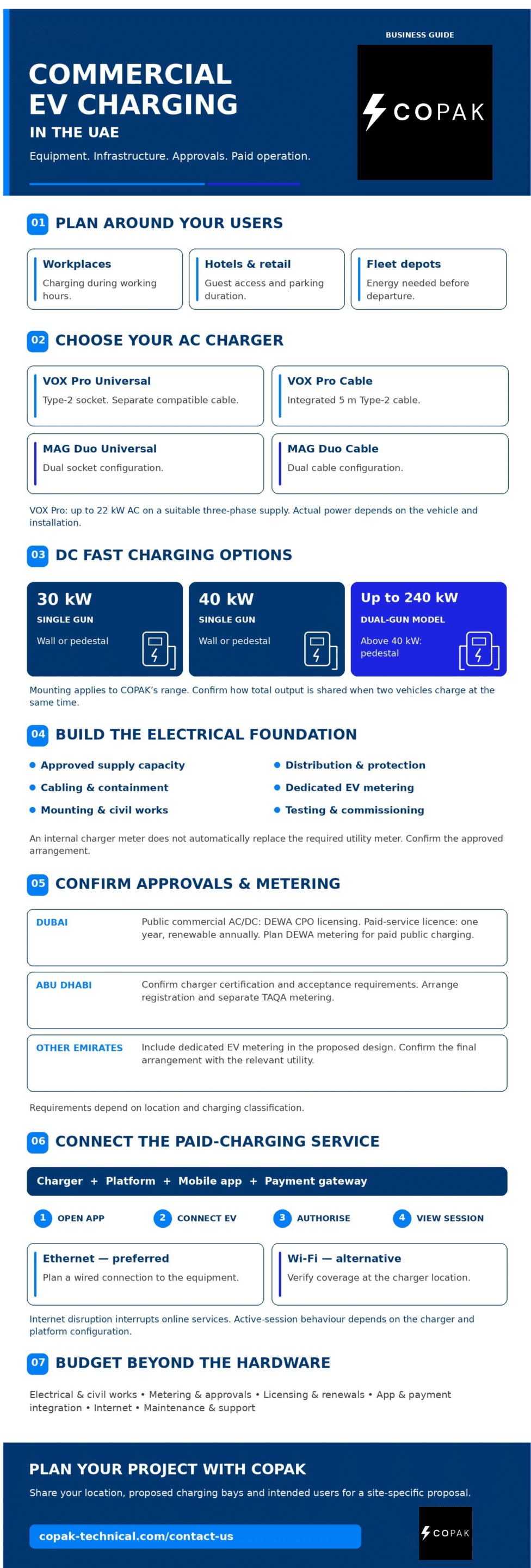
6. Set Up App-Based Paid Charging
For the app-based paid-charging solution described here, the charger must be integrated with a compatible management platform, mobile application and payment gateway.
The components work together:
| Component | Role |
|---|---|
| Charger | Supplies energy and reports supported session information |
| Management platform | Coordinates authorisation, session records and operational monitoring |
| Mobile application | Lets the driver identify the charging point and request a session |
| Payment gateway | Processes supported payment transactions |
| Internet connection | Connects the charger with the online platform |
The Driver’s Charging Journey
A typical user journey is:
- Open the supported application.
- Select or identify the charging point.
- Connect the vehicle.
- Review the applicable terms and authorise the session.
- View supported charging information and payment records.
The precise sequence depends on the selected platform.
The customer-facing experience should make the charging point, applicable price and session status clear. Payment integration does not permit an operator to set charges outside the applicable rules.
Confirm Integration Before Ordering
OCPP provides a communication framework between chargers and charging management systems. Compatibility depends on the protocol version, firmware and implemented functions.
The Open Charge Alliance’s OCPP overview explains the protocol’s role.
Ask for confirmation that the proposed hardware supports the actual application and payment workflow required for the project. Agree which reports, administrator controls and support functions will be available.
Also distinguish user records from vehicle records. A session associated with an account or credential does not necessarily identify the physical vehicle connected to the charger.
7. Provide Reliable Internet Connectivity
Internet connectivity is part of an online paid-charging installation.
For COPAK’s proposed setup, Ethernet is the preferred connection. Where a wired connection is impractical, provide suitable Wi-Fi and test it at the charger’s actual location.
A signal available in an office or reception area does not establish reliable coverage at a basement charging bay.
The installation plan should address:
- Network availability at each charger.
- Router and access-point locations.
- Necessary network permissions.
- Responsibility for the internet service.
- Monitoring and recovery after an outage.
Internet disruption interrupts the online services on which app-based charging depends. Users may be unable to authorise a new session, complete an online payment or receive current status information.
Whether an existing charging session continues or stops depends on the charger and platform configuration. Confirm and test that behaviour before handover.
8. Budget for Installation and Operation
Compare quotations using the complete project scope.
| Cost category | What to include |
|---|---|
| Equipment | Chargers, cables, mounting accessories and communications hardware |
| Electrical installation | Cabling, containment, switchgear, protection and connections |
| Civil works | Foundations, trenching, reinstatement and parking works |
| Metering and approvals | Required utility arrangements, submissions and inspections |
| Licensing | Applicable initial and renewal charges |
| Digital services | Platform, application, payment gateway and connectivity costs |
| Ongoing support | Maintenance, troubleshooting and agreed site visits |
The Department of Energy’s infrastructure procurement checklist provides useful general planning questions. Its US incentives and permitting rules do not apply to UAE projects.
For paid charging, evaluate expected utilisation alongside operating costs. Revenue is not the same as profit, and return on investment depends on actual demand.
For fleet charging, assess operational outcomes as well: vehicle readiness, charging availability and staff time spent managing sessions.
Request a clear list of inclusions, exclusions and recurring charges. The equipment price alone should not be treated as the cost of a complete operating service.
9. Test, Commission and Maintain the System
Before launch, verify the complete service—not just whether a vehicle receives power.
The handover process should cover:
- Required electrical tests and documentation.
- Charger operation with suitable vehicles.
- Metering and session records.
- App-based identification and authorisation.
- Payment processing and billing records.
- Ethernet or Wi-Fi connectivity.
- Behaviour during an internet outage and after reconnection.
- Administrator training and support contacts.
Agree who is responsible for electrical faults, charger faults, platform issues and payment queries.
A maintenance proposal should identify the inspections included, how faults are reported and how site visits are arranged. Record the support scope rather than assuming every service is included in the equipment purchase.
After launch, review actual usage. Monitor busy periods, charging interruptions and occasions when drivers cannot find an available bay. Use those observations to guide future expansion.
10. Frequently Asked Questions
Which AC chargers does COPAK offer?
COPAK offers VOX Pro Universal, VOX Pro Cable, MAG Duo Universal and MAG Duo Cable. Confirm the exact configuration and electrical requirements when requesting a proposal.
What DC charging capacities are available?
COPAK’s range includes 30 kW and 40 kW single-gun chargers and extends to a 240 kW dual-gun charger. Ask for the available model that matches your site, vehicles and required charging time.
Can COPAK’s DC chargers be wall mounted?
The 30 kW and 40 kW models can be wall or pedestal mounted. Higher-power models in COPAK’s range require pedestal mounting.
Will every vehicle charge at the charger’s maximum power?
No. Actual power depends on the vehicle, the installation and operating conditions. For AC charging, the vehicle’s onboard charger is an important limit.
Does the charger’s internal meter replace the utility meter?
Not automatically. The internal meter can support session information, while the utility’s metering arrangement must follow the approved connection requirements.
Does paid charging require an internet connection?
The app-based service described here requires stable internet for online authorisation, payment-related communication and monitoring. Ethernet is preferred; suitable Wi-Fi is an alternative.
Does buying a charger include the complete paid-charging service?
Not automatically. Confirm installation, metering, approvals, licensing, platform integration, payment services, connectivity and maintenance in the quotation.
11. Discuss Your Project with COPAK
COPAK provides commercial EV charging solutions in Dubai and the UAE.
To prepare a useful proposal, share:
- Your property location and type.
- The proposed number of charging bays.
- The intended users and vehicle types.
- Typical parking duration or fleet schedules.
- Whether paid charging is required.
- Whether Ethernet or Wi-Fi is available near the proposed equipment.
Explore the COPAK charging equipment shop, or contact COPAK for a site-specific commercial charging proposal.