
Transitioning a corporate fleet to electric power isn’t just a hardware purchase; it’s a strategic energy management challenge that can either stabilize your operational costs or cripple your facility’s power supply. Most UAE fleet managers recognize that the shift is inevitable, yet they’re rightfully cautious about high upfront costs and the technical complexities of grid compliance. You’ve likely worried that installing multiple chargers might exceed your DEWA or TAQA allocated load, or that tracking individual driver consumption for reporting will become an administrative burden.
We understand these pressures and are here to help you master the transition. This 2026 guide provides a scalable blueprint for fleet EV charging solutions Dubai corporations can rely on for safety and performance. You’ll learn how to implement intelligent energy management to protect your infrastructure and reduce operational costs. We’ll also explore how seamless data integration and high-performance hardware, such as the VOX PRO, ensure your fleet remains future-ready and fully compliant with local regulations. From load management strategies to scalable infrastructure design, this expert guide covers everything required to power your commercial journey in the Emirates.
Key Takeaways
- Understand how the UAE’s Green Mobility Strategy is shaping corporate transport and what your business needs to do to remain compliant and future-ready by 2026.
- Assess approved electrical capacity and the required supply infrastructure before expanding the fleet charging network.
- Identify the most efficient fleet EV charging solutions Dubai offers by matching charger capacities to your specific vehicle requirements and choosing between hardware like the VOX PRO or Mag Duo.
- Follow a professional blueprint for hub installation that covers everything from comprehensive site surveys and load calculations to obtaining necessary approvals from local authorities.
- Discover how Charge Point Operator (CPO) services and structured maintenance protocols can reduce long-term operational costs and prevent critical fleet downtime.
The Evolution of Fleet EV Charging Solutions in the UAE
As we enter 2026, the UAE’s commercial landscape is undergoing a fundamental transformation. What began as a series of pilot programs has matured into a nationwide mandate for sustainable logistics. This shift is heavily influenced by the UAE Green Mobility Strategy, which provides a clear roadmap for corporate EV adoption across the Emirates. For businesses, implementing robust fleet EV charging solutions Dubai requires moving beyond simple hardware purchases toward integrated, long-term energy strategies that account for both current needs and future growth.
The transition involves a significant shift in capital expenditure. While traditional fuel costs remain volatile, electricity costs in the UAE follow a structured slab system that rewards efficiency. By investing in scalable infrastructure today, corporations can lock in predictable operational expenses for years to come. COPAK advocates for a “total solutions” approach, ensuring that logistics hubs don’t just charge vehicles but manage their entire energy footprint. This comprehensive oversight is essential for preventing costly downtime and ensuring that every vehicle is ready for its shift.
Logistics hubs and commercial centers must consider several critical factors during this transition:
- Scalability: The ability to add more charging points as the fleet expands without rebuilding the entire electrical backbone.
- Compliance: Adhering to the latest safety standards set by local authorities like DEWA and TAQA.
- Reliability: Selecting high-utilization hardware such as the VOX PRO 22kW Smart EV Charger to handle back-to-back charging cycles.
- Efficiency: Using intelligent software to track energy consumption per vehicle for accurate financial reporting.
Corporate Sustainability Goals in the UAE
The UAE Net Zero 2050 targets are no longer just government policy; they’re now key performance indicators for private enterprises. In Dubai and Abu Dhabi, corporate reputation is increasingly tied to environmental stewardship. Transitioning a fleet from internal combustion to electric power is the most visible way for a company to demonstrate its commitment to these goals. We’ve seen a clear move from small-scale testing to full-scale deployment as organizations realize that green branding attracts both top-tier talent and high-value international clients who prioritize sustainable supply chains.
Key Considerations for Commercial Sites
Site readiness varies significantly across the Emirates. A warehouse parking lot in JAFZA has different electrical requirements than a corporate headquarters in Downtown Dubai. Future-proofing your site involves more than just pulling cables; it requires a detailed assessment of existing capacity and the installation of hardware that can scale. Private fleet hubs often prioritize high-density equipment like the Mag Duo Dual Wall EV Charger to maximize space efficiency while providing reliable power to multiple vehicles simultaneously.
Scaling Infrastructure: Electrical Capacity and OCPP Integration
Plan fleet charging around vehicle energy requirements, operating schedules and the site’s approved electrical capacity. Assess the proposed simultaneous charging demand before specifying equipment.
Assessing Approved Electrical Capacity
The assessment should cover distribution boards, cabling, protection, metering and planned expansion. Where capacity is insufficient, revise the project or arrange the required approved upgrade.
Confirm the connection arrangement and relevant permissions before procurement. Ask COPAK for a site assessment to define the project scope.
OCPP and Smart Charging Management
OCPP enables communication between compatible chargers and a management platform. VOX Pro can provide supported session information through a configured backend; agree the required functions before deployment.
The benefits of data-driven fleet management include:
- Consumption tracking: record energy by session or user credential where supported; identifying the physical vehicle may require additional integration.
- Access Control: Use RFID or app-based authentication to ensure only authorized personnel use the chargers.
- Remote diagnostics: investigate supported faults remotely; electrical and hardware repairs may still require a site visit.
- Automated Reporting: Generate sustainability reports that align with UAE Net Zero 2050 targets.
OCPP can reduce dependence on proprietary systems. Compatibility depends on the protocol version, firmware, functions and backend configuration; changing providers may require testing and setup.
Selecting Commercial Hardware: VOX PRO vs. Mag Duo
Selecting the right hardware for fleet EV charging solutions Dubai involves more than just comparing power ratings. A common industry misconception is that a 22kW charger is always the superior choice. In reality, the charging speed is dictated by the vehicle’s onboard AC charger. If your fleet consists of light commercial vehicles limited to 7.4kW or 11kW, a 22kW unit won’t provide faster results. It’s vital to audit your vehicle specifications to ensure your infrastructure investment matches the actual intake capacity of your fleet.
Assess the charger’s documented temperature capability and protection ratings against the site. Do not assume an IP rating prevents thermal derating. Select tethered or socket equipment around vehicle compatibility and operational needs.
VOX PRO 22kW Smart Wallbox: The Elite Choice
VOX Pro Cable has a Type 2 cable, while VOX Pro Universal uses a separate compatible cable. Confirm the model’s documented environmental performance, electrical requirements and suitability for the project.
Mag Duo: Maximizing Efficiency in Corporate Parking
MAG Duo provides two charging points in one enclosure. The current Cable model offers up to 22kW per outlet on a suitable three-phase supply. Full simultaneous output requires adequate infrastructure; two outlets do not automatically double the available electrical capacity.
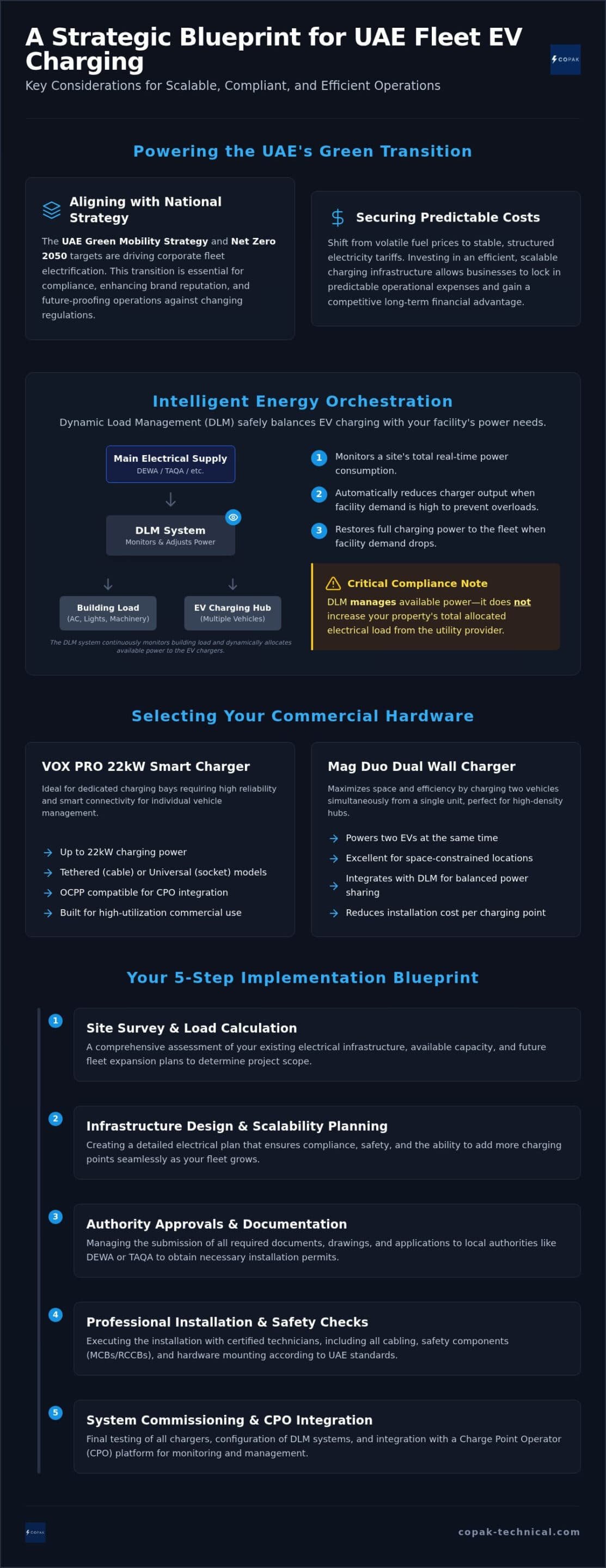
Example Workflow: Planning a Multi-Vehicle Charging Hub
Execution is where your strategy meets the reality of the UAE’s electrical environment. Transitioning to fleet EV charging solutions Dubai corporations can rely on requires a structured project management approach. This ensures that the installation isn’t just functional but also fully compliant with authority standards and optimized for long-term ROI. Following a proven blueprint helps mitigate risks, such as project delays or unexpected infrastructure costs, while ensuring safety benchmarks are met from the start.
The implementation process follows five critical stages:
- Step 1: Site Survey and Load Calculation. We perform a detailed analysis of your facility’s current electrical capacity. This includes identifying the main distribution board’s available load and determining the most efficient cable routes.
- Step 2: Coordination and Permitting. Commercial installations require coordination with building management and, in many cases, specific work permits. We handle the technical documentation required to secure these approvals.
- Step 3: Physical Infrastructure Build. This stage involves the installation of safety components, heavy-duty conduits, and high-spec cabling designed for the UAE’s high-temperature environment.
- Step 4: Commissioning and Integration. Once the hardware is physically installed, we commission the chargers and integrate them with your chosen OCPP management software for real-time tracking.
- Step 5: Operational Rollout. The final step includes driver training to ensure your team understands how to use the authentication systems and handle the equipment correctly.
This is an illustrative workflow, not a completed-project case study or guaranteed programme. Timing depends on approvals, equipment, metering, civil works and electrical readiness.
Documentation and Authority Compliance
Commercial setups in Dubai demand rigorous documentation. This includes detailed Method Statements (MS) and Risk Assessments (RA) that outline every aspect of the work. As an experienced contractor, COPAK ensures that all works meet the technical requirements of local authorities. We don’t just install chargers; we manage the entire compliance lifecycle. This protective oversight is vital for businesses operating in multi-tenant commercial zones where building management requirements are particularly strict.
Infrastructure Optimization for ROI
Placement and hardware choice directly impact your operational efficiency. Utilizing a Dual Gun Pedestal Stand allows for flexible placement in parking bays, reducing the distance between vehicles and charging points. This setup minimizes vehicle maneuvering time and maximizes the use of available space. By aligning your charging power with vehicle intake capacities, you reduce unnecessary downtime and ensure your fleet remains active. To begin your infrastructure transition with a professional assessment, you can book your site survey today.
Operational Excellence: Maintenance and CPO Services
The successful deployment of a charging hub is merely the beginning of the electrification journey. To ensure long-term viability, corporations must shift their focus toward operational excellence. Professional maintenance and robust Charge Point Operator (CPO) services are the primary safeguards against fleet downtime. In the high-utilization environments typical of the Emirates, neglecting these services can lead to hardware failure and significant logistical disruptions. Implementing comprehensive fleet EV charging solutions Dubai businesses can depend on requires a commitment to proactive care and intelligent management software.
Proactive Maintenance for Fleet Readiness
Plan maintenance around the equipment instructions, usage and site conditions. Review cables, connectors, protection and communications, and apply firmware updates according to release guidance. Maintain contingency arrangements for charger downtime.
CPO Services and Commercial Monetization
Operational services may include user access, session reporting, platform integration and technical support. If charging is offered to additional users, confirm the applicable classification, tariff and licensing route. Read COPAK’s CPO services guide for planning considerations.
Technical support and hardware guarantees provide an additional layer of security for your investment. Having a dependable partner who understands the specific regulatory distinctions between DEWA and TAQA ensures that your infrastructure remains compliant as local standards evolve. This steady hand in management allows your organization to focus on its core operations while we handle the technical complexities of your energy infrastructure.
Future-Proofing Your Corporate Fleet in the Emirates
Fleet charging requires suitable equipment, approved electrical capacity and an operating plan matched to vehicle schedules. Confirm platform compatibility and maintenance responsibilities before launch.
COPAK can assist with charger selection, installation and agreed support. Discuss electrical capacity, approvals and operating requirements before ordering equipment.
Consult with COPAK for your Fleet EV Charging Solution to begin your transition with confidence. Your journey toward a sustainable, high-efficiency fleet starts with a single professional assessment.
Frequently Asked Questions
Does DEWA offer a cheaper electricity tariff for commercial fleet charging at night?
There is no automatic nighttime discount simply because the load is an EV fleet. Billing depends on the relevant utility, account and charging arrangement. Confirm the current applicable tariff before using overnight savings in a business case.
What if the proposed fleet charging demand exceeds the approved load?
Arrange a qualified assessment of the proposed demand, approved capacity and electrical infrastructure. The project may require a revised charger layout, reduced scope or an approved supply upgrade before installation.
What is the benefit of an OCPP-compliant charger like the VOX PRO for my fleet?
OCPP supports communication with compatible management platforms. Confirm the reporting, authorisation and migration functions actually implemented. Session data linked to a user does not necessarily identify the vehicle.
How long does a professional commercial EV charger installation take in Dubai?
Obtain a programme after the site survey. Allow for documentation, permissions, equipment delivery, metering, civil works, electrical installation and commissioning; a fixed four-to-six-week period should not be assumed.
Is a 22kW charger always better than an 11kW charger for fleet vehicles?
Not necessarily, as the actual charging speed is limited by the vehicle’s onboard AC charger. If your fleet vehicles are limited to an 11kW intake, they won’t charge any faster on a 22kW unit. It’s more efficient to audit your vehicle specifications first and then select the charger capacity that matches your fleet’s actual power requirements.
What documentation is required for EV charger installation in a commercial building?
Commercial installations demand a rigorous documentation package to ensure safety and compliance. You’ll typically need a Method Statement, Risk Assessment, and the contractor’s Trade License and insurance. Building management also requires technical drawings, charger datasheets, and occasionally an NOC. COPAK handles this documentation process to ensure your project meets all necessary commercial property benchmarks.
Can we integrate solar power with our corporate fleet charging hub?
Yes, solar integration is possible but requires specific compatible hardware and monitoring equipment. You’ll need chargers that support solar-aware protocols, along with dedicated energy meters and a management system. This setup allows you to prioritize the use of self-generated clean energy, though it requires a professional assessment to ensure your site’s solar capacity matches your charging needs.
What happens if a fleet vehicle has a Type 1 port but our chargers are Type 2?
Check each vehicle’s AC inlet, onboard charging limits and manufacturer guidance. A universal Type 2 socket charger can serve different vehicles through appropriately rated, compatible cables. American-specification vehicles may use Type 1 or NACS inlets; do not assume a Type 2-to-Type 1 adapter covers every imported vehicle.