
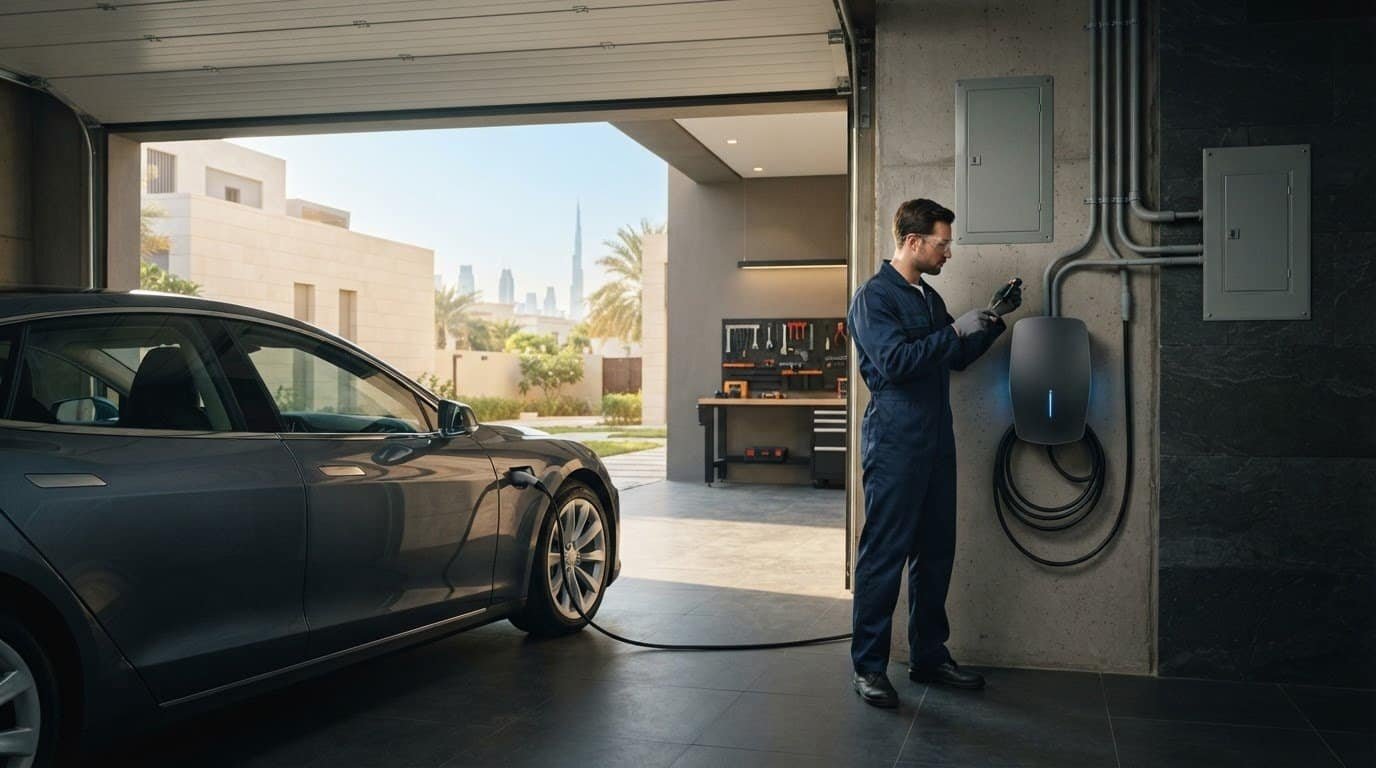
Buying the most powerful charger on the market won't charge your electric vehicle any faster if your car's onboard converter caps out at 11kW. When setting up residential EV charging Dubai homeowners and tenants face critical decisions regarding panel capacities, charging speeds, and utility compliance. You want the effortless convenience of plugging in overnight, but you also need certainty that your electrical infrastructure remains safe, your vehicle warranties stay intact, and your installation aligns with DEWA standards.
Following a clear technical checklist makes residential EV charging Dubai property setups straightforward and reliable. Whether you live in a standalone villa or require building management approvals for an apartment bay, getting the engineering right prevents costly disruptions. This 2026 checklist outlines how to evaluate domestic power supplies, choose compatible hardware, and secure professional residential EV charging Dubai services for safe, turnkey commissioning.
Key Takeaways
- Your vehicle's onboard AC charger determines your actual charging speed, making it essential to align wallbox specifications with car capabilities before purchase.
- A successful installation requires evaluating your distribution board's spare capacity and remaining within sanctioned electrical limits under Dubai utility standards.
- Planning residential EV charging in Dubai differs significantly between villas and apartments, requiring distinct approaches for cable routing and building management approvals.
- Selecting between tethered and universal wallbox units affects daily convenience, cable management, and long-term multi-vehicle compatibility in your parking bay.
- Working with certified technical specialists ensures safe cable containment, correct breaker selection, and full compliance from pre-inspection to final commissioning.
Residential EV Charging in Dubai: Essential Pre-Purchase Checklist
Planning proper residential EV charging Dubai installations requires verifying technical parameters well before unboxing any wallbox hardware. Skipping upfront feasibility checks leads to costly power mismatch issues or building management disputes. A structured pre-purchase approach guarantees your selected hardware integrates cleanly with domestic circuits.
Vehicle AC Onboard Charger and Connector Verification
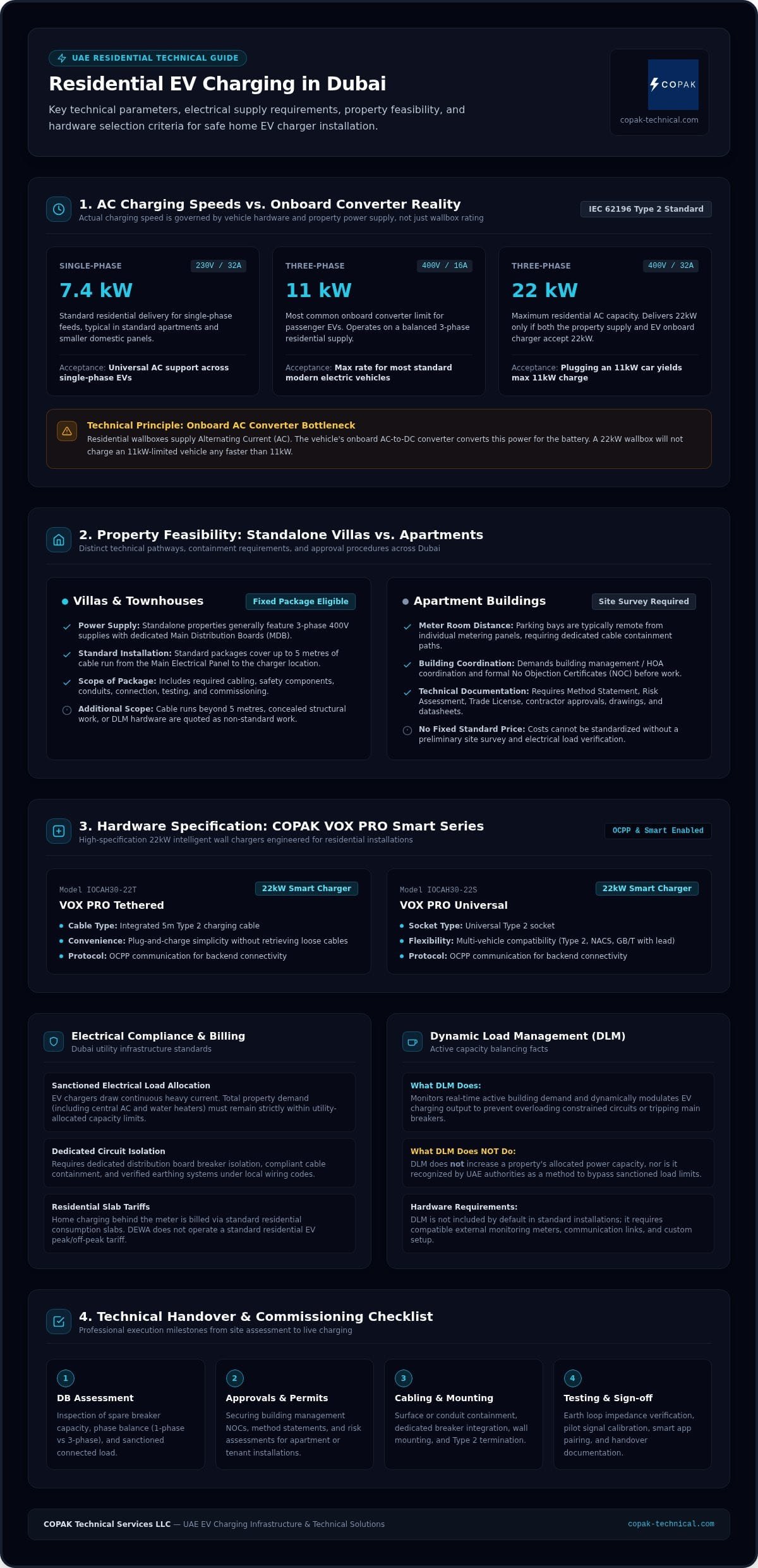
Never assume a higher-output wallbox forces your car to charge beyond its factory limit. Public rapid stations rely on DC power, but residential EV charging Dubai setups interact directly with your car's onboard alternating current converter. Most passenger electric cars feature single-phase 7.4kW or three-phase 11kW onboard converters. Plugging an 11kW-limited car into a 22kW wallbox yields an 11kW rate. Review our guide to 22kW EV chargers in Dubai to compare technical acceptance thresholds across major electric vehicle models.
Physical connector compatibility is equally vital. Charging infrastructure in Dubai follows European IEC 62196 Type 2 standards. For imported electric cars equipped with North American NACS or Chinese GB/T inlets, drivers require certified conversion hardware conforming to international EV charging standards to maintain safe grounding and pilot-signal communication.
Villa vs. Apartment Residential Feasibility Check
Property typology dictates electrical access and administrative pathways across the city:
- Standalone Villas and Townhouses: Private garages or carports provide straightforward access to the main distribution board. Short containment routes simplify installing dedicated breakers without civil disruptions.
- Apartment Buildings: Parking bays sit far from individual electricity meters. Successful execution demands developer coordination, building management NOCs, and validated load checks before booking a certified home EV charger installation.
Confirming physical parking access and ownership approvals early ensures your residential EV charging Dubai setup proceeds without administrative roadblocks.
Dubai Electrical Infrastructure and DEWA Compliance Checklist
Safe residential EV charging Dubai installations rely entirely on the capacity and protection built into your distribution board. Wallbox units draw continuous heavy current for hours at a time. Because of this prolonged electrical load, bypassing professional panel evaluations or proper circuit breaker specifications introduces substantial thermal strain and fire risks to your home.
Can You Install an EV Charger at Home If Spare Electrical Capacity Is Limited?
Limited spare capacity does not automatically rule out home EV charging. The first step is to assess your supply type, approved load and existing electricity demand to establish how much power is available for charging.
A 32A single-phase charger draws approximately 7.4kW at 230V. Your installer must check whether the electrical system can accommodate this demand alongside air conditioning, water heaters and other appliances. An empty breaker space does not necessarily mean spare electrical capacity.
Dynamic Load Management (DLM) is particularly useful when available capacity changes throughout the day. It monitors the property’s electricity demand and automatically adjusts charging power, reducing it when household consumption rises and increasing it when capacity becomes available.
The COPAK VOX Pro smart charger supports DLM with the appropriate monitoring equipment and configuration. This can help homes use available capacity effectively and may avoid unnecessary supply upgrades, subject to a site assessment.
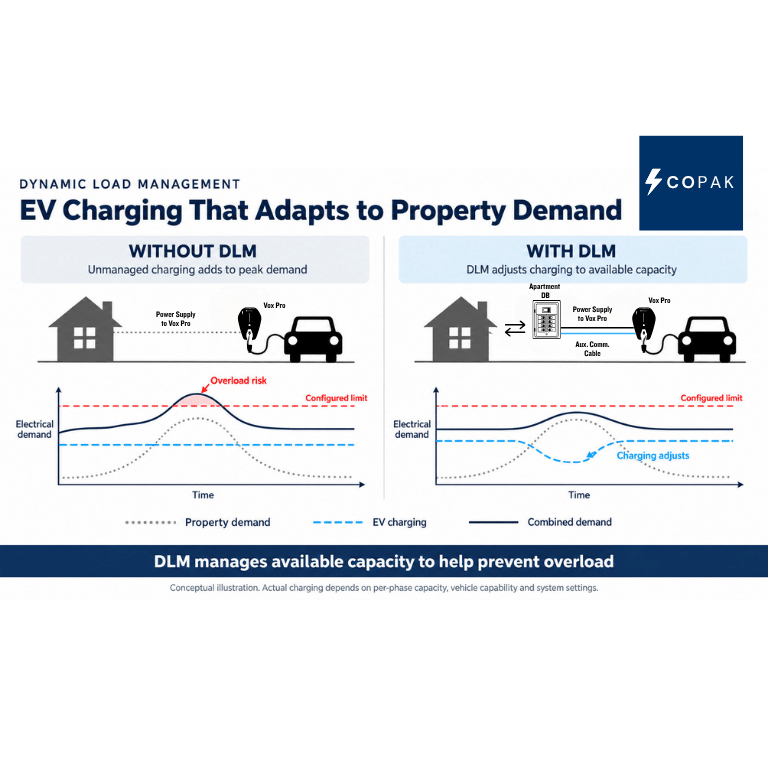
For private apartment charging and villas with multiple chargers, a correctly designed DLM system can manage charging within the available supply capacity. However, it does not increase the property’s approved load or replace electrical protection, building permissions or required approvals.
Charger compatibility also matters. Some 11kW and 22kW three-phase models support single-phase installation, but their output is reduced. A 16A-per-phase model typically provides up to 3.7kW on single-phase, while a 32A-per-phase model can provide up to 7.4kW, subject to manufacturer support and vehicle limits.
Before proceeding, arrange an electrical assessment through COPAK’s residential EV charger installation service. The assessment should establish whether DLM, a lower charging current or electrical upgrades offer the most suitable solution for your home.
What Electrical Protection Does Your Home EV Charger Need?
A home wallbox needs a dedicated electrical circuit with suitable isolation, earthing and protective devices. Your installer should design this circuit for EV charging rather than connect the wallbox to an existing general-purpose socket circuit.
Overcurrent protection protects the wiring against overloads and short circuits. The circuit breaker must suit the charger’s configured current, cable capacity and installation conditions—not simply match the charger’s advertised power.
Residual current protection helps protect against electric shock. The design must also address DC leakage, which can affect some RCDs. Recognised arrangements include a Type A RCD combined with suitable 6mA DC leakage detection, or a Type B RCD, subject to the charger’s documented protection and applicable DEWA requirements.
Built-in leakage protection does not automatically remove the need for external protective devices. A qualified installer must verify the complete protection arrangement and test it before handover.
Read COPAK’s professional EV charger installation guide for further guidance on planning and assessing your installation.
DEWA Residential Tariffs and Consumption Slabs Explained
A widespread misconception among electric car owners is that nighttime residential EV charging Dubai usage qualifies for reduced off-peak power rates. DEWA does not operate an off-peak or time-of-use tariff for residential accounts behind private meters. Instead, consumption is billed across tiered residential slabs:
- 0 to 2,000 kWh per month: 23 fils per kWh
- 2,001 to 4,000 kWh per month: 28 fils per kWh
- 4,001 to 6,000 kWh per month: 32 fils per kWh
- Above 6,001 kWh per month: 38 fils per kWh
Standard fuel surcharges and 5% VAT apply across each tier. Smart scheduling remains valuable to balance household peaks and manage battery temperatures during warm months, rather than securing discounted utility rates. If you need a verified assessment of your panel's electrical headroom, speak with a technical specialist to schedule an on-site load evaluation.
Choosing Your Home EV Charger: Hardware and Specification Checklist
Selecting the right wallbox is about long-term reliability and electrical balance. A quality charger must withstand regional ambient temperatures exceeding 45°C while integrating smoothly with your home electrical system. Focusing on durability, connectivity, and power delivery ensures your residential EV charging in Dubai runs reliably without nuisance tripping or hardware degradation.
Before buying, find charging options for your car using the COPAK EV Charger Selector, then continue to an installation estimate with your selections.
Power Ratings: 7kW Single-Phase vs. 11kW and 22kW Three-Phase
The right power rating depends on your daily commute and your property's electrical service. A single-phase 7.4kW charger replenishes roughly 35 to 45 kilometers of driving range per hour, which easily restores an empty battery overnight. Homes with a balanced three-phase supply can support 11kW or 22kW units, cutting charging times substantially for vehicles equipped to accept higher AC inputs. A 22kW wallbox automatically modulates power downward to match vehicle limits, protecting battery components while keeping your installation future-ready.
Tethered Cable vs. Universal Socket Wallbox Options
Wallboxes generally fall into two physical formats, each serving distinct household priorities:
- Tethered Wallbox: Features a permanently attached cable, typically five metres long. It eliminates the hassle of pulling a loose cable from your trunk every evening. You simply park, unholster the plug, and connect.
- Universal Socket Wallbox: Equipped with an open Type 2 socket outlet. This design provides maximum flexibility for multi-vehicle households, allowing European Type 2, North American, or Chinese GB/T cars to charge using their respective adapter cables.
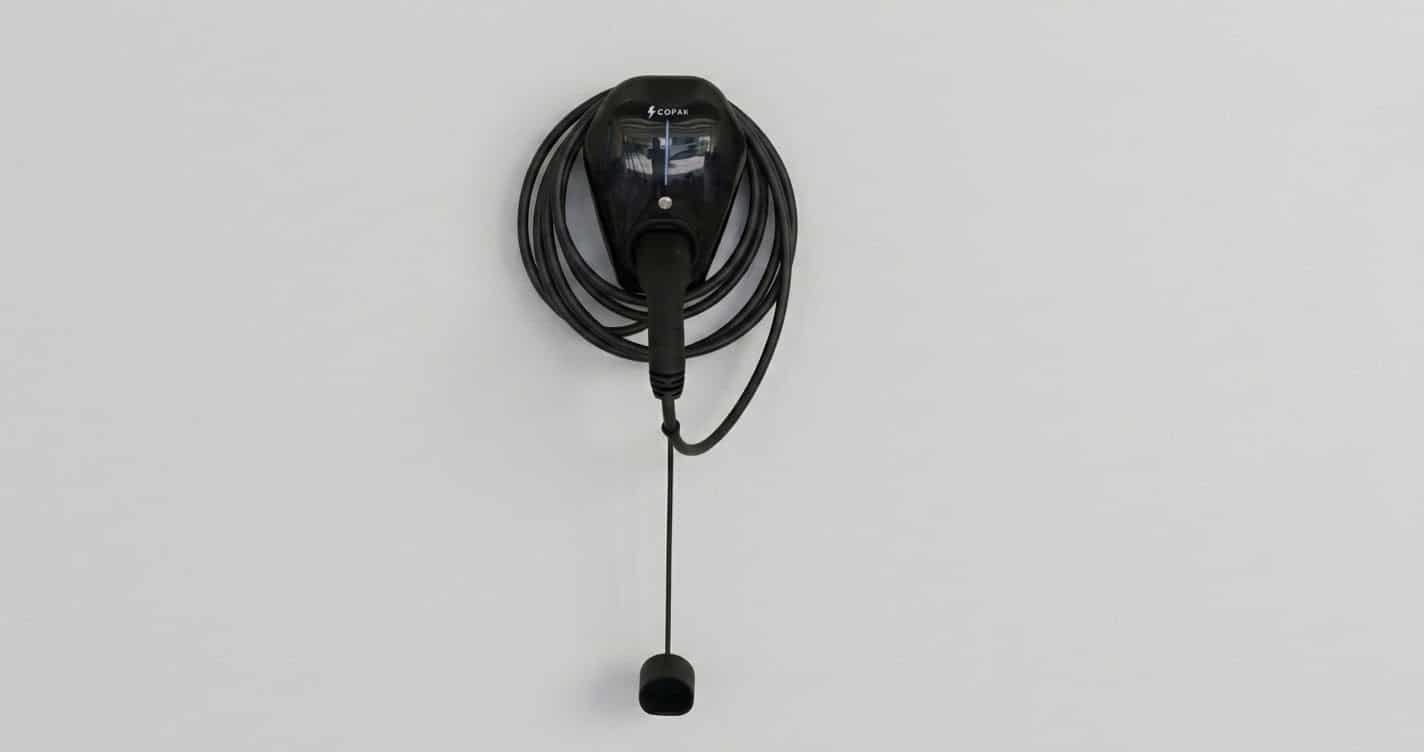
The VOX PRO 22kW Wall EV Charger comes in both tethered and universal socket variants, giving Dubai property owners the flexibility to prioritize daily plug-in speed or multi-car adaptability.
Connectivity, OCPP Compatibility, and Dynamic Load Management
Smart connectivity transforms a standard wallbox into a fully manageable energy asset. Select units equipped with local Wi-Fi, Ethernet, or integrated cellular connectivity so you can monitor real-time charging rates, track consumption, and manage user access via mobile applications. Compliance with the Open Charge Point Protocol (OCPP) is vital; it ensures the charger communicates with compatible backend management platforms without binding you to proprietary operating software.
For private residential charging, DLM can monitor household demand and adjust charging current within configured limits. It requires compatible monitoring equipment and commissioning. It does not increase the approved supply capacity or guarantee protection against every electrical fault.
Professional Installation and Handover Checklist
A professional installation connects suitable equipment to an assessed electrical supply. Mains electrical work requires qualified personnel, appropriate protection and testing. Insurance and vehicle warranty outcomes depend on the applicable terms and circumstances; they should not be presented as automatic consequences.
Standard Villa Installation Scope and Routing
The route between the electrical source and parking bay determines much of the installation scope. COPAK’s quoted package should specify the included cable length and containment method. Extra distance, concealed routing, trenching and reinstatement must be assessed and priced separately. Review the installation package and written quotation.
Apartment Building Management and NOC Documentation
Securing approvals in multi-tenant residential buildings involves navigating formal administrative channels. Unlike private villas, apartment installations involve running cables through shared risers, sub-basement corridors, and communal containment trays. Certified technical contractors handle this process through a systematic series of steps:
- Detailed Site Survey: Tracing the cable path from the assigned floor distribution board or residential meter down to the tenant's parking bay.
- Compliance Documentation: Compiling contractor Trade Licenses, engineer certifications, equipment datasheets, and single-line electrical diagrams.
- Method Statements and Risk Assessments: Providing facilities management with detailed execution plans and third-party liability insurance to obtain the formal No Objection Certificate (NOC).
Testing, Commissioning, and Handover Protocols
Physical mounting represents only half the job. Rigorous electrical testing must verify circuit integrity before energising the wallbox. Technicians use calibrated multifunction testers to record supply voltage, confirm phase polarity, measure earth fault loop impedance, and trigger residual current devices to test millisecond trip speeds. Once verified, the technician pairs your mobile management application, configures local RFID access cards, and runs a live vehicle charging session to validate sustained power delivery.
To avoid delays and guarantee a safe installation from panel to parking bay, contact our certified engineering team to book your preliminary site assessment today.
COPAK Residential EV Charging Solutions: Turnkey Hardware and Installation
Sourcing standalone hardware from one retailer and hiring an independent electrician for cabling often leads to split accountability and technical friction. COPAK eliminates these hurdles by delivering complete end-to-end solutions for residential EV charging in Dubai. By uniting climate-resilient hardware supply, regulatory coordination, certified electrical labor, and long-term support under a single entity, property owners receive dependable performance backed by dedicated engineering oversight.
VOX PRO 22kW Smart EV Charger Overview
VOX Pro is available with an attached cable or a Type 2 socket. Its published rating is −30°C to +50°C with IP55/IK10 protection; COPAK separately reports full rated performance in testing at +55°C. Confirm documented suitability for the proposed site.
- VOX PRO Tethered: Fitted with an integrated 5-metre Type 2 charging cable for fast, daily plug-in convenience in dedicated private parking bays.
- VOX Pro Universal: A Type 2 socket for a separate, correctly rated cable matched to the vehicle's AC inlet. Compatibility must be checked.
Supported app features include charging-session information and energy records. OCPP can provide platform flexibility, but compatibility depends on protocol version, firmware and configuration.
Fixed-Price Standard Residential Installation Packages
COPAK offers residential installation packages for qualifying sites. Confirm the included cable-route allowance, installation method, exclusions and current price in the selected package and written quotation.
The installation scope should identify cabling, containment, electrical protection, mounting, testing and commissioning. Longer routes, concealed work, civil works and building-management coordination may require a separate assessment and quotation.
Comprehensive Technical Support and Warranty Coverage
Confirm the warranty terms, included support and any separately contracted maintenance services in writing. Keep installation records and contact details for technical assistance.
Ready to Set Up Home EV Charging with COPAK?
Reliable home charging starts with a charger suited to your vehicle, your daily driving needs and your property’s electrical capacity. A professional assessment helps establish the right charging power, cable route and electrical protection before installation begins.
COPAK supplies VOX Pro smart chargers and provides residential installation services, from site assessment to testing and handover. Where spare capacity is limited, Dynamic Load Management can adjust charging power as household electricity demand changes, subject to suitable monitoring equipment and configuration.
Your quotation should clearly identify the included cable length, installation work and any additional requirements, such as trenching, concealed wiring or approvals. This gives you a clear understanding of the scope and cost before work starts.
Book a home EV charging assessment with COPAK to discuss a suitable setup for your property.
Frequently Asked Questions
Can I plug my electric vehicle into a standard 3-pin domestic socket in Dubai?
You can use a 3-pin domestic socket for emergency top-ups, but it's not recommended for regular daily charging. Standard UK-style 13A household sockets aren't designed to handle continuous high-amp loads for extended hours. Drawing continuous current through domestic outlets causes thermal stress and significantly increases fire risks. Installing a dedicated wallbox ensures your charging is isolated, grounded, and fully protected against electrical faults.
How many kilowatts (kW) should my home EV charger be?
Most residential EV charging Dubai installations utilize 7.4kW single-phase or 11kW and 22kW three-phase units. A 7.4kW charger easily replenishes most battery packs overnight, adding 35 to 45 kilometers of range per hour. If your home has a three-phase supply and your vehicle supports higher AC inputs, an 11kW or 22kW charger offers faster turnaround times and ensures your hardware remains future-proof.
Is electricity cheaper for EV charging during the night in Dubai?
No, electricity is not cheaper at night for domestic EV charging. DEWA bills all residential consumption behind private customer meters using a tiered slab tariff, ranging from 23 fils to 38 fils per kilowatt-hour plus applicable fuel surcharges and VAT. There is no dedicated off-peak or time-of-use discount. Scheduling charging overnight helps manage ambient temperatures and household appliance loads, but unit rates stay constant.
Do I need permission from DEWA or building management to install a home charger?
Yes, all installations must satisfy local utility safety codes and building management rules. Private villa setups require a licensed electrical contractor to verify panel limits and perform certified connections behind your utility meter. Apartment buildings require formal approval, including a No Objection Certificate (NOC), method statements, risk assessments, and single-line diagrams submitted to the facilities management team before work begins.
Will installing a 22kW charger allow any electric car to charge at 22kW?
No, an EV will only charge as fast as its onboard AC converter allows. While a 22kW wallbox can deliver up to 32 amps across three phases, many vehicles feature onboard limits of 7.4kW or 11kW. The charger safely communicates with the car and automatically down-regulates its power output to match the vehicle's maximum acceptance threshold without damaging the battery.
Can I install an EV charger in an apartment parking space in Dubai?
Yes, you can install a charger in an apartment parking bay, provided you obtain building management approval. The process involves a site survey to trace the cable route through communal risers from the meter room to your assigned spot. Certified contractors handle the full documentation package, including contractor trade licenses, insurance certificates, and single-line drawings needed to secure the management NOC.
What does Dynamic Load Management do for home EV charging?
Dynamic Load Management (DLM) continuously monitors active household electricity consumption and adjusts the wallbox output in real time. When major domestic appliances like central air conditioning or water heaters turn on, DLM reduces charger draw to prevent main breaker trips. DLM doesn't increase your sanctioned utility load or bypass regulations; it safely balances charging within your home's existing electrical envelope.
What is included in a standard residential EV charger installation package?
Check the selected package and quotation for the included cable length, containment, protection, mounting, testing and commissioning. DLM accessories, civil works, concealed wiring, extra cable and approvals are included only when specifically stated.