
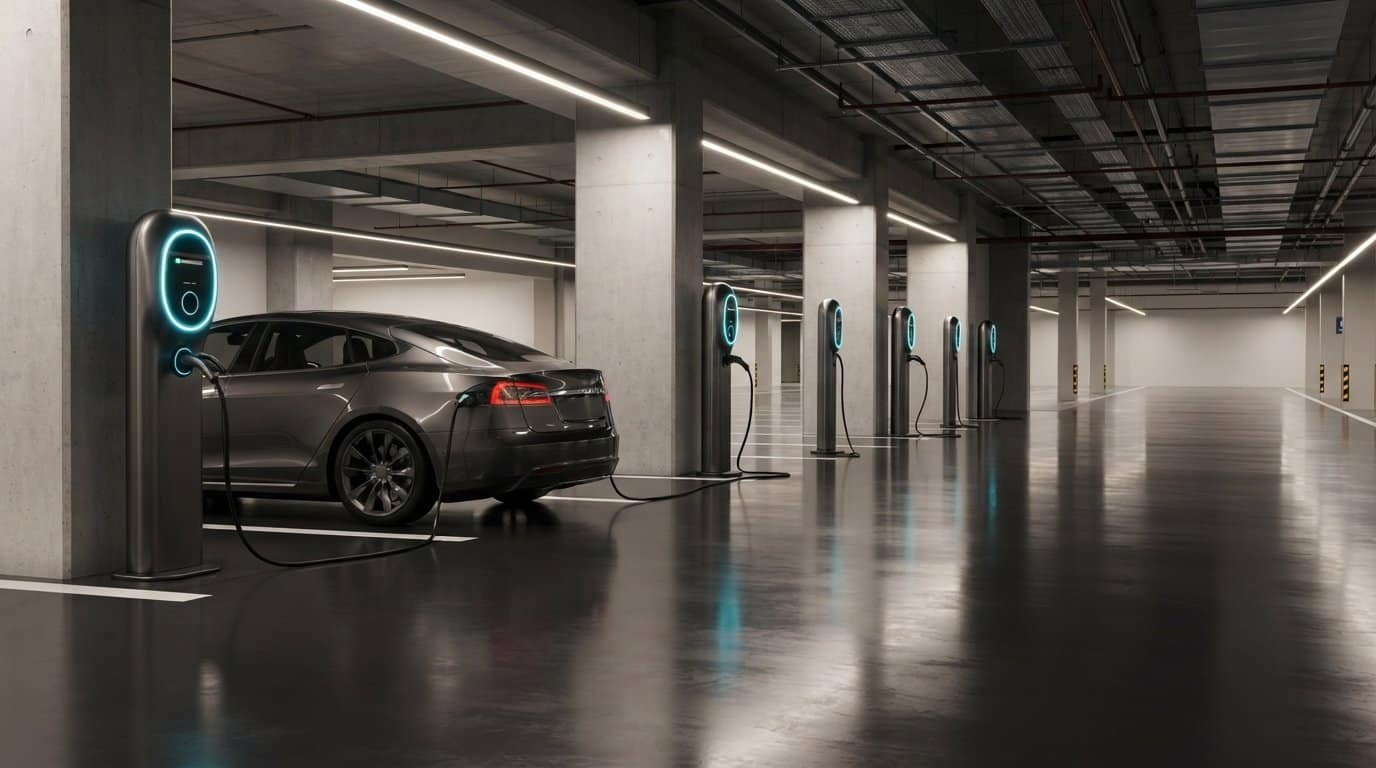
EV charging gives mall visitors a practical opportunity to charge while shopping, dining or using other facilities. Its commercial value depends on local demand, charger availability, parking arrangements and service reliability. Assess those factors alongside electrical capacity and operating costs before investing.
COPAK helps property teams assess equipment, electrical infrastructure and charging operations. This guide covers practical planning considerations; confirm the applicable DEWA licensing and technical requirements before procurement.
Key Takeaways
- Assess charging demand and measure actual utilisation, visitor feedback and business outcomes after launch.
- Confirm the applicable public-charging tariff, licensing route and building requirements for the particular site.
- Compare a dual charger with two single units using the complete installation scope; savings depend on the site.
- Confirm operator responsibilities, required licensing and charger-to-platform compatibility before launch.
The Business Case for EV Charging in UAE Shopping Malls
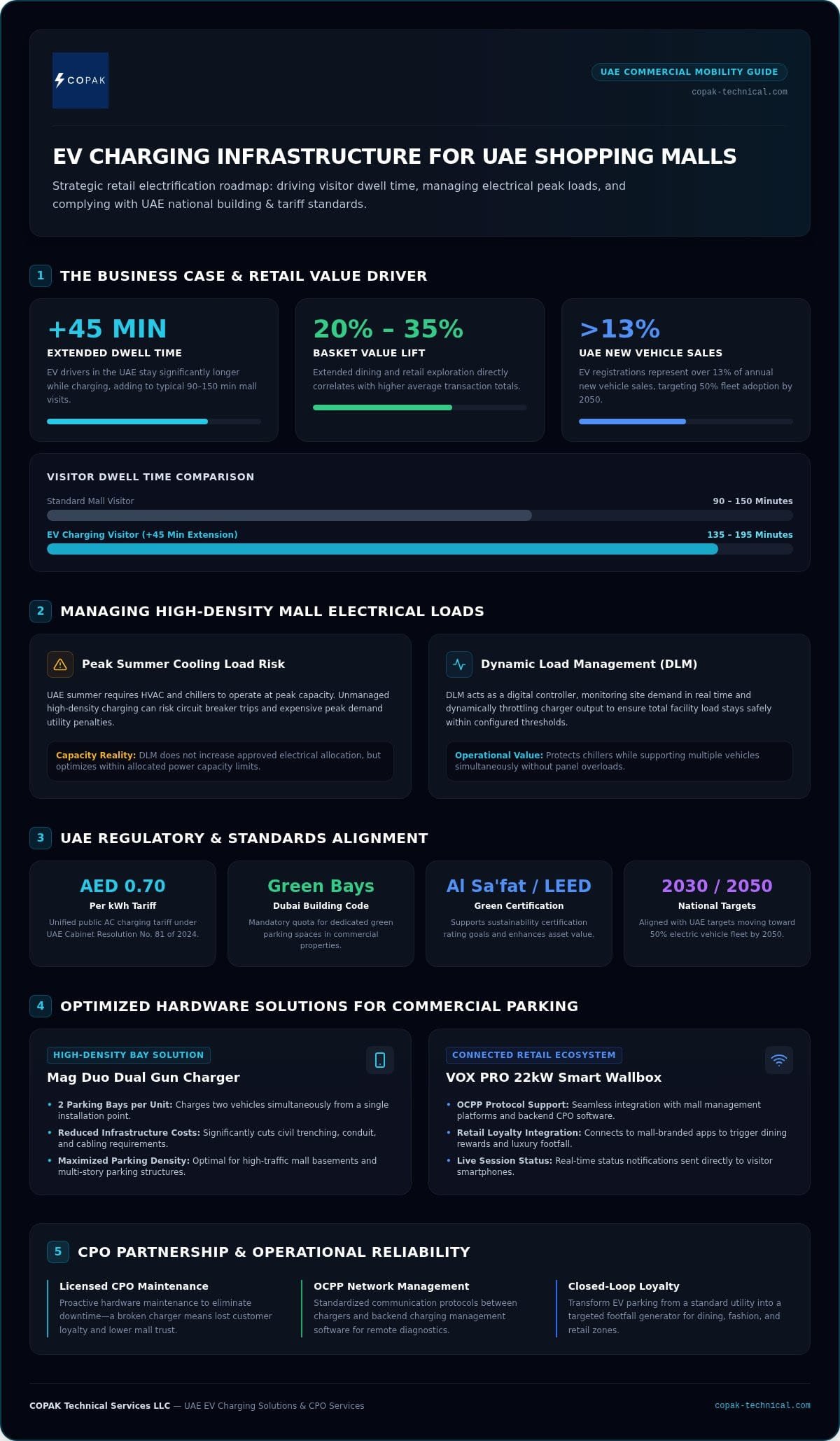
Charging can make a mall more convenient for EV drivers. Assess demand using relevant local information and observed visitor needs rather than assuming all EV owners form a high-spending demographic.
To better understand the daily economic dynamics and consumer habits of EV owners in the UAE, watch this helpful video:
Do not assume a fixed increase in shopping time or spending. Measure charging sessions, occupancy and customer feedback at the property. If retail outcomes form part of the investment case, collect evidence that distinguishes charging visitors from other customers.
Retail Loyalty and the Charging Connection
A supported charging platform may provide session information and customer notifications. Integration with a mall application requires technical confirmation. Any loyalty arrangement affecting charging prices must comply with the applicable rules.
Future-Proofing Commercial Property Value
Confirm the parking and infrastructure provisions applicable to the development with the project consultant and authority. A dual charger does not by itself establish compliance with a green-building rating or guarantee an increase in property value.
Selecting the Right Power Output
Select AC or DC charging power around expected parking duration, vehicle capabilities and available approved capacity. A 22kW AC point can serve compatible vehicles at lower power, but the vehicle’s onboard AC charger limits the actual rate. There is no single ideal charger rating for every mall.
Check ingress protection, impact resistance and temperature capability separately. DEWA’s AC equipment table specifies IP54/IK10, not a universal IP65 minimum. The electrical design must also provide suitable protection, isolation and earthing.
Operational Excellence: CPO Services and Smart Software
Successful implementation of EV charging for shopping malls Dubai involves far more than just the initial electrical installation. In high-traffic retail environments, the hardware is only one component of a larger ecosystem that requires active management. A Charge Point Operator (CPO) acts as the technical backbone of this system, ensuring that the infrastructure remains reliable, secure, and profitable. Without professional oversight, chargers can suffer from extended downtime, leading to visitor frustration and a direct negative impact on the mall’s reputation for convenience.
Preventative maintenance is a critical pillar of operational excellence. COPAK provides comprehensive support that includes scheduled physical inspections and real-time digital monitoring to identify potential faults before they affect a user. In a mall setting, where connectors and cables are handled by hundreds of different users weekly, wear and tear are inevitable. A proactive maintenance strategy reduces the risk of equipment failure and extends the lifespan of your investment.
OCPP and Management Connectivity
OCPP is an open communication protocol between chargers and management systems. It supports interoperability, but the protocol version, firmware and required functions must be checked with the intended backend. See the Open Charge Alliance’s overview.
This data is invaluable for optimizing the charging network. By monitoring usage patterns, operators can determine if certain parking zones require more chargers or if power distribution needs to be adjusted. Remote troubleshooting and firmware updates also become possible, allowing technical teams to resolve software glitches without needing to be physically present on-site. This level of connectivity ensures the mall can provide detailed reporting for sustainability audits and corporate social responsibility targets.
User Access and Payment Systems
Confirm the applicable charging tariff and operating conditions before launch. Display the price, VAT treatment and permitted additional charges clearly. Do not assume a platform’s discount or subscription features can lawfully be used for every project.
Where permitted overstay charges apply, explain the rate, grace period and conditions before the session starts. Use the operator’s verified terms rather than a generic fee estimate. Charging discounts and access subscriptions must also be checked against Dubai’s applicable public-charging rules.
Implementation Strategy for Commercial EV Infrastructure
Establishing a successful network for EV charging for shopping malls in Dubai requires a methodical implementation strategy that begins long before the first charger is mounted. A comprehensive site survey is the first critical step. This technical assessment identifies the closest electrical distribution board, evaluates available capacity, and determines the most efficient cable routes through complex multi-level parking structures. Designing with a modular mindset is essential for retail landlords. By installing oversized conduits and spare capacity during the initial phase, you ensure that future expansion can be handled with minimal disruption to mall operations as visitor demand grows.
Professional documentation is a non-negotiable requirement for commercial sites in the UAE. Every project must be supported by detailed Method Statements and Risk Assessments that align with the mall’s specific safety protocols. These documents provide building management and local authorities with a clear roadmap of the installation process, ensuring that all work is conducted without compromising the facility’s structural integrity or fire safety systems.
The Mall Installation Workflow
A structured workflow ensures that the transition to electric mobility is seamless for both the property manager and the visitor. The process typically follows three core stages:
- Stage 1: Infrastructure Preparation. Our engineers establish the electrical source and map out cable routes, often utilizing existing basement tray systems to minimize civil works.
- Stage 2: Regulatory Coordination. We manage the necessary work permits and insurance requirements with building management. This stage includes the submission of technical datasheets and electrical drawings for final approval.
- Stage 3: Commissioning. After professional connection, the network undergoes rigorous testing. This includes verifying communication with the CPO backend and ensuring all safety trip mechanisms are fully functional.
Compliance and Safety Standards
Outdoor equipment and mounting arrangements must suit the site and manufacturer’s instructions. Canopies can help shield direct sun and rain. An enclosure must preserve required ventilation, access and cable routing; it does not change the charger’s temperature rating or guarantee service life.
Have the complete electrical protection arrangement designed and tested for the selected charger and installation. Built-in leakage detection does not automatically replace external protective devices. Confirm the applicable requirements before commissioning.
Optimizing Hardware: VOX PRO and Mag Duo for Malls
Compare the documented specifications of the proposed models. VOX Pro has an official −30°C to +50°C operating rating; COPAK separately reports full rated performance in testing at +55°C. Verify supporting documentation and project suitability rather than promising that charging will never derate.
Select equipment for the actual environment and follow its maintenance instructions. IP ratings cover ingress and IK ratings cover impact; neither guarantees temperature performance or uninterrupted operation.
Mag Duo: The Dual-Charging Advantage
MAG Duo can serve two compatible vehicles from one enclosure. This may simplify placement between adjacent bays, but electrical capacity, protection and installation costs still depend on the design.
The current MAG Duo Cable specification lists a 304 stainless-steel body and up to 22kW per charging point. Full simultaneous output requires an adequate supply. Compare complete quotations rather than assuming that a dual unit halves trenching or conduit costs.
Tethered vs. Universal Solutions
Deciding between tethered cables and universal sockets involves balancing visitor convenience with long-term maintenance. Tethered models, such as the VOX PRO 22T, include an integrated 5-meter cable. This provides a seamless experience for visitors who don’t want to unpack their own cables from the trunk. For open-air mall parking lots, the use of pedestal stands allows for flexible placement without the need for nearby walls or pillars. These stands can be equipped with canopies to provide additional shade and protection from the elements.
A Type 2 socket charger uses a separate cable suited to the vehicle’s AC inlet. Physical fit alone does not establish compatibility. Universal describes the socket arrangement; it does not guarantee compatibility with every vehicle or remove the need to check cable ratings.
Securing Your Mall’s Future in the UAE EV Ecosystem
A useful mall charging service combines a suitable electrical design, compatible equipment, clear user access and reliable operational support. Monitor actual utilisation and service issues before expanding.
COPAK can help with equipment selection, installation and agreed operational support. Request a commercial site assessment to establish scope, costs and approval requirements.
Frequently Asked Questions
Do we need to upgrade the mall’s main transformer to install EV chargers?
An upgrade is not always required. A site assessment must confirm available approved capacity and the proposed charging demand. Any load rearrangement must be assessed and approved where required; it does not automatically eliminate connection or approval charges.
If the demand exceeds your allocation, you’ll need to apply for a load increase from the relevant utility.
How many EV charging points should a typical mall in Dubai provide?
There is no single bay count suitable for every mall. Check the requirements applicable to the development and assess demand, parking duration, approved electrical capacity and expansion plans. Do not confuse low-emission parking provisions with a universal quota of installed charging points.
Can we charge visitors for electricity, or must it be a free service?
Free and paid services have different operating arrangements. In Dubai, public charging requires the applicable CPO licence. Confirm the current tariff, metering and billing requirements before launch and identify who will operate the service.
What is the difference between AC and DC charging for shopping malls?
AC charging may suit visitors parked for longer periods. DC charging may suit shorter stops and vehicles able to use the available power. Compare expected use, vehicle capabilities, electrical capacity and complete installation and operating costs.
How long does a standard commercial EV charger installation take?
Timing depends on site readiness, equipment availability, civil and electrical works, permissions, metering and commissioning. Obtain a project-specific programme after the survey; mounting time alone is not the total project duration.
What happens if a non-electric vehicle parks in an EV charging bay?
Non-electric vehicles parking in charging bays, often called ICE-ing, can be managed through a mix of physical and digital solutions. Malls use distinct floor painting and signage to deter unauthorized parking. Additionally, smart CPO platforms can apply overstay or idle fees of approximately AED 0.50 per minute after a grace period. This encourages drivers to move their vehicles once charging is complete, ensuring that the bays remain available for those who actually need them.
Are COPAK chargers compatible with Tesla and European EV brands?
COPAK hardware is fully compatible with all major electric vehicle brands sold in the UAE. Our units, including the VOX PRO and Mag Duo, utilize the universal Type 2 (IEC 62196-2) standard, which is the official requirement for the region. This ensures a seamless connection for Tesla, Audi, BMW, Mercedes, and most other European or Asian EV models. We also provide various adapters to ensure that every visitor can charge their vehicle regardless of its origin.