

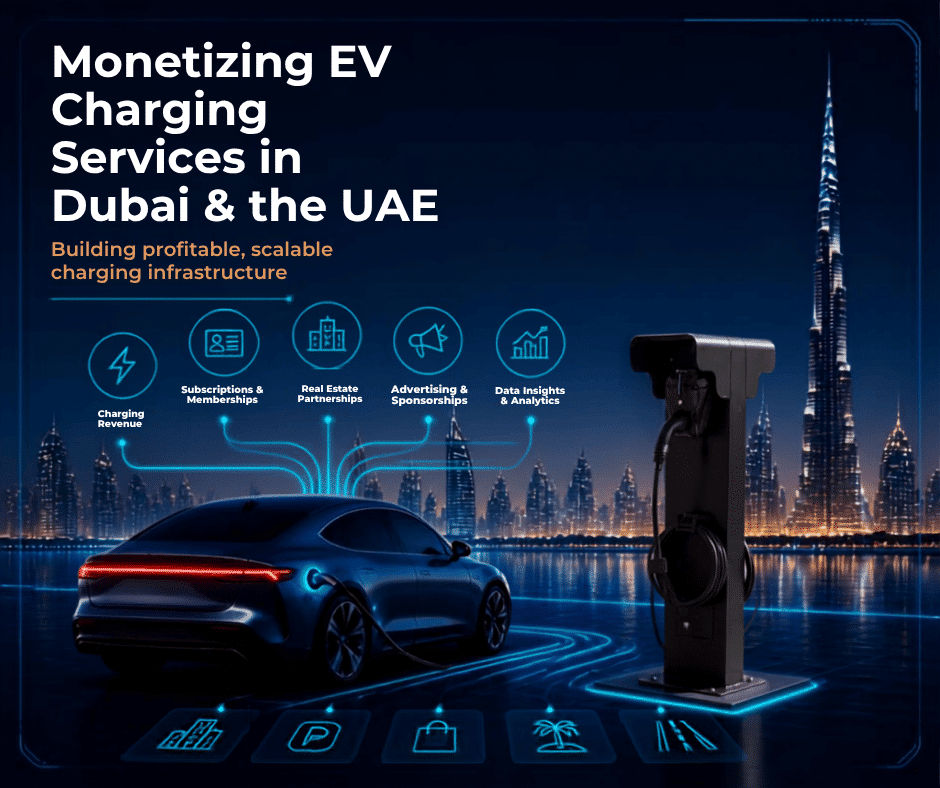
The UAE’s transition toward electric mobility is creating new opportunities for property owners, businesses, hotels, workplaces, residential developments, fleet operators, and parking operators to build professionally managed EV charging infrastructure.
For commercial property owners, EV charging can offer more than a convenient amenity. When planned correctly, charging infrastructure can support direct charging revenue, improve customer and tenant experience, provide useful energy-consumption data, and strengthen a property’s long-term readiness for electric mobility.
However, successfully monetizing EV charging stations in the UAE requires more than simply installing chargers and collecting payments. Businesses need to consider local regulations, electrical capacity, charger selection, payment infrastructure, Charge Point Operator (CPO) requirements, software integration, maintenance, and the charging behavior of their users.
At COPAK Technical Services LLC, we provide end-to-end EV charging solutions across the UAE, including commercial charger installation, electrical load assessment, smart charging, CPO/backend integration, Dynamic Load Management, maintenance, and support with applicable authority requirements.
This guide explains how businesses can monetize EV charging stations in the UAE while building a scalable, reliable, and professionally managed charging network.
Key Takeaways
- Paid EV charging in the UAE is governed by federal and emirate-specific requirements, so the applicable regulatory framework should be confirmed before collecting payments.
- In Dubai, operators of public charging equipment must comply with DEWA’s EV Charging Infrastructure Regulation and applicable CPO licensing requirements.
- A CPO or compatible charging-management platform can provide user authentication, charging-session management, billing integration, energy reporting, and remote monitoring.
- OCPP-compatible chargers provide greater flexibility when integrating chargers with third-party charging-management platforms.
- Dynamic Load Management can automatically adjust charger output according to available electrical capacity, helping prevent overloads and optimize power usage.
- The most profitable charging model depends on site type, customer behavior, charger utilization, electrical capacity, and operating costs.
Federal Cabinet Resolution No. 81 of 2024 established a unified EV recharge-service fee framework applicable to concerned federal, local, and private entities. In Dubai, DEWA’s current public-charging framework sets AC public charging at AED 0.70/kWh + VAT and DC public charging at AED 1.20/kWh + VAT.
Table of Contents
- The Business Case for EV Charging Infrastructure in the UAE
- Legal Framework and Monetization Models
- Essential Hardware and Software for Revenue-Generating Stations
- Maximizing ROI: Dynamic Load Management and Operational Efficiency
- Implementing a Managed Charging Solution with COPAK
- Frequently Asked Questions
The Business Case for EV Charging Infrastructure in the UAE
The UAE continues to expand its electric-mobility infrastructure, supported by national sustainability objectives and growing EV adoption.
Dubai alone had 47,944 EVs by the end of 2025, up from 37,486 a year earlier, while the number of charging points across Dubai exceeded 1,860, including DEWA stations and chargers operated by licensed private-sector participants.
For property owners and businesses, this creates an opportunity to move beyond complimentary charging and develop professionally managed charging services that can support commercial objectives.
Creating Value Beyond the Charging Transaction
EV charging can generate value in several ways.
A business may earn revenue directly from paid charging, but charging infrastructure can also support broader commercial objectives. Customers may spend time at a hotel, shopping center, restaurant, office, gym, or other destination while their vehicle charges.
Rather than relying on unsupported claims about exact increases in customer spending, it is better to view destination charging as part of the overall customer experience.
For businesses such as:
- shopping centers,
- hotels and resorts,
- commercial buildings,
- office developments,
- residential communities,
- hospitals,
- leisure destinations,
- fleet depots,
- and public parking operators,
EV charging can become an additional service that improves convenience while supporting future demand for electric mobility.
Attracting Tenants, Employees and Visitors
Modern commercial properties increasingly need to consider EV charging when planning parking infrastructure.
Corporate tenants may require charging for employees or fleet vehicles, while hotels and residential developments may need charging facilities for guests or residents.
Using equipment such as the Mag Duo Dual Gun Wall EV Charger can allow two vehicles to be served from a single charger enclosure, helping reduce the physical equipment footprint.
Actual simultaneous charging capacity, however, depends on the charger configuration and the electrical power available at the site.
EV charging infrastructure can also support corporate sustainability strategies and broader UAE decarbonization objectives.
Revenue Streams Beyond Charging
Charging revenue does not necessarily have to be the only commercial benefit.
Depending on the charging-management platform and site business model, businesses may also combine charging with:
- customer loyalty programs,
- tenant charging packages,
- employee charging programs,
- fleet charging,
- parking charges,
- promotional offers,
- membership programs,
- and digital or physical advertising near charging locations.
For example, charger pedestals or charging bays in prominent locations can also provide useful branding opportunities.
Legal Framework and Monetization Models for UAE Businesses
This is one of the most important parts of any paid EV charging project.
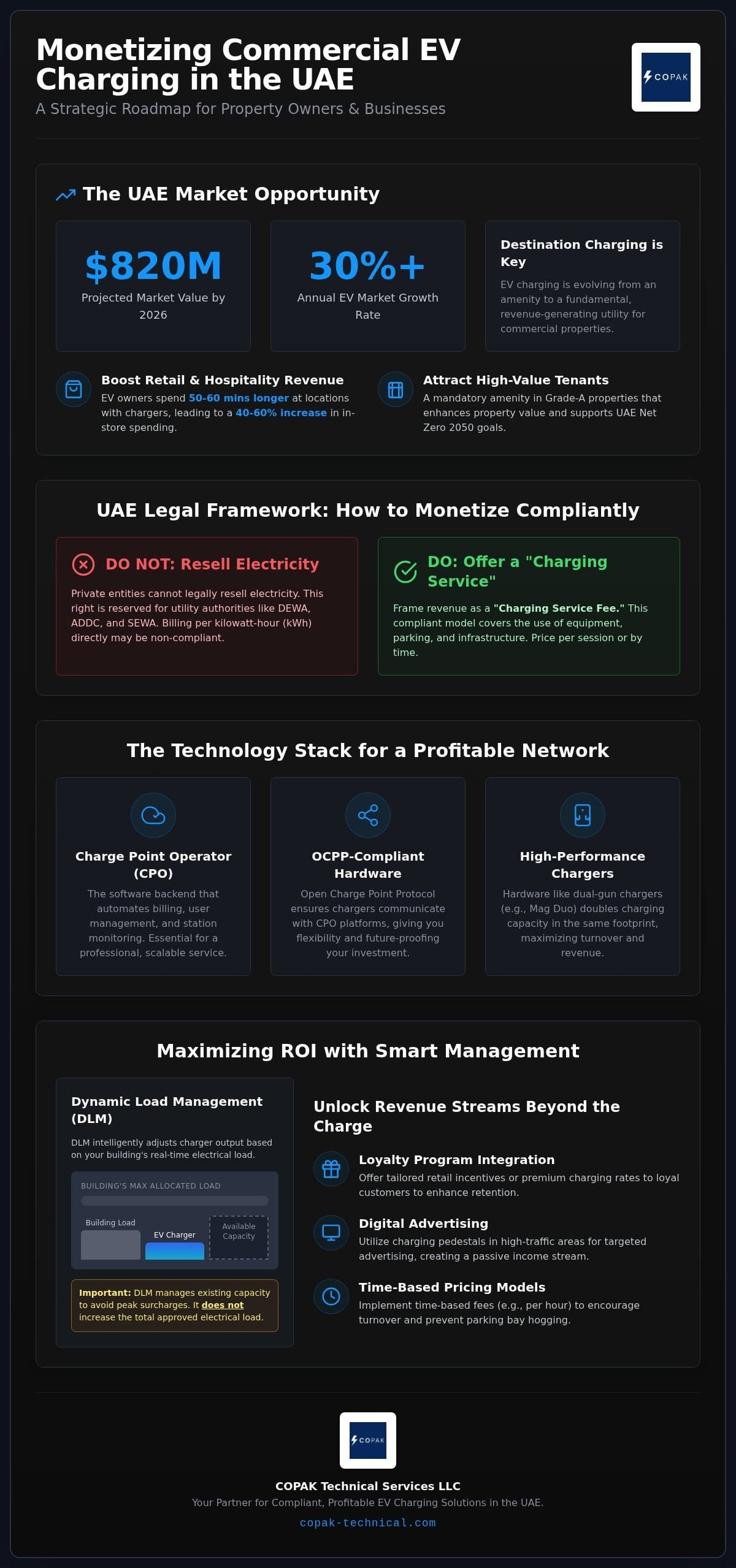
Paid charging in the UAE should not be approached simply as an informal resale of electricity. The country now has a formal framework governing EV recharge services.
Cabinet Resolution No. 81 of 2024 applies to federal, local, and private entities concerned with providing EV recharge services and introduced a unified charging-fee framework.
Individual Emirates can also impose additional technical, licensing, connection, and operating requirements.
Paid EV Charging in Dubai
Dubai has a dedicated regulatory and licensing framework for public EV charging infrastructure.
Independent Charge Point Operators operating public charging equipment must hold a valid CPO licence and comply with DEWA’s EV Charging Infrastructure Regulation and Technical Regulations.
DEWA currently distinguishes between CPO licences for:
- public charging provided free to users; and
- public charging where payments are collected from users.
DEWA states that collecting payments for public charging infrastructure without the applicable CPO licence is prohibited.
Businesses planning paid charging should therefore determine whether their proposed charging facility falls within the applicable public-charging framework and whether they need their own licence or should operate through an appropriately licensed CPO.
Current Public Charging Fees in Dubai
DEWA’s current framework lists:
AC public charging: AED 0.70/kWh + VAT
DC public charging: AED 1.20/kWh + VAT
These rates are aligned with Cabinet Resolution No. 81 of 2024 and may be amended in the future.
Because charging regulations can differ between Emirates and may change over time, commercial charging projects should be reviewed according to the authority and location applicable to the site.
What Does a Charge Point Operator Do?
A Charge Point Operator manages some or all of the operational infrastructure behind a charging network.
Depending on the platform and commercial arrangement, CPO services may include:
- charger monitoring,
- charging-session management,
- user authentication,
- payment integration,
- tariff configuration,
- energy-consumption reporting,
- RFID management,
- remote diagnostics,
- charger availability monitoring,
- transaction reporting,
- and network administration.
For COPAK projects, the exact operating and licensing structure should be established according to the project location and applicable regulatory requirements.
Internal link:
Link “Charge Point Operator services” to your dedicated CPO Services page rather than the general Resources & Support page.
Pay-Per-Use Charging
Pay-per-use charging is commonly suitable for locations where drivers do not necessarily have an ongoing relationship with the property.
Examples include:
- malls,
- hotels,
- visitor parking,
- public parking areas,
- leisure destinations,
- restaurants,
- and mixed-use developments.
Users can authenticate through a compatible mobile application, RFID card, QR-code workflow, or other supported mechanism.
The applicable charging tariff and payment structure must comply with the relevant regulatory framework.
Subscription and Membership Models
Charging subscriptions can be useful where users return regularly.
Examples include:
- residential communities,
- corporate offices,
- fleet operators,
- staff parking,
- hotel membership programs,
- and managed parking facilities.
Depending on the applicable charging regulations and backend capabilities, a business may structure user access around memberships, account groups, fleet accounts, or other managed charging arrangements.
Any tariff or discount arrangement must remain compliant with applicable local and federal requirements.
Essential Hardware and Software for Revenue-Generating EV Charging Stations
A successful paid charging operation requires hardware and software that can work together reliably.
OCPP Compatibility
For commercial charging networks, Open Charge Point Protocol (OCPP) compatibility is strongly recommended.
OCPP allows compatible EV chargers to communicate with a Charge Point Management System or CPO backend.
This can enable functions such as:
- remote charger monitoring,
- session management,
- energy reporting,
- user authentication,
- tariff configuration,
- fault monitoring,
- and integration with compatible third-party charging platforms.
OCPP does not itself process payments. Instead, it enables communication between the charger and backend system, while the charging platform and its payment infrastructure manage transactions.
Using OCPP-compatible equipment can also reduce dependence on a single proprietary charging ecosystem.
Choosing Charger Power
The ideal charging power depends heavily on how long vehicles normally remain parked.
For example:
7kW AC chargers can be suitable for long-stay locations where vehicles remain parked for several hours.
11kW or 22kW AC chargers are commonly considered for commercial destination-charging applications where faster AC charging is desirable.
A 22kW charger can provide up to approximately 22kW AC to compatible vehicles, but the actual charging rate depends on the vehicle’s onboard AC charger.
You can internally link this section to:
The Ultimate Guide to 22kW EV Chargers in Dubai and the UAE
High-turnover locations may also require DC fast charging, depending on dwell time, electrical infrastructure, budget, expected utilization, and business objectives.
Environmental Protection and Installation Conditions
EV charging equipment in the UAE may be exposed to heat, dust, humidity, sunlight, and outdoor conditions.
The correct environmental and impact-protection rating should therefore be selected according to the installation location and applicable authority requirements.
Avoid stating that all commercial UAE chargers must be IP65.
For example, the VOX PRO uses its own specified enclosure and impact-protection ratings and should be represented according to its actual technical datasheet rather than a generic IP requirement.
Commercial Hardware Solutions from COPAK
For commercial locations requiring two charging points from one enclosure, the Mag Duo Dual Gun Wall EV Charger can serve two vehicles from a single unit.
This can help reduce the physical equipment footprint and simplify the layout of certain multi-bay installations.
Actual charging output and simultaneous load depend on the unit configuration and available electrical capacity.
For single-point smart charging applications, the VOX PRO Smart EV Charger provides up to 22kW AC charging, smart connectivity and OCPP compatibility.
These chargers can be integrated into compatible charging-management platforms where required.
Connectivity and Backend Management
Commercial EV chargers need reliable communication with their backend platform.
Depending on the charger and site, connectivity may be provided through:
- Ethernet,
- Wi-Fi,
- 4G/LTE,
- or another compatible communication method.
A connected charging-management platform can allow operators to monitor:
- energy consumption,
- charging sessions,
- charger status,
- user activity,
- revenue information,
- faults,
- and charger availability.
RFID authentication may also be used for employees, residents, fleets or other registered users.
Maximizing ROI: Dynamic Load Management and Operational Efficiency
Installing several EV chargers can significantly increase a property’s electrical demand.
This is where Dynamic Load Management (DLM) becomes valuable.
DLM monitors available electrical capacity and automatically adjusts compatible charger output according to the load being used by the rest of the property.
Instead of allowing every charger to draw maximum power simultaneously, the system distributes available capacity intelligently.
Benefits of Dynamic Load Management
DLM can help:
- prevent electrical overload,
- reduce the risk of nuisance tripping,
- make better use of existing available capacity,
- support multiple chargers,
- reduce unnecessary simultaneous peak loading,
- and potentially reduce or defer some infrastructure upgrades where technically appropriate.
DLM does not increase the building’s total electrical capacity.
A site must still have sufficient allocated power and an electrical design suitable for the proposed charging infrastructure.
Can DLM Reduce Initial Project Cost?
Potentially.
Without load management, installing multiple high-power chargers may require upgrades such as:
- larger feeders,
- switchgear upgrades,
- transformer upgrades,
- increased utility allocation,
- or additional electrical infrastructure.
A properly designed DLM system may allow the available capacity to be distributed more efficiently.
However, whether upgrades can actually be avoided depends on the site's electrical calculations and utility requirements.
DLM should therefore be treated as an engineering solution, not as a guaranteed alternative to electrical upgrades.
Optimizing Power Distribution
A well-configured DLM system can monitor the site’s electrical demand in real time.
When the building is using less electricity, additional power can be made available to EV charging.
When demand increases elsewhere in the property, compatible chargers can automatically reduce their charging output.
Some charging-management platforms can also apply charging priorities according to operating rules or user groups.
For example, a fleet operator could prioritize vehicles that need to leave first, while a workplace may distribute available power across employee vehicles during the working day.
Maintenance and Technical Support
Availability is essential for any charging network that generates revenue.
A charger that is offline cannot serve customers and may reduce confidence in the charging service.
A professional maintenance program may include:
- visual inspections,
- electrical testing,
- charger diagnostics,
- communication checks,
- connector inspection,
- firmware updates,
- backend monitoring,
- fault investigation,
- and preventive maintenance.
COPAK provides EV charging maintenance and technical support for commercial charging infrastructure across the UAE.
Regular maintenance is particularly important for high-utilization sites where charger availability directly affects the user experience and potential revenue.
Implementing a Managed Charging Solution with COPAK
A commercial EV charging network should begin with proper planning rather than simply selecting chargers.
At COPAK Technical Services LLC, a project can begin with a site survey and electrical load assessment to determine:
- available electrical capacity,
- charger locations,
- cable routes,
- parking layout,
- expected usage,
- required charger quantities,
- charging power,
- backend requirements,
- and applicable approvals.
Step 1 — Site and Electrical Assessment
The existing electrical infrastructure is reviewed to determine whether the proposed chargers can be supported safely.
This may include assessment of:
- the main electrical panel,
- spare capacity,
- cable routes,
- distribution equipment,
- earthing,
- protection,
- parking configuration,
- and possible future expansion.
Step 2 — Define the Charging Business Model
Before selecting the backend platform, the property owner should decide who will use the chargers.
Typical user groups include:
- visitors,
- hotel guests,
- residents,
- employees,
- fleets,
- tenants,
- or the general public.
The expected users influence the most appropriate charging and access model.
Step 3 — Select Appropriate EV Chargers
Charger selection should consider:
- required output power,
- number of parking bays,
- expected dwell time,
- vehicle compatibility,
- environmental conditions,
- OCPP compatibility,
- user authentication,
- mounting method,
- and expansion requirements.
COPAK can supply both single-output and dual-output smart charging equipment depending on the project.
Step 4 — Regulatory and Authority Requirements
The applicable regulatory route depends on the location and type of charging facility.
For Dubai projects involving public EV charging, DEWA’s EV Charging Infrastructure Regulation and CPO licensing requirements should be considered. DEWA requires independent CPOs operating public charging infrastructure to hold the appropriate licence.
Other Emirates may have different requirements through their respective utilities and regulatory authorities.
COPAK can support the technical and project documentation required for the installation and coordinate applicable approvals within the scope of the project.
Step 5 — Installation and Commissioning
Following the necessary approvals, the charging infrastructure can be installed, tested and commissioned.
This can include:
- EV chargers,
- electrical protection,
- distribution equipment,
- cabling,
- pedestals,
- signage,
- networking,
- metering,
- communication equipment,
- and load-management hardware.
Step 6 — Charging Management and Backend Integration
Compatible chargers can then be connected to a suitable CPO or charging-management platform.
Depending on the selected platform, this can provide:
- user authentication,
- remote monitoring,
- energy reporting,
- charging history,
- tariff management,
- transaction reporting,
- and payment integration.
Where a licensed CPO is required, the operating arrangement should be structured accordingly.
Step 7 — Maintenance and Ongoing Support
Once the charging network is operational, continued monitoring and preventive maintenance help maintain reliability.
A charging network should be viewed as long-term operating infrastructure rather than a one-time installation.
Partnering With COPAK for Commercial EV Charging
Different businesses require different charging strategies.
A hotel may need overnight guest charging.
A shopping center may prioritize destination charging and visitor convenience.
A residential development may require individual user identification and consumption reporting.
A corporate facility may require employee and fleet charging.
A public charging location may require a full payment and CPO arrangement.
COPAK provides commercial EV charging solutions tailored to the property, electrical infrastructure, users and regulatory environment.
Our services can include:
- consultation,
- site assessment,
- charger selection,
- electrical design,
- authority coordination,
- charger supply,
- installation,
- commissioning,
- Dynamic Load Management,
- CPO/backend integration,
- payment-platform integration,
- monitoring,
- maintenance,
- and technical support.
Securing Your Position in the UAE’s Electric Future
EV charging is becoming an increasingly important part of commercial and residential infrastructure across the UAE.
For businesses, the opportunity is not simply to install chargers, but to create a reliable charging service that fits the property’s users, available electrical capacity, commercial objectives, and regulatory requirements.
Successful monetization depends on the combination of:
**the correct regulatory structure,
the right charging hardware,
reliable software and connectivity,
appropriate electrical design,
effective load management,
and ongoing technical support.**
With a properly designed solution, parking infrastructure can evolve into a professionally managed EV charging asset.
COPAK Technical Services LLC provides complete EV charging solutions across the UAE, from initial feasibility and electrical assessment through installation, commissioning, charging-management integration, maintenance and ongoing technical support.
Contact COPAK Technical Services LLC to discuss a commercial EV charging or monetization project.
Frequently Asked Questions
Is it legal to charge EV drivers for using charging stations in the UAE?
Yes, paid EV charging is permitted within the applicable regulatory framework. Cabinet Resolution No. 81 of 2024 introduced a unified framework for EV recharge service fees that applies to concerned federal, local and private entities. Individual Emirates may also impose additional licensing and operational requirements. In Dubai, public charging operators must comply with DEWA's EV Charging Infrastructure Regulation and applicable CPO licensing requirements.
What is a Charge Point Operator (CPO)?
A Charge Point Operator manages the operational infrastructure behind an EV charging network. Depending on the arrangement, this can include charger monitoring, user authentication, charging-session management, payment integration, tariff configuration, reporting and remote diagnostics.
Whether a particular project requires a licensed CPO depends on the applicable regulatory framework. In Dubai, independent operators of public EV charging equipment must hold the appropriate DEWA CPO licence.
Can I install 22kW chargers in my existing office parking area?
Yes, provided the electrical infrastructure can support the additional demand and the installation complies with applicable requirements.
A professional load assessment should determine available electrical capacity before installation. If capacity is limited, Dynamic Load Management may be used to distribute available power between compatible chargers and other building loads.
What is OCPP and why is it important for commercial EV charging?
Open Charge Point Protocol is a communication protocol that enables compatible EV chargers to communicate with charging-management systems.
OCPP can support functions such as remote monitoring, user authentication, charging-session management, energy reporting and integration with compatible third-party platforms.
For businesses, it can provide greater flexibility and reduce dependence on a single proprietary charger-management ecosystem.
Does Dynamic Load Management increase my building's electrical capacity?
No.
Dynamic Load Management does not create additional electrical capacity. It distributes the electrical capacity already available at the property.
When building demand increases, charger output can be reduced automatically. When more electrical capacity becomes available, compatible chargers may be allowed to draw additional power.
Can Dynamic Load Management help avoid an electrical upgrade?
Sometimes, but not always.
DLM can improve the utilization of existing electrical capacity and may reduce the need for certain infrastructure upgrades in some projects.
However, this depends on the site's available load, proposed charger quantity, required charging power and applicable electrical-design requirements.
A professional load assessment is required before making that determination.
How do EV drivers pay for charging?
Payment depends on the charging-management platform and regulatory arrangement.
Depending on the system, users may authenticate using a mobile application, RFID card, QR-code workflow or another supported method.
The backend platform can then record the charging session, calculate applicable charges and integrate with compatible payment services.
What are the DEWA requirements for commercial EV charging in Dubai?
DEWA regulates both public and private EV charging infrastructure in Dubai.
Independent CPOs operating public charging equipment must hold a valid DEWA CPO licence and obtain required approvals for deployment and connection. Public charging is also subject to DEWA's EV Charging Infrastructure Regulation and Technical Regulations.
The precise requirements depend on the nature of the project, so the regulatory classification should be confirmed before installation and operation.
What are the current public EV charging fees in Dubai?
Under DEWA's current framework:
AC public charging: AED 0.70/kWh + VAT
DC public charging: AED 1.20/kWh + VAT
These rates are based on the federal unified EV charging framework and may be amended in the future.
How long does it take to recover the investment in an EV charging station?
There is no universal ROI period.
Return on investment depends on factors such as:
- charger utilization,
- charging tariff,
- electrical cost,
- charger and installation cost,
- CPO/backend fees,
- maintenance,
- parking model,
- charger availability,
- financing,
- and indirect commercial benefits.
For this reason, ROI should be calculated using the actual site assumptions rather than a generic industry figure.
Can COPAK help establish a paid EV charging solution?
Yes. COPAK can provide the technical infrastructure required for a managed commercial charging solution, including site assessment, electrical design, EV charger supply, installation, commissioning, Dynamic Load Management, compatible backend/CPO integration and ongoing technical support.
Where licensing or a licensed CPO is required, the project structure must comply with the applicable authority requirements.