
COPAK FIELD NOTES · TOWN SQUARE, DUBAI
A 40 A supply.
A smarter way to charge.
A Tesla, a private villa and changing household demand. See how VOX Pro with Dynamic Load Management adjusts three-phase charging in a real home.
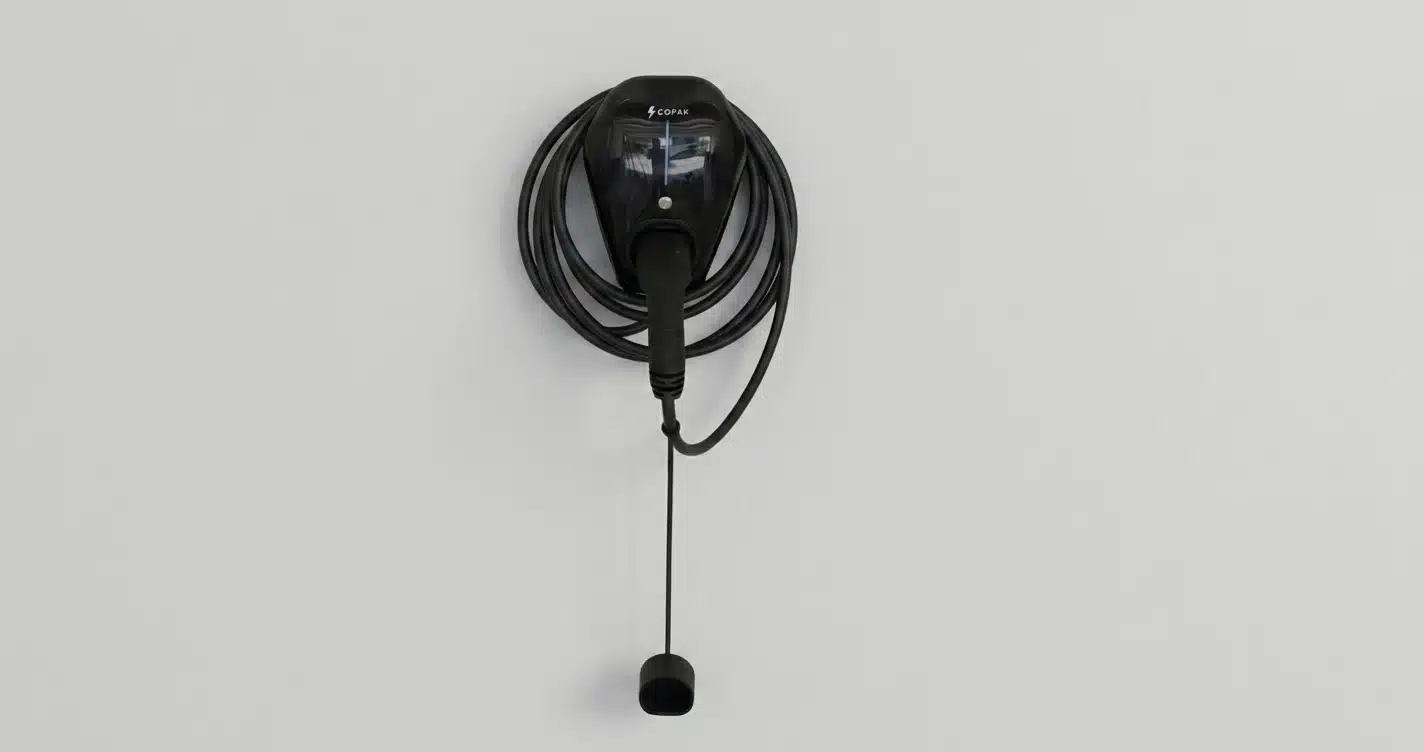
MAIN SUPPLY40 A
Per phase · three-phase supply
DLM LIMIT34 A
Home + EV · per phase
SAFETY BUFFER6 A
Per phase · project setting
Can a home charge an EV while also running its household appliances, when spare electrical capacity is limited? At this customer’s villa in Town Square, Dubai, COPAK demonstrated how VOX Pro with Dynamic Load Management responds to that challenge.
The Tesla charged at 16 A per phase across three phases. When household demand increased, charging reduced to 10 A per phase. The vehicle display showed approximately 11 kW → 7 kW.
REAL HOME · REAL DEMONSTRATION
Watch the Tesla Charging Demonstration
Watch the demonstration on YouTubeThe booster pump is switched on during the demonstration. Other household loads may also have been operating, so the change in charging power is not a measurement of the pump’s consumption alone.01 / THE CHALLENGE
Why Did This Villa Need Managed Charging?
The Tesla and household appliances draw from the same electrical supply. A charging session that fits within the available capacity at one moment may need to reduce when household demand rises.
The villa’s 40 A three-phase main breaker must be considered on a per-phase basis. Household demand can differ between phases, so the assessment cannot rely only on total kilowatts or an assumed equal split.
The demonstration uses three-phase Tesla charging at 16 A per phase. The task was to let that charging respond to the home’s demand while working within the configured 34 A per-phase running-load limit.
A home EV charger installation assessment should establish the available capacity, phase arrangement, cable route, protection and vehicle requirements before equipment is selected.
02 / THE SOLUTION
What Does the 34 A DLM Setting Mean?
COPAK used the VOX Pro Cable charger with compatible DLM monitoring equipment. The system uses household-load information to adjust the current available for EV charging.
PER-PHASE PROJECT SETTING40 A − 6 A = 34 A
Main-breaker rating − safety buffer = maximum running-load setting
The 34 A setting covers household demand plus EV charging on each phase.
It does not mean the Tesla draws 34 A. In the demonstration, the Tesla initially draws 16 A per phase. The available charging allowance falls when household demand increases.
For each phase, the remaining allowance can be understood as 34 A minus household current on that phase. Three-phase charging must respect the available capacity on all supplying phases; spare capacity on one phase does not cancel excessive demand on another. The vehicle, circuit and charger limits also apply.
Why retain a 6 A safety buffer?
The 6 A buffer is the project-specific margin selected below the 40 A main-breaker rating. It is not a universal setting for every home or a guarantee against every transient load. Monitoring response, protective devices and commissioning checks remain important.
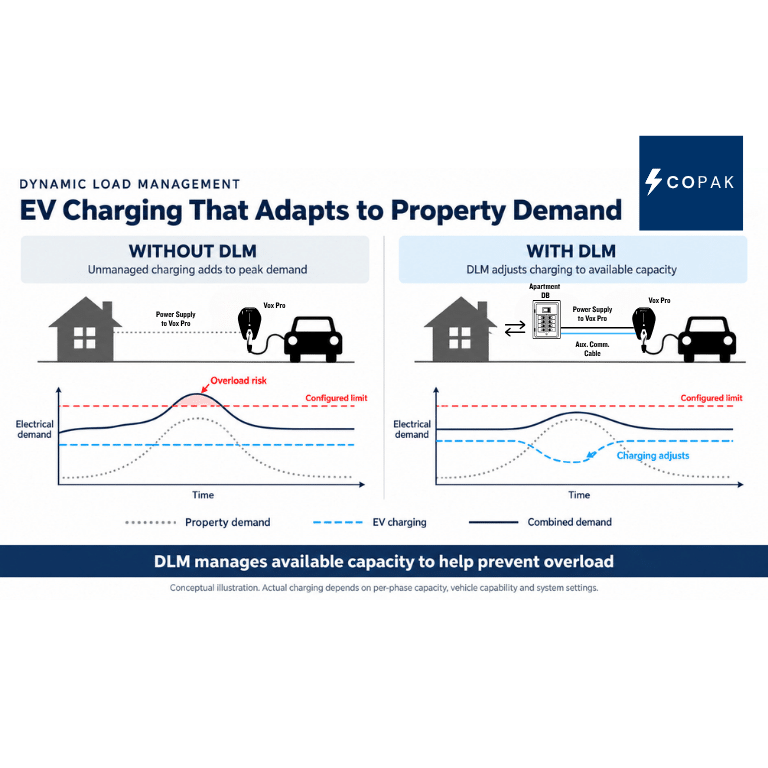
DLM manages the EV charger’s contribution to demand. It does not replace suitable wiring or electrical protection.
03 / THE DEMONSTRATED RESULT
How Did Charging Change from 16 A to 10 A?
Before household demand increased
Tesla charging
The available capacity supports the demonstrated charging rate.
With increased household demand
Charging adjusts
DLM reduces the EV charging allowance as the home needs more current.
Same DLM setting
Combined-load limit
The charging rate changes; the configured limit remains the same.
Why is 10 A approximately 7 kW here?
These current readings apply to each of three phases. As an illustrative calculation at 230 V phase-to-neutral and a power factor close to one: 3 × 230 V × 16 A ≈ 11.04 kW, and 3 × 230 V × 10 A ≈ 6.90 kW.
230 V is an assumed value for explaining the calculation, not a reported voltage measurement from the test. Actual voltage, power factor and display rounding affect the reading. These three-phase figures should not be interpreted using a single-phase calculation.
What can we conclude from the demonstration?
Charging continues at a reduced rate when household demand rises. The demonstration illustrates the benefit of automatic adjustment rather than leaving the charger at a fixed current regardless of household use.
We have not inferred exact household current on each phase from the charging display. The change does not establish the booster pump’s consumption in isolation.
If available capacity falls further, charging may need to pause. Pause, restart and monitoring-loss behaviour should be checked during commissioning. Reducing EV charging cannot solve an overload caused by household appliances alone.
04 / THE CUSTOMER OUTCOME
What Does This Mean for Everyday Charging?
The demonstration shows a practical response to limited capacity: the vehicle continues charging at a lower rate while the home uses more electricity.
01
Use available capacity
Charging can use more of the available allowance when household demand is lower.
02
Reduce manual adjustment
The system adjusts the charging allowance in response to monitored demand.
03
Match the property and vehicle
The setup must respect the home’s supply, each phase’s demand and the vehicle’s charging capability.
A charger’s advertised maximum output is not a promise of that charging rate for every vehicle. This Tesla demonstration starts at approximately 11 kW and reduces to approximately 7 kW.
IN THE CUSTOMER’S OWN WORDS
What Did Our Customer Say?
Karam Hajjar
★★★★★ · Google review
We used Copak to install a home Vox Pro charger with a Dynamic Load Management system which was quite difficult to find but the company was able to provide a unique a tailored solution to our requirements.
The team was very helpful and responsive and highly technically capable. We have strict requirements given our household electrical load and Copak was ideal for our requirements. I highly recommend speaking with the team and understanding how the Dynamic Load Management can help your charging.
As a quick snapshot, our car used to take 12 hours to charge and with the Dynamic Load Management system it takes around 5 hours to charge from 20% to 90%.
Review reproduced in full, without changes, with the customer’s permission. The charging times are the customer’s reported experience; they are not a controlled before-and-after test or a guaranteed charging time for other vehicles and properties.
Thank You, Karam
We sincerely thank Karam Hajjar for his cooperation throughout the installation and for kindly welcoming us into his home to film this demonstration. His willingness to share his experience helps other EV owners and building management teams understand how managed home charging can work in practice.
The video was filmed at his home with his permission, and his Google review is shared here with his consent.
05 / PLANNING YOUR COST
How Should You Budget for a DLM Installation?
Ask for an itemised quotation covering charger supply, compatible DLM equipment, monitoring and communication wiring, electrical installation and commissioning.
The correct DLM configuration depends on the charging arrangement and the phases that must be monitored. A project price should be confirmed against the actual scope.
Explore COPAK’s DLM options for compatible VOX Pro and MAG Duo chargers, or use the installation cost calculator as an initial planning tool. Apartment installations require a site survey and separate quotation.
06 / VILLAS AND APARTMENTS
Could This Approach Work at Your Home?
For villa owners, managed charging may help accommodate an EV alongside changing household demand. For apartment residents and building managers, it can form part of a properly assessed private charging proposal where spare capacity is a concern.
What should the assessment cover?
- Vehicle connector and AC charging capability.
- Main supply and breaker ratings.
- Existing demand and available capacity on each phase.
- Single-phase or three-phase charging arrangement.
- Cable route, circuit capacity and electrical protection.
- Compatible monitoring equipment and communication wiring.
- DLM limits, operating margin and commissioning checks.
- Building permissions and installation requirements.
DLM does not increase the approved supply capacity or automatically secure building-management permission. Each installation needs its own assessment; this villa’s settings should not simply be copied to another property.
Use the COPAK EV Charger Selector to explore equipment for your vehicle, then confirm suitability for the property.
07 / YOUR QUESTIONS
Frequently Asked Questions
Is 34 A the Tesla’s charging current?
No. It is the configured maximum running-load limit for household demand plus EV charging on each phase. The Tesla charges at 16 A per phase initially, reducing to 10 A per phase during the demonstration.
Are 16 A and 10 A totals across all three phases?
No. They are per-phase charging currents. The vehicle uses three-phase AC charging, producing approximately 11 kW and 7 kW respectively in the demonstration.
Why was the limit set to 34 A?
COPAK retained a 6 A safety buffer below the 40 A main-breaker rating: 40 A − 6 A = 34 A per phase. This is a project-specific setting.
Does DLM switch off household appliances?
The demonstrated system adjusts EV charging in response to household demand. It does not switch off the household appliances.
Will my vehicle always charge at 11 kW?
No. Charging depends on the vehicle, supply and available capacity. The demonstration itself shows charging reducing when household demand rises.
Can DLM help with private apartment charging?
It may be suitable where the electrical arrangement, monitoring and permissions allow. A site assessment and coordination with building management are required.
08 / THE NEXT STEP
How Can You Plan a Similar Home Charging Solution?
The Town Square customer’s challenge began with a simple concern: could his home support the charging he wanted?
The answer came from examining the electrical supply, understanding the car’s requirements and allowing charging to respond to household demand.
For COPAK, this first successful customer DLM implementation provided a practical example of what carefully configured load management can achieve: more charging when capacity is available, and a reduced charging allowance when the home needs more.
MAKE YOUR HOME CHARGING PLAN
Not sure how much capacity is available?
Share your vehicle model, property type and available electrical information. COPAK can assess whether compatible DLM suits your home.
Final suitability and scope are subject to assessment. Apartment installations require a site survey and separate quotation.