

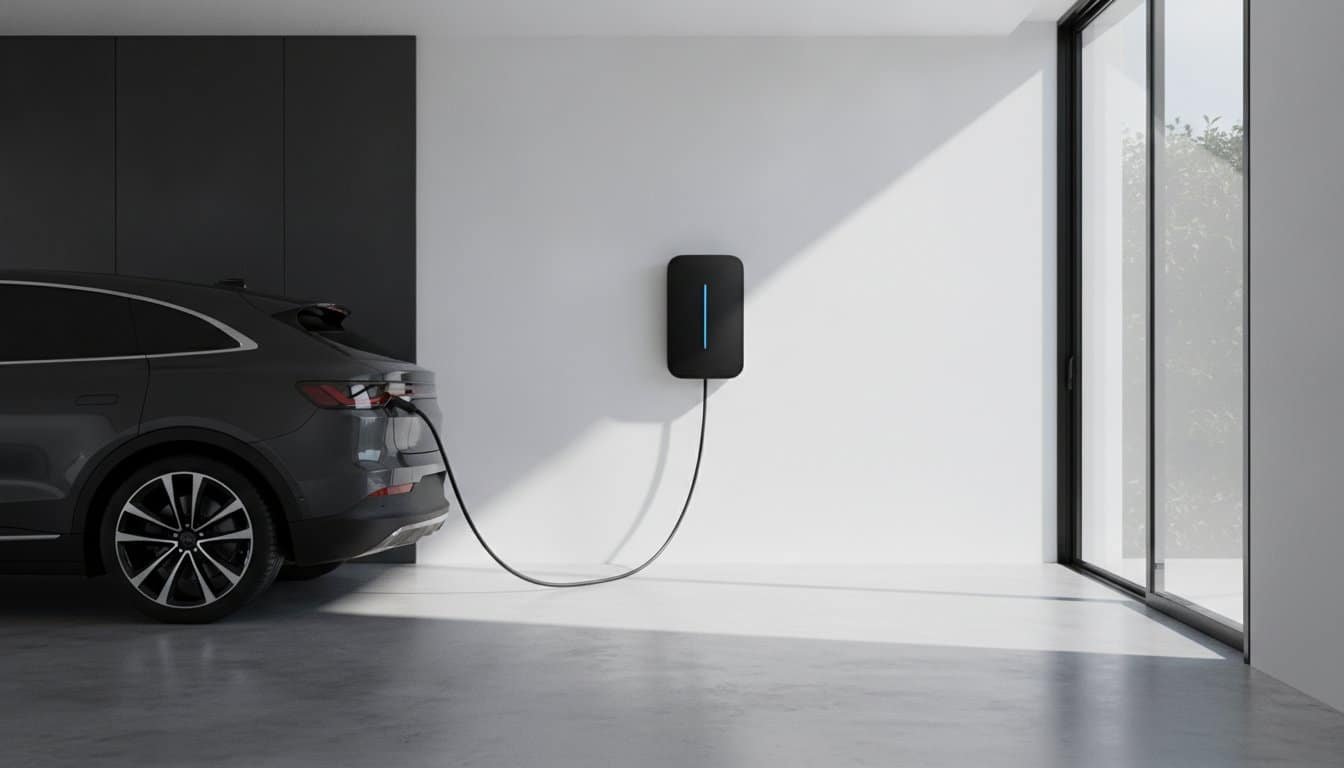
A modern home EV charger can do much more than simply supply electricity to your vehicle. Smart EV charging allows homeowners to monitor charging sessions, control charger access, manage energy consumption and, with compatible equipment, automatically adjust charging power according to the electrical load of the property.
For UAE homeowners, however, smart charging should begin with the fundamentals: a properly designed electrical installation, sufficient allocated load, appropriate protection and a charger suitable for the local environment.
Features such as OCPP connectivity, mobile applications and Dynamic Load Management can then add intelligence and flexibility to that foundation.
This guide explains how smart home EV charging works, how technologies such as OCPP and Dynamic Load Management fit into a residential installation, and what UAE homeowners should consider when selecting and installing a smart EV charger.
For homeowners planning a new charger installation, our complete guide to home EV charger installation explains the installation process for villas, townhouses and apartments in greater detail.
Key Takeaways
- Smart EV charging combines the physical EV charging installation with connectivity, monitoring and energy-management features.
- OCPP can allow compatible chargers to communicate with third-party charging-management platforms.
- Dynamic Load Management requires additional compatible components to monitor the active electrical load of the property and dynamically control charger output.
- Dynamic Load Management does not replace the requirement for proper electrical load allocation or authority compliance.
- DLM becomes particularly useful where available electrical capacity is limited or where multiple EV chargers need to operate simultaneously.
- Home EV charging in UAE is billed through the property's normal residential electricity consumption; DEWA does not provide a residential EV off-peak charging tariff.
- Charger power should be selected according to the vehicle, available electrical supply and property requirements rather than simply choosing the highest available kW rating.
- Professional installation remains essential regardless of how advanced the charger's smart features are.
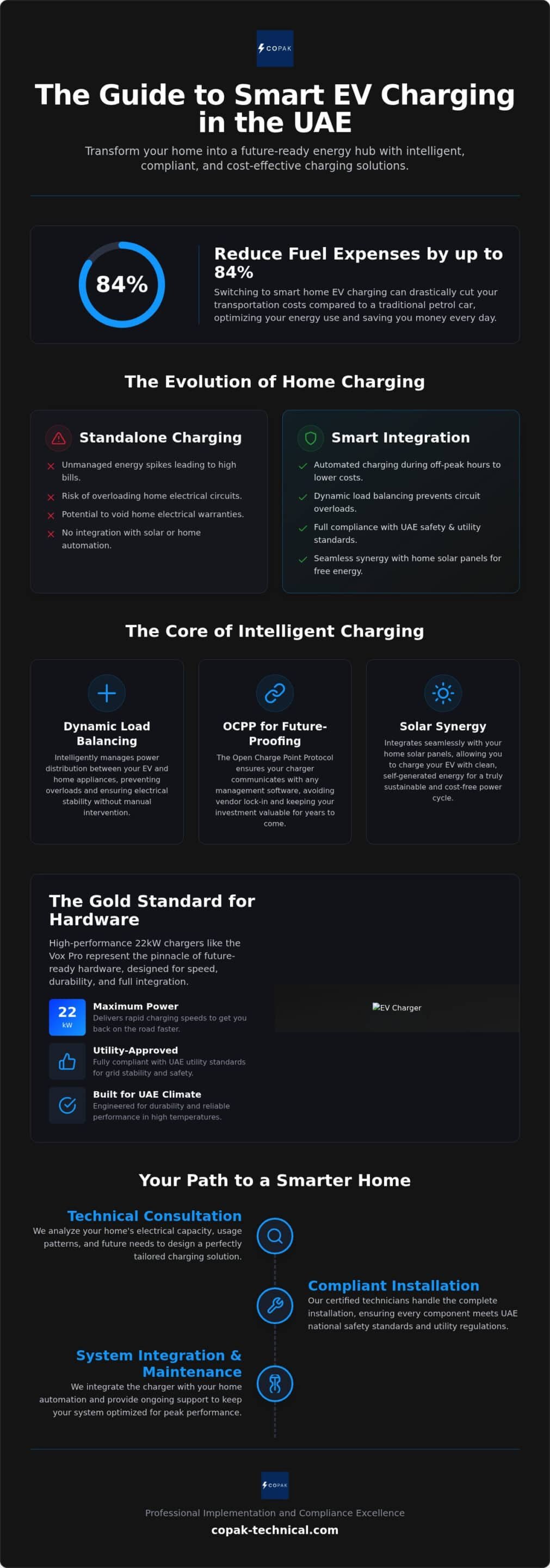
Choosing the Right Smart EV Charger
When evaluating a smart charger, consider more than its maximum charging power.
Important criteria include:
Vehicle Compatibility
Confirm the connector type and the vehicle's maximum supported AC charging rate.
Electrical Supply
Determine whether the property has the electrical supply and allocated capacity required for the proposed charger.
Smart Connectivity
Consider Ethernet, Wi-Fi, 4G and OCPP according to how the charger will be managed.
Energy Monitoring
A good smart charging platform should provide useful charging-session and energy-consumption information.
User Access
RFID or application-based access can be valuable where the charger is accessible to other people.
Dynamic Load Management
If DLM is required, confirm that the charger supports the proposed solution and that the quotation includes the necessary additional equipment.
Environmental Protection
The charger should be suitable for the UAE installation environment.
DEWA's current technical regulations specifically address outdoor environmental conditions and require EVSE to operate under Dubai's demanding climate conditions.
Professional Support
Firmware, connectivity and charging-platform configuration can require ongoing technical support, so local after-sales capability is valuable.
7kW, 11kW or 22kW Smart EV Charger?
A smart charger doesn't necessarily need to operate at 22kW.
The appropriate charging power depends on:
- Vehicle onboard AC charger
- Property electrical supply
- Allocated electrical capacity
- Daily driving requirements
- Available charging time
- Future vehicle requirements
A vehicle capable of accepting only 11kW AC will not normally charge at 22kW simply because it is connected to a 22kW charger.
However, a 22kW-capable charger can provide flexibility for future vehicles when the property's electrical infrastructure supports it.
Compare 7kW and 22kW EV Charging in Our 22kW Guide
Smart EV Charger Installation in Villas and Townhouses
For villas, townhouses, farmhouses and standalone residential properties, COPAK offers Fixed Price EV Charger Installation Packages for standard installations.
The standard package includes complete installation with up to 5 metres from the Main Electrical Panel to the charger, including the required cable, safety components, conduits, installation, testing and commissioning.
Additional cable length, concealed installation and other non-standard work are charged separately.
Dynamic Load Management is an additional solution and requires the appropriate extra equipment where requested or required.
View COPAK Fixed Price Home EV Charger Installation Packages
Smart EV Charging in Apartments
Apartment EV charger installations require a different approach.
COPAK coordinates the site survey with the building management team to identify the appropriate electrical source, charger position and cable route.
Following customer approval, the building-management submission can include:
- Method Statement
- Risk Assessment
- Contractor's All Risk Insurance
- Trade License
- Emirates ID
- Applicable approved-contractor documentation
- Installation drawings
- Charger datasheet
Installation proceeds after the necessary building-management review and work-permit approval.
For the complete villa and apartment installation process, see:
Ultimate Guide to Home EV Charger Installation in Dubai & UAE
UAE Electrical Compliance Comes Before Smart Features
Smart functionality does not remove the need for a properly engineered electrical installation.
In Dubai, DEWA states that home EV chargers can be installed behind the customer's meter and that DEWA-approved electrical contractors should be used for electrical installations, including home charging stations.
DEWA also maintains dedicated EV Charging Technical Regulations covering areas including electrical supply conditions, IEC compliance, charging modes, connectors and environmental requirements.
The important principle is simple:
Electrical compliance first. Smart energy management second.
For a detailed explanation of the regulatory side:
Read the DEWA EV Charger Installation Requirements: 2026 Guide
Professional Smart EV Charging Installation with COPAK
A successful smart charging installation brings together:
EV charger + electrical infrastructure + connectivity + energy monitoring + software + optional load-management equipment
COPAK Technical Services LLC provides complete EV charging solutions across the UAE, from initial site assessment and charger selection through electrical installation, smart configuration, testing and commissioning.
Depending on the project, our solutions can include:
- Smart EV charger supply
- 7kW, 11kW and 22kW charging solutions
- VOX PRO smart chargers
- MAG DUO dual charging solutions
- Electrical load assessment
- Dynamic Load Management
- OCPP configuration
- Ethernet, Wi-Fi and 4G connectivity
- User and charging-platform configuration
- Villa and townhouse installations
- Apartment EV charger installations
- Testing and commissioning
- Technical and after-sales support
For VOX PRO setup information and technical resources:
Building a Smarter EV Charging System
Smart EV charging isn't about adding as many connected features as possible.
A well-designed system starts with the property's electrical capacity and the driver's actual charging requirements.
The charger and smart features are then selected around those requirements.
For some homeowners, that may mean a straightforward connected wallbox with mobile monitoring.
For another property, it may mean a 22kW VOX PRO installation with additional Dynamic Load Management equipment.
For a multi-EV home, apartment development or commercial property, it may involve several chargers sharing available charging capacity through a coordinated load-management solution.
The objective remains the same:
safe, reliable and intelligently managed EV charging.
Frequently Asked Questions
What is OCPP and why is it useful for a smart EV charger?
OCPP, or Open Charge Point Protocol, is a communication protocol used between compatible EV chargers and charging-management software.
An OCPP-compatible charger can potentially operate with different compatible management platforms, helping reduce dependence on a single proprietary software ecosystem.
Can Dynamic Load Management increase my property's approved electrical capacity?
No.
Dynamic Load Management does not increase the electrical capacity allocated to the property and should not be considered a substitute for authority load requirements.
It monitors electrical demand and adjusts compatible charger output within the configured system limits.
Does Dynamic Load Management require additional equipment?
Yes.
For a charger to respond to the active electrical load of the entire property, additional compatible monitoring and communication equipment is required as part of the DLM installation.
The exact equipment depends on the charger and electrical architecture.
When is Dynamic Load Management most useful?
DLM is particularly useful where available electrical capacity is constrained or where multiple EV chargers need to operate simultaneously.
It allows the charging system to manage charger output according to the available capacity instead of allowing every charger to continuously request maximum power.
Is electricity cheaper if I charge my EV at night in Dubai?
DEWA does not currently apply a residential day/night time-of-use tariff for normal home EV charging.
Home EV charging behind the customer's meter is added to the normal residential electricity bill, which uses DEWA's applicable consumption-slab tariff.
Smart scheduling can still be useful for convenience and electrical load management, but charging at night does not itself create a special cheaper residential DEWA rate.
Can I integrate an EV charger with solar panels?
Potentially, yes, where the charger and energy-management equipment support the required integration.
Solar-aware EV charging generally requires compatible monitoring and control equipment so the system can respond to available solar generation. It should not be assumed that every smart charger automatically provides solar integration.
Is VOX PRO compatible with every electric vehicle?
VOX PRO uses the Type 2 AC charging interface appropriate for compatible Type 2 vehicles. Actual charging power is determined by factors including the vehicle's onboard AC charger and available electrical supply.
Vehicles using a different charging interface may require a suitable compatible charging arrangement.
What happens if my charger's internet connection fails?
It depends on the charger, configuration and connected platform.
Local charging may continue while cloud-dependent functions such as remote monitoring, remote commands or cloud reporting may temporarily become unavailable. The expected offline behaviour should be confirmed for the particular charger and platform.
Can COPAK install smart EV chargers in apartments?
Yes, subject to site feasibility and the required building-management approvals.
Apartment projects normally begin with a site survey and coordination with building management to determine the electrical source, charger position and cable route. Technical documentation is then submitted for approval before installation proceeds.
Can multiple EV chargers share the available electrical capacity?
Yes, with a properly designed compatible charging and load-management system.
This is one of the applications where intelligent load management can be particularly valuable, because charging capacity can be managed across several charging points instead of every charger independently demanding its maximum output.