

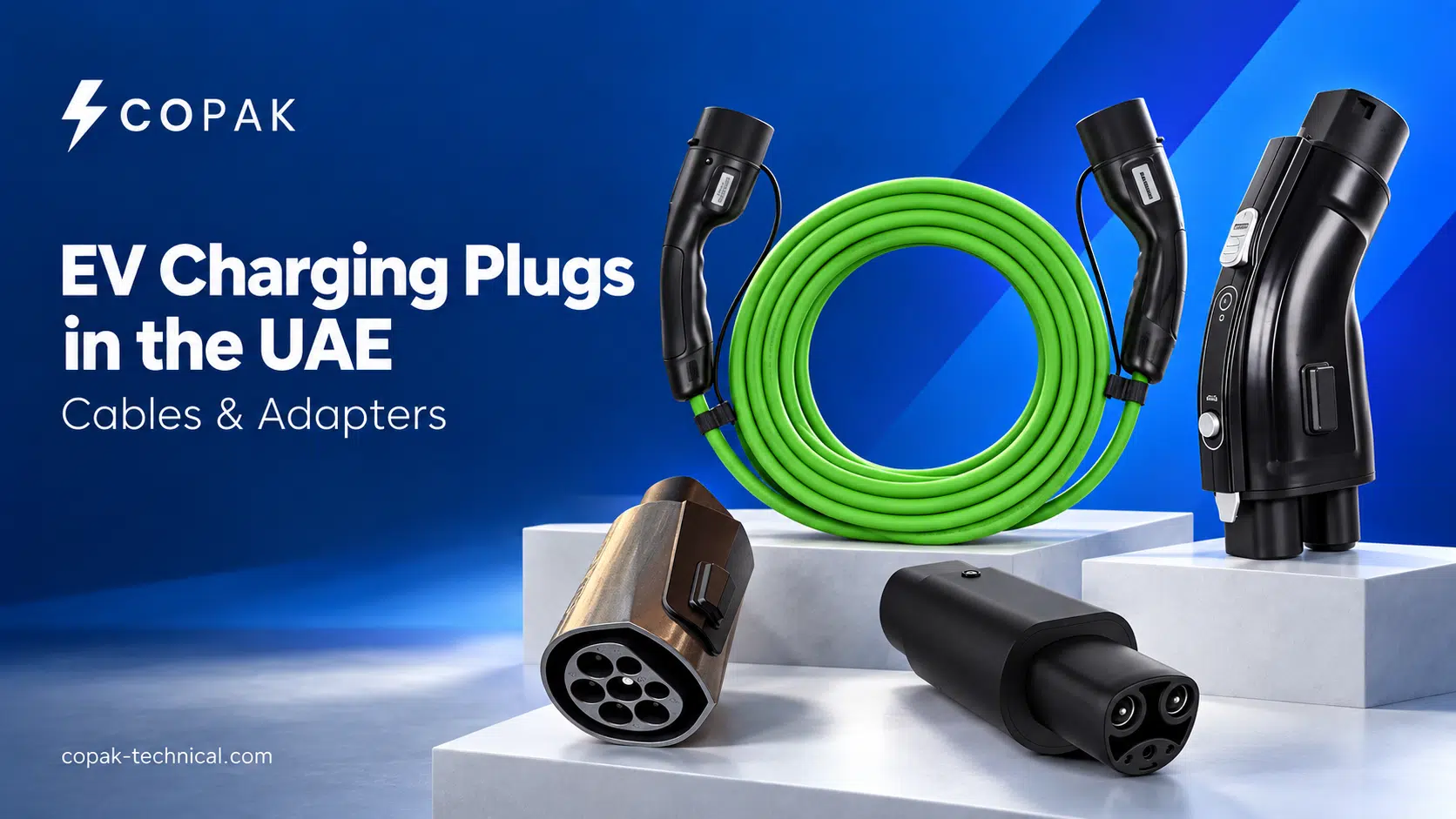
Arriving at a charging station with the wrong connector can turn a convenient stop into a frustrating search for another charger. Buying an adapter that fits physically but cannot communicate with your car creates a different problem: everything connects, but charging will not start.
In COPAK’s installation and support experience, UAE drivers use a mix of GCC-specification vehicles and cars imported from Chinese and North American markets. These vehicles can have different charging inlets, even when they share the same brand or model name.
The solution starts with identifying your particular car, understanding the difference between AC and DC charging, and choosing accessories for the charging stations you actually use.
This guide explains EV charging plug types in the UAE, the equipment to carry, and the charging-power limitations that can affect your purchase.
Key Takeaways
- Check your car’s actual charging inlet and specifications; its brand or country of manufacture is not enough.
- Type 2 AC and CCS2 DC are important connections to understand for UAE charging.
- Socket-type AC chargers require a separate compatible charging cable.
- An AC adapter does not automatically support DC fast charging.
- A single-phase car may receive only about 3.7 kW from a typical three-phase 11 kW charger.
- CCS2-to-GB/T DC adapters need electronic communication compatibility as well as matching connectors.
- Choose accessories by documented ratings, fit, support and vehicle compatibility—not price alone.
- Shared charging facilities should account for different vehicle specifications when selecting equipment.
Table of Contents
- Identify Your Car’s Charging Connections
- Understand Cables, Adapters and Portable Chargers
- Choose the Right Equipment for Your Vehicle
- Why an 11 kW Charger Can Charge More Slowly
- Understand Chinese EV Fast-Charging Compatibility
- Choose an Adapter with Safety in Mind
- Select the Right Charging Cable and Length
- Plan Shared Charging for Different Vehicles
- Troubleshoot Charging Problems
- Frequently Asked Questions
- Get Help Choosing Your Charging Equipment
1. Identify Your Car’s Charging Connections
Before buying a charger or accessory, confirm:
- Vehicle make, model and model year.
- Original market specification.
- AC charging inlet.
- DC charging inlet, if fitted.
- Maximum AC charging current and supported phases.
- Any manufacturer restrictions on adapters.
Take clear photographs of the charging ports with their covers open. These are often more useful to a supplier than a description such as “Chinese car” or “American Tesla.”
A vehicle manufactured in China for the UAE market may use different connectors from the same model built for China’s domestic market. Similarly, American-specification vehicles do not all use one connector.
AC and DC Charging Are Different
During AC charging, the vehicle’s onboard charger converts incoming AC electricity into DC for the battery. That onboard equipment limits how much AC power the car can accept. Tesla’s onboard charger guidance illustrates how this capability differs between vehicles.
DC fast charging supplies DC power through a separate charging process. A car’s AC limit therefore does not tell you its DC charging capability.
The Main Connector Families
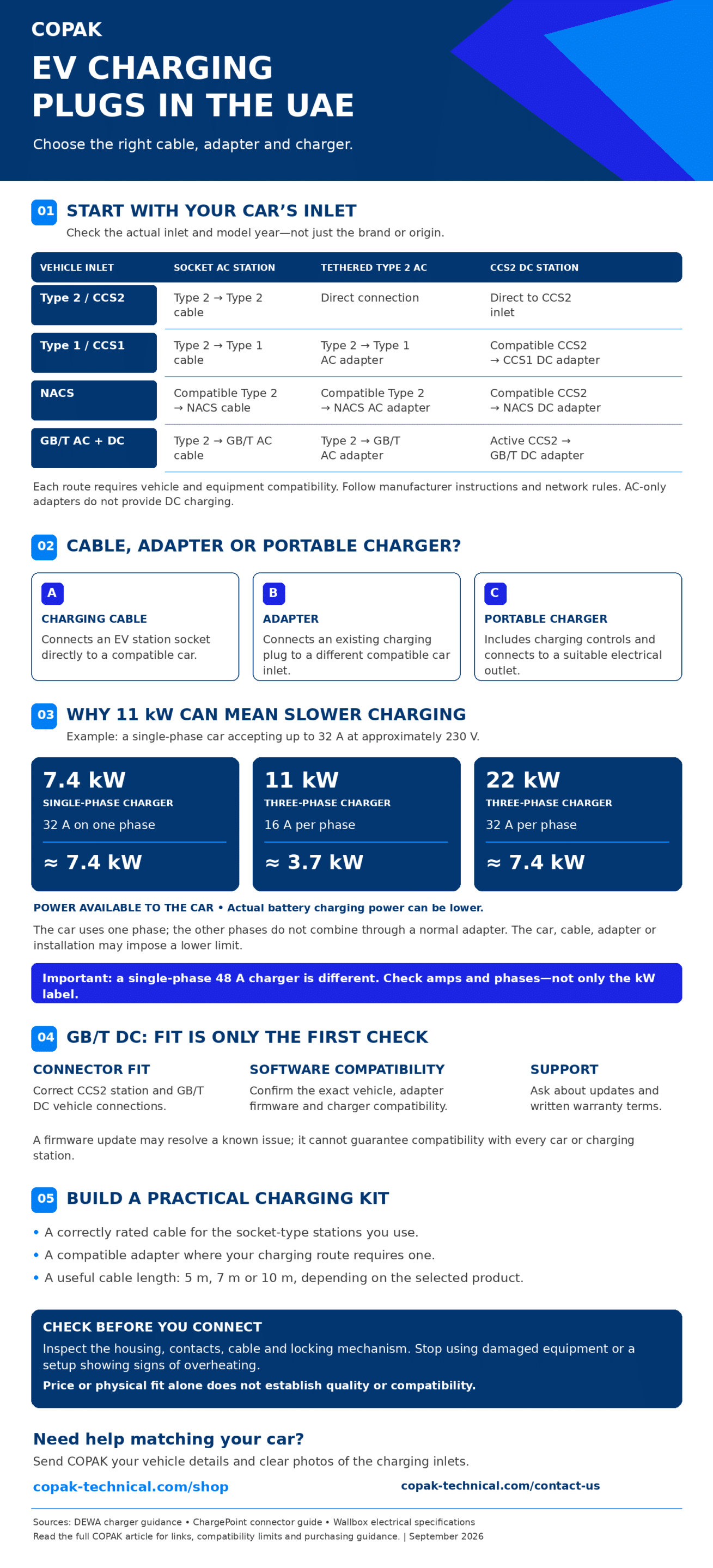
| Connection | Used for | What to check |
|---|---|---|
| Type 2 | AC charging | Common on GCC/European-market EVs and UAE AC equipment |
| CCS2 | DC charging | Recognisable by the Type 2-shaped upper section and two large lower DC contacts |
| Type 1 / SAE J1772 | Single-phase AC charging | Found on various North American-market vehicles |
| CCS1 | DC charging | Combines a Type 1-shaped upper section with two lower DC contacts |
| NACS | AC and DC through the vehicle inlet | Found on North American Teslas and other vehicles; adapter capabilities vary |
| GB/T AC | AC charging | Used on relevant Chinese domestic-market vehicles |
| GB/T DC | DC charging | Separate from GB/T AC; requires the correct DC equipment |
| CHAdeMO | DC charging | Relevant to some vehicles, including certain Japanese models |
ChargePoint’s connector guide provides useful illustrations of Type 1, Type 2, CCS1, CCS2, NACS and CHAdeMO.
DEWA’s published equipment information includes Type 2 AC sockets and DC equipment with CCS and CHAdeMO connections. Check the individual station rather than assuming every location has the same equipment.
2. Understand Cables, Adapters and Portable Chargers
These terms are frequently mixed together, although the products solve different problems.
A Detachable Charging Cable
A detachable AC cable connects a socket-type EV charging station to the car. It has a charging connector at each end.
For example, a Type 2-to-GB/T cable connects a compatible Type 2 station socket directly to a GB/T AC vehicle inlet.
This is the type of cable used with a socket charger such as VOX Pro Universal. It does not plug directly into an ordinary household outlet.
A Charging Adapter
An adapter connects an existing charging plug to a different compatible vehicle inlet.
For example, a suitable Type 2-to-Type 1 adapter may allow a tethered Type 2 AC charger to connect to a Type 1 vehicle.
The adapter must support the charging mode, electrical ratings and intended vehicle. A connector that fits is only part of the compatibility check.
A Portable EV Charger
A portable EV charger includes charging-control equipment, often in an inline enclosure, and connects to a suitable electrical supply outlet.
It is different from a detachable cable for a socket-type EV station. The supply outlet and circuit must be appropriate for the portable unit; its portability does not make every available socket suitable.
When purchasing, explain whether you need to connect to an EV charging station socket, an attached charging plug, or a building’s electrical outlet.
3. Choose the Right Equipment for Your Vehicle
Choose accessories according to the car’s inlet and the station’s connection arrangement.
GCC-Specification Vehicles with Type 2 and CCS2
For a vehicle equipped with these connections:
- At a Type 2 socket-type AC station, use a Type 2-to-Type 2 cable.
- At a tethered Type 2 AC station, connect its cable directly.
- At a compatible CCS2 DC station, use the station’s attached connector.
COPAK’s Type 2-to-Type 2 charging cable provides a separate cable option for socket-type AC charging.
Check the actual vehicle before buying. Regional specification is a useful starting point, not a substitute for inspecting the inlet.
American-Specification Vehicles with Type 1 or CCS1
A vehicle with a Type 1 AC inlet needs a suitable Type 2-to-Type 1 connection when using Type 2 infrastructure.
For socket-type stations, a Type 2-to-Type 1 charging cable provides a direct connection.
For tethered Type 2 stations, consider a vehicle-compatible Type 2-to-Type 1 AC adapter, subject to the vehicle and station operator’s instructions.
DC charging through a CCS1 inlet requires equipment specifically supporting CCS2-to-CCS1 DC use. Some combination products support both AC and DC connections, but both functions must be explicitly documented. A standard AC adapter cannot perform the DC role.
American-Specification Vehicles with NACS
For AC charging from a tethered Type 2 station, the relevant accessory is a compatible Type 2-to-NACS AC adapter.
At a socket-type station, a suitable Type 2-to-NACS cable can provide a direct connection where supported by the vehicle and equipment instructions.
For DC charging, select a CCS2-to-NACS product with confirmed vehicle support. COPAK also lists a combined Type 2 and CCS2-to-NACS adapter; confirm the exact model’s AC and DC functions before purchase.
NACS inlet shape alone does not establish CCS compatibility. Tesla’s own CCS adapter information requires vehicle compatibility checks and notes that some cars need a retrofit. That guidance does not establish compatibility with every third-party CCS2 adapter.
Chinese-Specification Vehicles with GB/T
The AC and DC solutions are different:
| Charging situation | Relevant equipment |
|---|---|
| Type 2 AC station with a socket | Type 2-to-GB/T AC cable |
| Type 2 AC station with an attached cable | Compatible Type 2-to-GB/T AC adapter |
| CCS2 DC fast charger | Compatible active CCS2-to-GB/T DC adapter |
COPAK offers a Type 2-to-GB/T charging cable and a separate Type 2-to-GB/T AC adapter.
Check the selected product’s current rating and supported phases. Neither accessory increases the car’s onboard charging capacity.
4. Why an 11 kW Charger Can Charge More Slowly
This is an important purchasing issue for owners of single-phase EVs.
A charger’s advertised power can represent the combined output across three phases. A car that accepts only one phase cannot use the other two through a normal adapter.
Typical AC arrangements are:
| Charger arrangement | Current available per phase | Approximate input available to a compatible single-phase car |
|---|---|---|
| 7.4 kW single-phase charger | 32 A | Up to 7.4 kW |
| 11 kW three-phase charger | 16 A | Up to 3.7 kW |
| 22 kW three-phase charger | 32 A | Up to 7.4 kW |
These figures assume approximately 230 V between phase and neutral and no lower limit elsewhere. Wallbox’s published installation specifications show the corresponding 16 A and 32 A charger arrangements.
For a single-phase car, the basic calculation is:
230 V × 16 A ≈ 3.7 kW
230 V × 32 A ≈ 7.4 kW
A vehicle limited to approximately 7 kW will still respect its own limit.
Why Drivers May See Around 3.4 kW
Supply voltage, charging losses, vehicle auxiliary consumption and the measurement displayed can affect the observed figure. Power entering the vehicle and power reaching the battery are not necessarily identical.
This explains why a nominally “larger” 11 kW charger can deliver less power to a particular car than a 7.4 kW charger.
Do Not Reject Every Charger Labelled 11 kW
The limitation above concerns a typical three-phase, 16 A-per-phase charger.
A single-phase 48 A charger is a different product. Tesla, for example, documents approximately 11.5 kW at 240 V for suitable 48 A equipment and compatible vehicles.
Before purchasing, ask:
What current can this charger supply on one phase, and what current can my car accept?
For a 32 A single-phase car, a suitable 32 A charging arrangement is generally the relevant target. Installation capacity and the ratings of every cable and adapter still apply.
5. Understand Chinese EV Fast-Charging Compatibility
A CCS2-to-GB/T DC adapter is an electronic interface, not simply a connector with rearranged contacts.
It must support communication between the charging station and vehicle so they can establish a charging session and control energy delivery. Published documentation for this adapter category includes firmware-update procedures, reflecting its software-dependent operation. Always use the documentation for your exact product when operating or updating it.
This creates two separate checks:
- Physical compatibility: Do the connectors fit the station and vehicle?
- Operational compatibility: Can that adapter version communicate successfully with that vehicle and charger?
A product can pass the first check and fail the second.
What to Confirm Before Buying
Give the supplier your vehicle’s model, year and original market specification. Ask about:
- Testing with that specific vehicle.
- Supported charger networks or models.
- Required vehicle settings or hardware.
- Adapter firmware version and update support.
- Continuous current and voltage ratings.
- Warranty coverage and the process for resolving incompatibility.
Where practical, arrange a charging demonstration with your car.
Successful testing with one model from a brand does not prove compatibility with every model, software version or charging station.
Firmware Updates Can Help—but Are Not a Universal Fix
COPAK’s experience includes situations where adapter software needs attention before charging operates correctly.
An appropriate update may address a known communication issue. However, unsuccessful charging can also result from an unsupported vehicle, station fault, hardware limitation or incorrect operating sequence.
Use only the update process and firmware specified for the exact adapter.
COPAK’s CCS2-to-GB/T DC adapter is an option to assess with your vehicle details. Confirm compatibility and written warranty terms before ordering.
6. Choose an Adapter with Safety in Mind
Price alone cannot establish adapter quality. An inexpensive product is not automatically unsafe, and an expensive one is not automatically suitable.
Look for identifiable specifications, secure engagement, appropriate ratings, clear instructions and support from a supplier who understands the intended application.
A Case Reported by COPAK’s Team
COPAK’s team reports encountering an American-specification Tesla whose owner used an adapter with a UAE Type 2 charger.
After several months of use, the adapter melted, damaging the charger connector and the vehicle’s charging inlet. According to the account provided to COPAK, repairs cost the owner thousands of dirhams.
This is a single reported incident, not a failure-rate study or a diagnosis of every contributing cause. It illustrates the consequences of a damaged charging connection and why successful charging on previous occasions is not proof of continued safety.
What to Inspect
Before connecting, look for:
- Cracked or distorted housing.
- Discoloured, corroded or damaged contacts.
- Loose-fitting connectors.
- Damaged cable insulation.
- Dirt or moisture in the connection.
- A damaged latch or locking arrangement.
Follow the product’s inspection instructions. Tesla’s adapter safety guidance, for example, explicitly warns against using damaged or malfunctioning equipment.
COPAK identifies a locking mechanism as a feature of its standard Type 2-to-GB/T AC adapter offering. Confirm how the selected model secures both connections and how it should be released.
A lock helps retain the connection; it does not by itself prove electrical quality, temperature performance or vehicle compatibility.
If you notice burning smells, smoke, deformation or repeated temperature warnings, stop charging and have the equipment assessed. Do not pull apart an energised connection or repeatedly restart a damaged setup. Tesla’s troubleshooting guidance warns that disconnecting certain third-party adapter arrangements during active charging can cause arcing and injury.
7. Select the Right Charging Cable and Length
A detachable cable is essential when the AC station has a socket and no attached lead.
DEWA lists both single-socket wallboxes and dual-socket public AC chargers. Drivers planning to use these should carry a suitable cable. Its charger types and instructions are useful when preparing for a visit.
Do not assume your new or imported vehicle includes one. Ask the seller exactly which accessories come with the car.
Match the Vehicle End
| Vehicle AC inlet | Cable for a compatible Type 2 socket station |
|---|---|
| Type 2 | Type 2-to-Type 2 |
| Type 1 / J1772 | Type 2-to-Type 1 |
| GB/T AC | Type 2-to-GB/T AC |
| NACS | Vehicle-compatible Type 2-to-NACS |
A correctly specified direct cable can avoid an additional adapter connection at a socket-type station. It still needs the correct electrical rating and operating approval.
Match Current and Phases
Connector shape is only one specification.
A 16 A cable may limit a setup intended for 32 A charging. A single-phase cable cannot provide three-phase charging to a vehicle that needs all three phases to reach its higher AC rate.
Ask for the cable’s continuous current rating, supported phases and intended charging mode.
Choose a Practical Length
COPAK offers charging cable lengths including 5 m, 7 m and up to 10 m, depending on the selected configuration.
| Length | Practical consideration |
|---|---|
| 5 m | Convenient where the station is close to the vehicle’s inlet |
| 7 m | More flexibility across different parking orientations |
| 10 m | Useful for longer reaches, with more weight and storage space |
Measure the route around the vehicle, not just the straight-line distance from charger to bumper.
Choose enough length to avoid tension at the inlet, while keeping the cable clear of walkways and moving vehicles. Follow the manufacturer’s guidance on deployment and storage; do not improvise an extension by joining charging cables.
Confirm the available connector combination, length and warranty when ordering.
8. Plan Shared Charging for Different Vehicles
A mall, workplace, hotel or shared residential parking area may serve cars with several inlet types.
Installing only tethered Type 2 AC chargers gives direct convenience to Type 2 vehicles. Drivers with incompatible inlets then need an approved adaptation solution or another charging point.
A Type 2 socket-type charger allows users to bring a cable matching their vehicle. This can make shared AC provision more flexible, provided the vehicle, cable, charger and operator requirements are satisfied.
Compare the Practical Trade-Offs
| Arrangement | Benefit | Planning consideration |
|---|---|---|
| Tethered Type 2 | Attached cable is ready for compatible cars | Other inlets may require permitted adapters |
| Type 2 socket | Users can bring an appropriate vehicle-specific cable | Drivers need to carry that cable |
| A planned mix | Serves different user preferences | Clear signage and equipment selection are important |
“Universal” describes the socket arrangement; it does not guarantee compatibility with every EV.
COPAK’s AC range includes VOX Pro Universal, VOX Pro Cable, MAG Duo Universal and MAG Duo Cable. The VOX Pro range provides socket and tethered options to consider against the site’s users.
For shared sites, specify:
- Expected vehicle inlet types.
- Whether users need their own cables.
- Single-phase charging current.
- Permitted adapter arrangements.
- Accessible parking and cable routes.
- Inspection and fault-reporting responsibilities.
Staff should know how to report damaged equipment and take an affected charging point out of service through the operator’s procedure.
For broader infrastructure and operating decisions, read COPAK’s commercial EV charging business guide.
9. Troubleshoot Charging Problems
Start with the symptom rather than immediately blaming the adapter.
The Connector Does Not Fit
Stop and identify both connection types. Never force the plug or modify contacts, latches or locating features.
Check whether you are trying to connect an AC accessory to a DC inlet or using the wrong direction of adapter.
Everything Connects, but Charging Will Not Start
Check that:
- The station is available and the session is authorised.
- The vehicle is ready to charge and any charging schedule is understood.
- Connections are fully seated and locked according to instructions.
- The accessory supports the intended charging mode.
- The vehicle and adapter meet the documented compatibility requirements.
For active DC adapters, contact the supplier about firmware and diagnostic information. Avoid repeated attempts when equipment reports a fault.
Charging Starts, but Power Is Lower Than Expected
Compare the station’s per-phase current with the car’s onboard charger capability. Then check cable and adapter limits, configured charging current and any vehicle messages.
A single-phase vehicle receiving around 3.7 kW from a three-phase 11 kW station may be operating as expected.
For DC charging, battery condition, charge level, temperature and the vehicle’s charging behaviour also matter. The station’s headline rating is not a promise of constant power.
Charging Repeatedly Stops
Record the vehicle model, station identification, adapter version and displayed error. These details help the supplier distinguish a compatibility issue from an equipment or station fault.
If there is physical damage or evidence of overheating, discontinue use pending inspection.
10. Frequently Asked Questions
Does Every Imported EV Need an Adapter?
No. The need depends on its actual inlet and the charging equipment used.
An imported car with Type 2 and CCS2 may connect directly. A GB/T car using socket-type AC stations may use a direct cable instead of a separate adapter.
Owners should carry the equipment needed for their regular and backup charging locations.
Will a 22 kW Charger Give My American-Spec Car 22 kW?
Not necessarily. A single-phase car using a 32 A connection typically has about 7.4 kW available at 230 V, subject to its own limit.
The charger’s remaining phases do not combine into higher single-phase power through a normal adapter.
Should I Avoid Buying an 11 kW Charger?
Check its electrical configuration first.
A typical three-phase 11 kW charger supplies 16 A per phase, which limits a single-phase car to approximately 3.7 kW. A single-phase 48 A charger is a different case.
Buy according to current, phases, vehicle capability and installation suitability—not the headline number alone.
Can One Adapter Handle AC and DC Charging?
Some products are designed for both. Others support only one mode.
Check the exact product documentation and vehicle requirements. The appearance of a combination connector does not establish every charging function.
Why Do GB/T DC Adapters Cost More Than AC Adapters?
They generally involve more complex electronic communication and higher-power DC operating requirements.
Compare compatibility support, documented ratings, firmware provision and warranty terms, rather than treating them as equivalent to simple AC accessories.
Does a High IP Rating Mean an Adapter Tolerates Dubai Heat?
No. An IP rating concerns ingress protection. It does not establish the product’s operating-temperature range, UV resistance or suitability for every outdoor location.
Check those properties separately in the product documentation.
Can I Use Any Adapter at a Public Station?
No. Follow the vehicle manufacturer’s instructions and the station operator’s rules, as well as the adapter’s own requirements.
Physical fit and successful operation elsewhere do not establish permission or compatibility at every network.
11. Get Help Choosing Your Charging Equipment
The right charging setup should match your car, your parking arrangement and the stations you use.
When contacting COPAK, share:
- Make, model, year and original market specification.
- Photographs of the AC and DC charging inlets.
- Whether you need home, workplace or public charging.
- Whether your usual station has a socket or an attached cable.
- Your preferred cable length.
- Any charging errors or existing adapter details.
COPAK supplies charging cables, adapters and AC/DC charging equipment, with guidance on matching the product to the application.
Browse the COPAK shop, explore home charger installation services, or contact COPAK for help selecting your charging equipment.