

Electric vehicle adoption continues to grow rapidly across the UAE. In Dubai alone, the number of electric vehicles reached 47,944 by the end of 2025, up from 37,486 a year earlier—an increase of 27.9%. As EV ownership grows, reliable home and commercial charging infrastructure is becoming increasingly important.
But choosing an EV charger is only part of the process.
A professional EV charger installation must consider your vehicle's charging capability, the property's available electrical capacity, cable routing, electrical protection, charger location, authority and building requirements, smart charging features, and future expansion.
For properties with limited available electrical capacity, Dynamic Load Management (DLM) can also help manage EV charging alongside other electrical loads without exceeding the property's available supply.
At COPAK Technical Services LLC, we provide EV charging solutions across the UAE for villas, townhouses, apartment buildings, workplaces, hotels, commercial properties and fleets.
This guide explains what you should consider before buying and installing an EV charger in the UAE in 2026.
Key Takeaways
- EV charger selection should consider both the vehicle's onboard AC charger and the property's available electrical capacity.
- A 22kW charger does not necessarily mean your vehicle will charge at 22kW.
- Professional installation includes more than mounting the charger—it requires appropriate cabling, electrical protection, testing and commissioning.
- Regulatory and approval requirements can differ by emirate, property type and installation.
- Apartment installations normally require considerably more building-management coordination than standard villa installations.
- Dynamic Load Management can help manage charging where available electrical capacity is limited.
- Smart chargers with features such as remote monitoring, scheduling and OCPP compatibility can provide greater flexibility.
- Site assessment is particularly important for complex, high-power and multi-charger installations.
Understanding EV Charger Installation Requirements in the UAE
EV chargers are substantial electrical loads. Installing one correctly requires integration with the property's existing electrical distribution system rather than simply connecting a charger to the nearest electrical supply.
Before installation, several factors should be assessed:
- Available electrical capacity
- Main electrical panel and protective devices
- Single-phase or three-phase supply
- Required charger capacity
- Cable size and cable-route length
- Charger location
- Earthing and electrical protection
- Indoor or outdoor environmental conditions
- Vehicle charging capability
- Building-management requirements where applicable
- Requirements of the relevant authority or utility
The exact process varies according to the emirate and property.
Dubai EV Charger Requirements
In Dubai, EV charging infrastructure falls under DEWA's regulatory and technical framework.
DEWA's current EV Charging Infrastructure Regulation distinguishes between Private Charging Equipment and Public Charging Equipment. Anyone deploying private charging equipment at their premises must follow the applicable procedures for DEWA approval and comply with the relevant EV charging technical regulations.
This distinction becomes especially important when charging infrastructure is intended for employees, customers, visitors or the general public, because different regulatory and licensing requirements may apply.
For a detailed explanation, read our:
**DEWA EV Charger Installation Requirements: 2026 Guide **
Abu Dhabi EV Charger Requirements
Abu Dhabi has its own EV charging regulatory framework overseen by the Abu Dhabi Department of Energy (DoE).
The DoE policy establishes principles covering the ownership, installation and management of EV charging equipment, electricity supply to EVSE and pricing mechanisms. Other Abu Dhabi entities and distribution companies participate in implementing the framework.
This is why an EV charger installation should be assessed according to its actual location rather than assuming that requirements in Dubai automatically apply throughout the UAE.
Building and Community Requirements
Utility requirements are only one part of the process.
Depending on the property, approval may also be required from:
- Building Management
- Owners Association
- Community or property developer
- Facility Management
- Landlord
- Other relevant entities
This is particularly important for apartment buildings and shared parking facilities.
Choosing the Right EV Charger: 7kW, 11kW or 22kW?
One of the most common mistakes when buying an EV charger is assuming that the highest-rated charger will always charge the vehicle faster.
It doesn't necessarily work that way.
For AC charging, the actual charging rate is limited by several factors, including:
Charger capacity → property electrical supply → vehicle onboard AC charger
The lowest applicable limit determines the actual charging power.
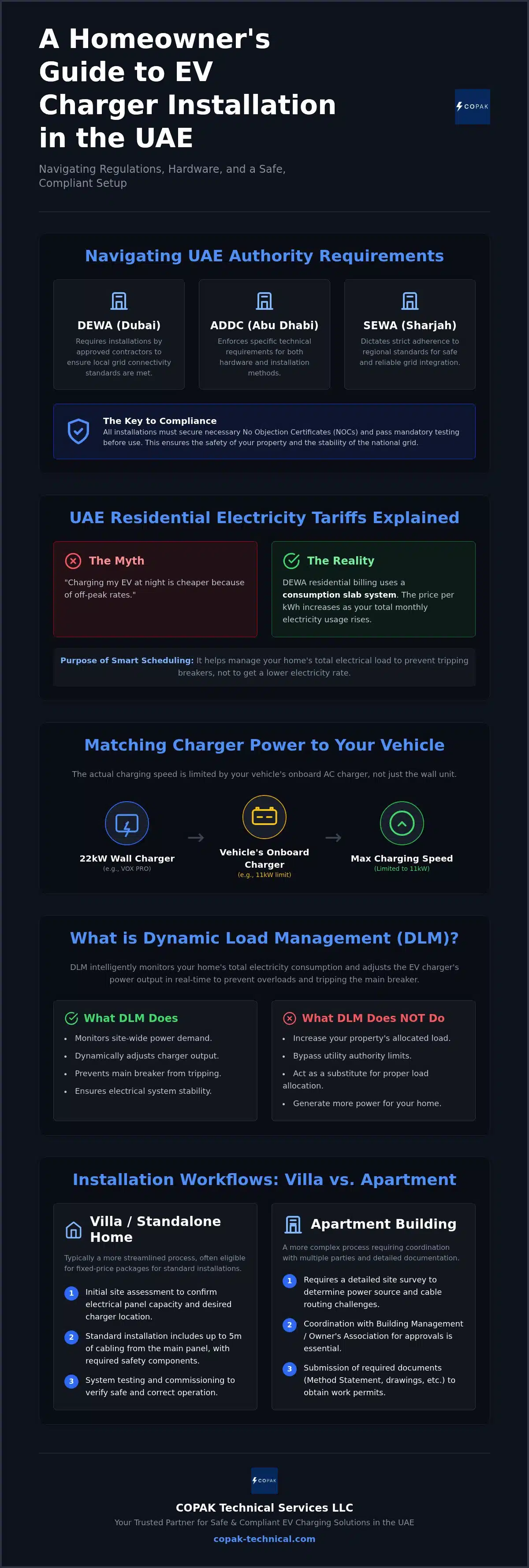
For example, connecting an EV that supports a maximum of 11kW AC charging to a 22kW wall charger will not make the vehicle charge at 22kW.
7KW EV Chargers
A 7kW charger is commonly suitable for single-phase residential installations and vehicles that do not require higher AC charging capacity.
For overnight home charging, 7kW can be sufficient for many EV owners.
11KW EV Chargers
An 11kW three-phase charger can provide faster AC charging where both the property supply and vehicle support it.
It can be suitable for homes as well as workplaces and other locations where vehicles remain parked for several hours.
22KW EV Chargers
A 22kW AC charger can deliver up to 22kW to a compatible vehicle when sufficient three-phase electrical capacity is available.
However, many EVs accept less than 22kW through their onboard AC charger.
Before selecting one, check:
- Your vehicle's maximum AC charging rate.
- Whether the property has suitable three-phase capacity.
- The available electrical load.
- Whether load management may be beneficial.
For a detailed comparison, read our Ultimate Guide to 22kW EV Chargers in Dubai and the UAE.
VOX PRO Smart EV Charger
For customers looking for a connected AC charging solution, the VOX PRO Smart EV Charger provides up to 22kW three-phase charging for compatible vehicles and installations.
Two configurations are available:
VOX PRO Tethered — IOCAH30-22T
The tethered model includes an integrated 5-metre Type 2 charging cable, providing convenient everyday charging without needing to connect a separate cable.
VOX PRO Universal — IOCAH30-22S
The universal model provides a Type 2 socket, allowing the driver to use a separate compatible charging cable.
Both versions provide smart connectivity and support compatible backend-management functionality, including OCPP depending on the applicable firmware/configuration.
The connected platform can provide useful information such as charging history, energy consumption, charging duration and other charging statistics.
For customers who want a charger capable of supporting different vehicle charging rates while providing room for future requirements, VOX PRO offers a flexible residential and commercial charging solution.
Explore the VOX PRO Smart EV Charger
What Is Dynamic Load Management?
One of the most important considerations in higher-power EV charger installations is the relationship between the charger and the property's existing electrical demand.
Imagine a villa operating:
- Air-conditioning
- Water heating
- Kitchen appliances
- Pool equipment
- Lighting
- Other household loads
and then adding a high-power EV charger.
The property's electrical supply has a finite available capacity. If simultaneous demand becomes too high, the installation needs an appropriate engineering solution.
This is where Dynamic Load Management (DLM) can help.
How Dynamic Load Management Works
A compatible DLM system monitors the property's electrical demand and adjusts EV charging power according to the available capacity.
For example, when household electricity demand is low, more available capacity may be allocated to EV charging.
When household demand rises, the system can reduce charging power so the combined load remains within the configured limits.
As other loads decrease, charging power can increase again where appropriate.
What DLM Does
Dynamic Load Management can help:
- Reduce the risk of electrical overload
- Manage EV charging alongside other building loads
- Make more effective use of available electrical capacity
- Support multiple chargers in compatible installations
- Reduce unnecessary simultaneous peak loading
- Potentially defer certain electrical upgrades in suitable projects
What DLM Does Not Do
DLM does not increase the property's total electrical capacity.
It manages how the available capacity is distributed.
Whether DLM is required or beneficial should therefore be determined through an electrical load assessment rather than automatically added to every EV charger installation.
Does Charging Your EV at Night Reduce Electricity Cost?
This is a common question from EV owners.
For a standard DEWA residential electricity account in Dubai, electricity is billed according to monthly consumption slabs rather than a simple cheaper overnight residential EV rate. DEWA's published residential/commercial electricity slabs currently increase progressively with monthly consumption.
Therefore, moving home EV charging from daytime to nighttime does not by itself mean the electricity unit rate becomes cheaper.
However, scheduled nighttime charging can still be useful.
At night, household electrical demand may be lower because fewer high-power appliances are operating. Scheduling charging during these periods can therefore help with load management and ensure the vehicle is ready the following morning.
Electricity tariffs and charging arrangements can differ by account, emirate and application, so current applicable tariffs should always be checked with the relevant provider.
Outdoor EV Charger Installation in the UAE
Outdoor EV charger installations require careful consideration of the local environment.
Equipment may be exposed to:
- High ambient temperatures
- Dust
- Humidity
- Rain and water exposure
- Direct sunlight
- Accidental physical impact
The charger and associated electrical equipment should therefore have environmental and mechanical protection appropriate for the installation location and comply with applicable technical requirements.
This does not mean every installation automatically requires the same IP rating.
The correct solution depends on the charger, mounting position, exposure and site conditions.
Where additional protection is required, suitable weather-resistant enclosures, canopies or mounting arrangements can be incorporated into the installation.
Professional EV Charger Installation Process
A well-designed installation begins before the charger reaches the wall.
At COPAK, the process is adapted according to the property and project requirements.
Step 1 — Site Assessment
We evaluate the proposed charger location, electrical panel, supply arrangement and cable route.
For more complex installations, an electrical load assessment helps determine the available capacity and whether additional measures such as Dynamic Load Management should be considered.
Step 2 — Charger Selection
The charger is selected according to factors including:
- Vehicle compatibility
- AC charging capacity
- Property electrical supply
- Required smart features
- Connectivity
- Cable or socket preference
- Indoor/outdoor location
- Future charging requirements
Step 3 — Electrical Design and Protection
Appropriate cabling, protective devices, isolation, earthing and other electrical components are selected according to the installation requirements.
Step 4 — Required Approvals and Documentation
Where approvals are required, the relevant technical documentation is prepared according to the project and property requirements.
For apartment installations, this stage is particularly important because Building Management or the Owners Association may require detailed contractor and technical documentation before issuing a work permit.
Step 5 — Installation
Once the necessary requirements and approvals are in place, the charger, cabling, conduits, electrical protection and associated equipment are installed.
Step 6 — Testing and Commissioning
The completed installation is tested before being placed into normal operation.
This may include verification of the electrical installation, charger operation, connectivity and applicable smart functions.
Step 7 — Handover
The customer receives guidance on normal charger operation and applicable smart features.
For VOX PRO installations, this can include assistance with the connected charging platform and available monitoring functions.
EV Charger Installation for Villas and Townhouses
Villas and townhouses generally provide a more straightforward installation environment than multi-unit buildings because the electrical panel and parking space are often within the same property.
COPAK offers a fixed-price standard Residential EV Charger Installation package for qualifying installations.
The standard package includes the complete installation for a cable route of up to 5 metres from the Main Electrical Panel to the EV charger, including the required:
- Electrical cable
- Safety components
- Conduits
- Installation and connection
- Testing
- Commissioning
Additional work is quoted separately where required.
Examples include:
- Cable routes beyond 5 metres
- Concealed cabling
- Civil works
- Non-standard electrical modifications
- Additional mounting arrangements
- Dynamic Load Management
- Other project-specific requirements
View COPAK's Home EV Charger Installation Package
For a more detailed residential explanation, see our Ultimate Guide to Home EV Charger Installation in Dubai & UAE.
EV Charger Installation in Apartments
Apartment EV charger installations require a different approach.
The parking space may be far from the relevant electrical source, while cable routes can pass through shared areas controlled by Building Management.
For this reason, COPAK begins with a site survey and coordination with the building management team.
We determine:
- Suitable electrical source
- Charger location
- Cable route
- Installation requirements
- Building-management requirements
- Applicable electrical and authority considerations
After the customer approves the proposal, the documentation required for the building-management approval process can include, as applicable:
- Method Statement
- Risk Assessment
- Contractor's All Risk Insurance
- Trade License
- Emirates ID documentation
- Relevant approved-contractor documentation
- Charger technical datasheet
- Drawings and proposed cable route
- Other documentation requested by the property management
Once approval and the necessary work permit are obtained, installation can proceed.
Because cable distance, building layout, parking arrangements and management requirements vary substantially, apartment installations are normally assessed and quoted individually rather than treated as a standard fixed-price installation.
Commercial EV Charger Installation
Commercial charging requires a different design approach from a single residential charger.
Hotels, workplaces, offices, residential developments, shopping facilities, fleets and public-facing locations may require multiple chargers operating simultaneously.
The design should therefore consider:
- Number of charging points
- Available electrical capacity
- Vehicle dwell time
- Expected charger utilization
- Load balancing
- Dynamic Load Management
- Network connectivity
- Backend/CPO integration
- User authentication
- Energy monitoring
- Expansion capacity
- Maintenance and technical support
Where multiple charging points are required, pedestal-mounted solutions can also help organize chargers in parking areas where wall mounting is unsuitable.
COPAK's Heavy-Duty Dual Gun Pedestal Stand with Canopy provides a practical mounting solution for compatible charger installations.
For paid or public charging projects, additional regulatory and CPO requirements may apply. In Dubai, operation of public charging equipment is subject to DEWA's CPO regulatory framework and licensing requirements.
Smart Charging, OCPP and Backend Connectivity
Modern EV charging infrastructure increasingly depends on software as well as electrical hardware.
One useful capability is OCPP — Open Charge Point Protocol.
OCPP allows compatible EV chargers to communicate with compatible backend charging-management systems.
Depending on the charger and platform, this can enable functions such as:
- Remote charger monitoring
- Charging-session records
- Energy-consumption reporting
- User authentication
- Remote configuration
- Fault information
- Charging-network management
OCPP itself does not process payments. Rather, it provides communication between compatible charging equipment and backend systems that may support billing, payment integrations and other services.
For commercial operators, selecting compatible hardware can provide greater flexibility when developing or expanding a charging network.
EV Charger Maintenance and Technical Support
Professional installation is only the beginning of the charger's operating life.
Like other electrical equipment, EV charging infrastructure benefits from periodic inspection and technical support.
Depending on the charger and installation, maintenance may include:
- Visual inspection
- Cable and connector inspection
- Electrical protection checks
- Charger diagnostics
- Communication troubleshooting
- Backend configuration support
- Firmware-update support where applicable
- DLM configuration checks
- Fault investigation
- Preventive maintenance
For commercial sites, maintaining charger availability becomes particularly important because charger downtime can affect customers, employees, residents or fleet operations.
Why Choose COPAK for EV Charger Installation?
COPAK Technical Services LLC provides end-to-end EV charging solutions across the UAE.
Rather than treating the charger as a standalone product, we consider the complete charging system—from the property's electrical infrastructure to the charger, connectivity and ongoing support.
Our EV charging services include:
- Residential EV charger installation
- Apartment EV charger installation
- Commercial EV charging infrastructure
- Charger supply
- Site surveys
- Electrical load assessments
- Dynamic Load Management
- Smart charger configuration
- OCPP/backend integration
- CPO-related charging infrastructure support
- Pedestal and mounting solutions
- Testing and commissioning
- Service and maintenance
Whether you are installing one charger at a villa or planning multiple charging points for a commercial property, the objective is the same:
A safe, practical and scalable EV charging solution designed around the actual requirements of your property and vehicle.
Choosing Your EV Charger: Final Checklist
Before purchasing an EV charger, confirm these five things:
1. How fast can your vehicle charge on AC?
Check the maximum AC charging capacity of the vehicle's onboard charger.
2. What electrical supply is available?
Determine whether the property has single-phase or three-phase supply and sufficient available capacity.
3. Where will the charger be installed?
Consider cable distance, mounting location, environmental exposure and parking arrangement.
4. Do you need smart charging or DLM?
Properties with constrained capacity or multiple chargers may benefit from intelligent load management.
5. Who will install and support the system?
The quality of the electrical installation, commissioning and after-sales support is just as important as the charger itself.
Get a Professional EV Charger Installation Assessment
The best EV charger is not necessarily the charger with the highest power rating.
It is the charger that correctly matches your vehicle, property, electrical capacity and charging requirements.
COPAK Technical Services LLC can assess your property, recommend the appropriate charging solution and provide professional installation, testing and commissioning across the UAE.
For villa owners, our standard installation package provides a straightforward solution for qualifying installations. For apartments, commercial properties and more complex projects, our technical team can carry out a site assessment and prepare a solution based on the actual site requirements.
Contact COPAK Technical Services LLC for a professional EV charger installation assessment.
COPAK Technical Services LLC — Your EV Charging Experts
Frequently Asked Questions
Do I need approval to install an EV charger at home in Dubai?
The applicable process depends on the installation and property. DEWA's current EV Charging Infrastructure Regulation states that anyone deploying private charging equipment at their premises must follow the applicable procedures to obtain DEWA approval and comply with the EV Charging Technical Regulations. Building, community or property-management requirements may also apply.
Can I install an EV charger myself?
EV charger installation involves dedicated electrical cabling, protective devices, earthing, isolation, testing and integration with the property's electrical system. A qualified contractor should carry out the installation in accordance with the applicable electrical and authority requirements.
Will a 22kW charger charge my EV faster than an 11kW charger?
Only if the vehicle supports a charging rate above 11kW AC and the property can supply the required power. If the vehicle's onboard AC charger is limited to 11kW, connecting it to a 22kW charger will not make it charge at 22kW.
Do I need three-phase electricity for a 22kW EV charger?
A typical 22kW AC charger uses three-phase power at approximately 32A per phase. The property therefore needs a suitable three-phase supply and sufficient available electrical capacity to support the installation.
What is Dynamic Load Management?
Dynamic Load Management monitors electrical demand and adjusts compatible EV charging power according to the available capacity. It can help prevent EV charging from pushing the property's total demand beyond configured electrical limits.
Does DLM increase my property's electrical capacity?
No. DLM manages the capacity already available. It does not increase the property's total allocated electrical supply.
Do I need DLM for my home EV charger?
Not necessarily. Whether DLM is beneficial depends on the property's available electrical capacity, existing loads, charger rating and charging requirements. A load assessment can determine whether it is appropriate.
How long does a standard villa EV charger installation take?
The installation time depends on the property, cable route, electrical panel, charger and any additional works required. Straightforward installations can often be completed within the same day, while complex cable routes, concealed works or electrical modifications may require additional time.
What is included in COPAK's standard villa installation package?
For qualifying installations, COPAK's standard residential package covers installation up to 5 metres from the Main Electrical Panel to the charger and includes the required cable, safety components, conduits, installation, connection, testing and commissioning. Additional cable length, concealed works and non-standard requirements are quoted separately.
Are apartment EV charger installations different?
Yes. Apartment installations generally require a site survey, identification of an appropriate electrical source and cable route, Building Management or Owners Association approval, documentation and a work permit before installation begins.
Does charging an EV at night reduce the electricity rate in Dubai?
Not automatically for a standard DEWA residential electricity account. DEWA currently applies progressive monthly electricity consumption slabs. Night scheduling can still be useful for vehicle readiness and load management when other household electrical loads are lower.
Can COPAK install EV chargers outside Dubai?
Yes. COPAK provides EV charging solutions across the UAE. The applicable authority, utility, building and technical requirements are assessed according to the project's location and property type.
Does COPAK provide maintenance after installation?
Yes. COPAK provides EV charger service and maintenance support, including electrical inspections, diagnostics, communication troubleshooting, configuration support, DLM checks and firmware-update support where applicable.
Can COPAK install chargers for hotels, offices and fleets?
Yes. Commercial projects can include multiple charging points, Dynamic Load Management, backend integration, OCPP-compatible charging infrastructure, energy monitoring and other solutions based on the site's requirements.